The Kenya money market remained resilient during the week as stable liquidity conditions, strong investor demand, and firm money market rates supported confidence across short-term fixed-income markets. Robust demand for Treasury bills, particularly the 91-day paper, highlighted investors’ preference for short-term yields amid a stable Kenyan shilling and supportive CBK monetary policy.
LIVEKenya MMF rates: Average 9.15% across 27 funds · top fund 11.01% · 21 OctCompare funds →Key Overview
- The Kenya money market remained stable.
- Treasury bill demand strengthened.
- 91-day bills attracted strong bids.
- Liquidity conditions stayed comfortable.
- Interbank activity moderated.
- The Kenyan shilling remained resilient.
- July bond programme announced.
- Business confidence improved.
Kenya Money Market Holds Its Nerve as Investors Chase Short-Term Yield and Shilling Stays Firm
The Kenya money market delivered another week of stability, reinforcing investor confidence despite slower interbank trading activity and ongoing global economic uncertainty. Healthy liquidity conditions, sustained appetite for government securities, and a resilient Kenyan shilling signalled that financial markets continue to function smoothly as investors favour short-term fixed-income investments over longer-duration assets.
While activity in the interbank market moderated, demand for Treasury bills remained exceptionally strong, highlighting continued confidence in government securities and the attractiveness of short-term yields.
Stable Liquidity Supports Money Market Conditions
Liquidity conditions remained comfortable throughout the week, with the Kenya Shilling Overnight Interbank Average (KESONIA) holding steady at an average of 8.75%.
The stable overnight benchmark indicated that banks continued to access sufficient short-term funding without significant stress in the financial system. Although trading volumes declined, the absence of sharp movements in overnight rates suggested that liquidity remained well balanced across the banking sector.
Rather than signalling financial pressure, the slower pace of activity reflected reduced demand for overnight borrowing as institutions comfortably managed their funding requirements.
Context is everything. Stay ahead of shifting trends with today’s market updates, and uncover emerging opportunities using the Serrari Group Market Index and Marketplace. Then, take control of your own financial future by exploring our Money & Life Reset Transformation Blueprint ™ to build stronger habits, create better systems, and design a path toward lasting wealth.
Interbank Market Activity Slows
Activity within the interbank market declined noticeably during the review period.
Average daily trading volumes fell by approximately 45%, decreasing from KES 16.10 billion to KES 8.80 billion, while the number of transactions declined from 28 to 19 deals.
Although fewer transactions took place, the stability of money market rates indicates that banks were not aggressively competing for liquidity. This points to orderly market conditions where institutions maintained sufficient cash positions without requiring significant overnight borrowing.
Stable interbank funding remains an important indicator of confidence within Kenya’s financial system.
Investor Demand for Treasury Bills Strengthens
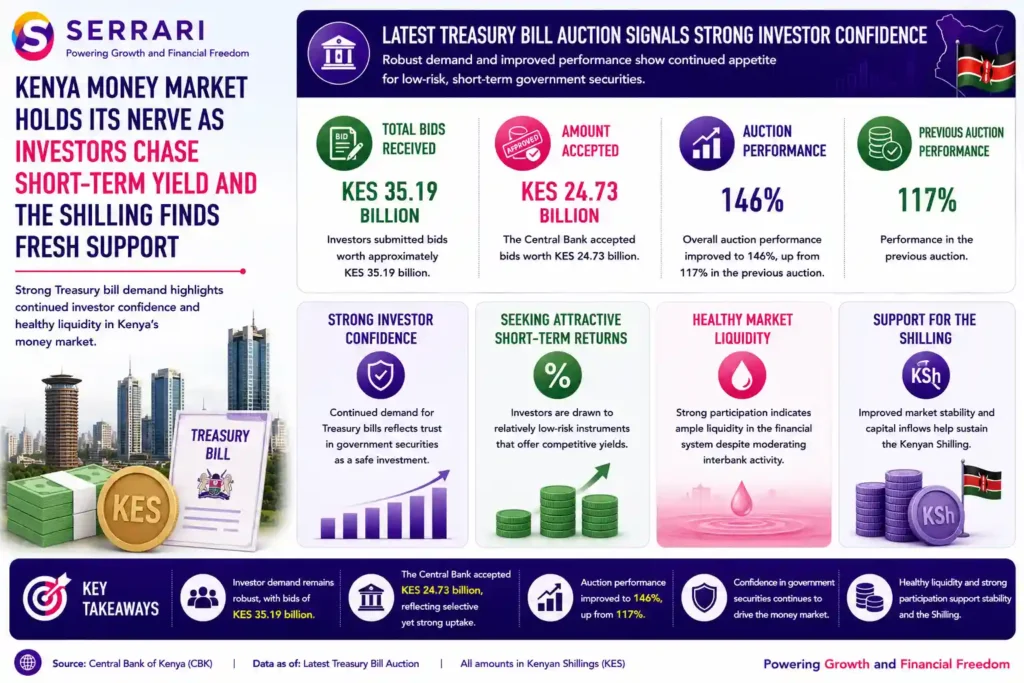
The strongest signal from the Kenya money market came from the latest Treasury bill auction, where investor demand remained robust.
Investors submitted bids worth approximately KES 35.19 billion, with the Central Bank accepting KES 24.73 billion. Overall auction performance improved to 146%, up from 117% in the previous auction.
The results demonstrate continued confidence in government securities as investors seek relatively low-risk opportunities offering attractive returns.
Strong participation also reflects healthy liquidity within the financial system despite moderating interbank activity.
91-Day Treasury Bill Leads Short-Term Investments
The 91-day Treasury bill emerged as the clear favourite among investors.
Against an offer size of KES 4 billion, investors submitted approximately KES 26 billion in bids, producing an impressive 640% performance rate.
The overwhelming demand illustrates why many investors currently favour the shortest maturity available.
With inflation remaining elevated and global uncertainty continuing, shorter-duration securities provide an attractive balance between competitive yields, capital preservation, and liquidity. Investors also benefit from greater flexibility to reinvest should interest rates continue changing in the coming months.
The continued preference for short maturities highlights the importance of cash management and prudent duration positioning in the current market environment.
CBK Announces New Domestic Borrowing Programme
The Central Bank of Kenya (CBK) also announced a KES 70 billion domestic bond programme for July 2026.
The programme includes reopened Treasury bonds across multiple maturities alongside a KES 10 billion switch auction designed to extend portions of the government’s debt maturity profile.
Rather than representing new borrowing alone, the switch transaction demonstrates active debt liability management by encouraging investors to exchange shorter-dated securities for longer-term bonds.
This strategy helps smooth future debt repayments while reducing refinancing pressure over the medium term.
LIVEKenya MMF rates: Average 9.15% across 27 funds · top fund 11.01% · 21 OctCompare funds →The programme aligns with broader CBK monetary policy objectives of maintaining orderly government financing and supporting stable domestic debt markets.
Kenyan Shilling Remains Resilient
The Kenyan shilling provided additional support for financial markets during the week.
The currency appreciated against several major international currencies, gaining approximately 0.7% against the euro, 0.3% against the Japanese yen, and 0.1% against the British pound, while recording only a marginal decline against the U.S. dollar.
Regionally, the shilling strengthened against both the Ugandan and Tanzanian currencies.
Stable exchange rates continue supporting investor confidence by reducing imported inflation risks and improving predictability across financial markets.
Lower Commodity Prices Ease Inflation Risks
Commodity markets also provided positive support for Kenya’s economic outlook.
Crude oil prices declined during the week, reducing pressure on fuel import costs and potentially easing inflationary pressures over coming months. Gold prices also retreated as global safe-haven demand softened following signs of easing geopolitical tensions.
Lower energy prices are particularly beneficial for Kenya because they help reduce transportation costs, moderate inflation, and improve the country’s external balance by lowering import expenditure.
These developments reinforce the supportive backdrop currently benefiting the domestic money market.
Business Confidence Continues Improving
Economic sentiment also strengthened during the review period.
Business optimism reached its highest level since early 2023, with roughly one-third of surveyed firms expecting higher production over the coming year, while only a very small proportion anticipated weaker activity.
Improving business confidence complements stable financial market conditions by supporting investment, credit demand, and broader economic growth.
The combination of resilient liquidity, strong Treasury bill demand, and improving business expectations paints a constructive picture for Kenya’s short-term financial outlook.
Conclusion
The Kenya money market continues demonstrating resilience through stable liquidity conditions, strong investor demand, and attractive short-term yields. Despite lower interbank trading volumes, financial markets remain orderly, with the 91-day Treasury bill attracting exceptionally strong interest from investors seeking liquidity and capital preservation.
Supported by a stable Kenyan shilling, improving business confidence, and prudent CBK monetary policy, Kenya’s money market remains well positioned to navigate both domestic financing needs and evolving global economic conditions.
FAQs
1. Why did investors favour the 91-day Treasury bill?
Investors strongly preferred the 91-day Treasury bill because it offers an attractive balance between yield, liquidity, and lower interest rate risk. Shorter maturities allow investors to preserve capital while maintaining flexibility to reinvest if market interest rates change, making them particularly attractive during periods of economic uncertainty.
2. What does lower interbank trading activity indicate?
Lower interbank trading activity does not necessarily signal weakness. In this case, stable overnight money market rates suggest banks had sufficient liquidity and did not need to borrow aggressively from one another. The decline in transaction volumes therefore reflects comfortable funding conditions rather than stress within the banking system.
3. How does the Kenyan shilling affect the money market?
A stable Kenyan shilling supports investor confidence by reducing exchange rate volatility and helping contain imported inflation. Currency stability also improves predictability for financial institutions and investors, making domestic fixed-income investments such as Treasury bills more attractive while supporting broader economic stability.
4. What role does the CBK play in Kenya’s money market?
The Central Bank of Kenya manages liquidity, conducts Treasury bill auctions on behalf of the government, oversees interbank market operations, and implements monetary policy to maintain financial stability. Through these activities, the CBK helps ensure orderly money market conditions, supports government financing needs, and promotes confidence in Kenya’s financial system.
Your financial future isn’t something you wait for—it’s something you build.
The real question is: when do you begin?
Move beyond simply staying informed.
Navigate the markets with clarity—track trends through the Serrari Group Market Index, uncover opportunities in the Serrari Marketplace, and build practical knowledge with our Curated Wealth Builder Platform.
Stay connected to what truly matters.
Get daily insights on macro trends and financial movements across Kenya, Africa, and global markets—delivered through the Serrari Newsletter.
Growth opens doors.
Advance your career through professional programs including ACCA, HESI A2, ATI TEAS 7 , HESI EXIT , NCLEX – RN and NCLEX – PN, Financial Literacy!🌟—designed to move you forward with confidence.
See where money is flowing—clearly and in real time.
Track Money Market Funds, Treasury Bills, Treasury Bonds, Green Bonds, and Fixed Deposits, alongside global and African indexes, key economic indicators, and the evolving Crypto and stablecoin landscape—all within Serrari’s Market Index.