
















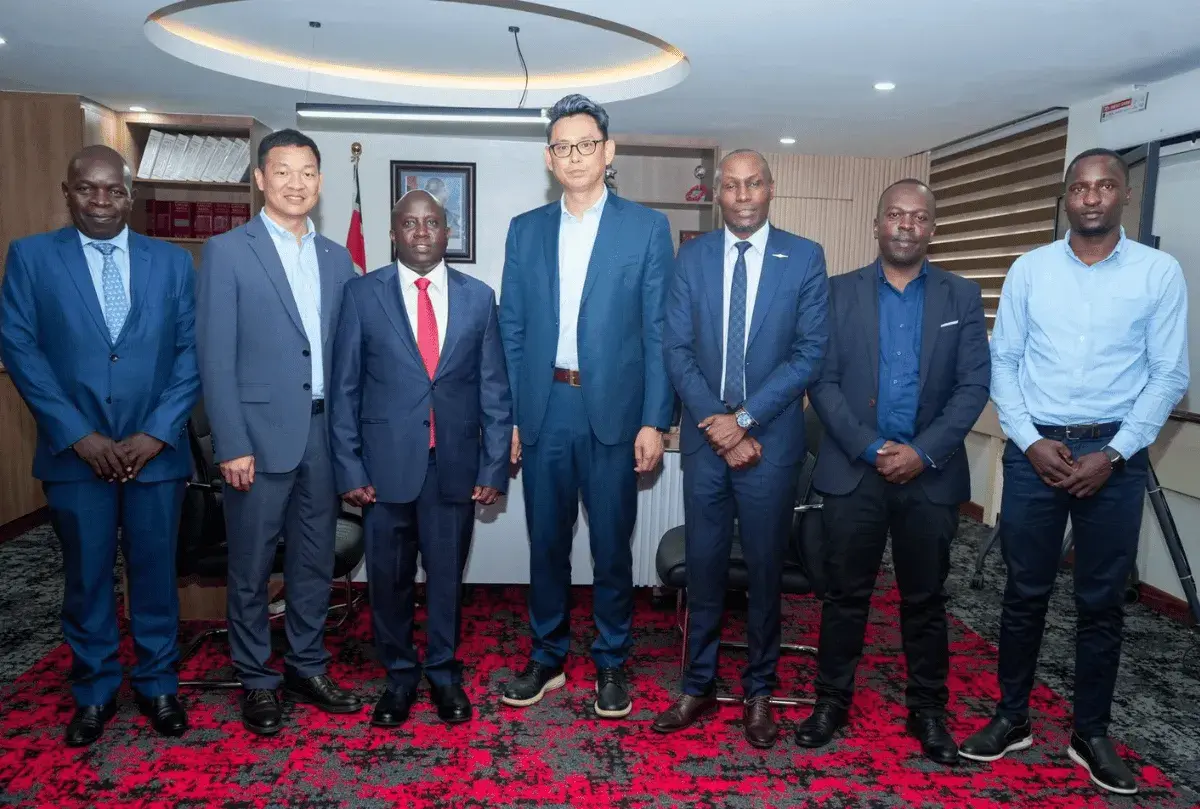
Kenya has moved to deepen its digital infrastructure partnerships with Asia, holding high-level discussions with Chinese telecommunications tower giant Guodong Networks Group about potential investment in fibre optic networks and telecom tower development across the country. The engagement, which brought together Guodong’s Chief Executive Officer, the Head of its Middle East and Africa operations, and Kenyan officials, focused on opportunities to expand nationwide coverage under the government’s flagship Digital Superhighway Programme. Guodong expressed strong interest in supporting the initiative, signalling a potential collaboration that could reshape the pace and cost of broadband expansion in one of Africa’s most advanced digital economies. Both parties committed to continuing engagements aimed at developing partnership models that can unlock investment and underpin long-term expansion of Kenya’s digital ecosystem.
Key Overview
- Kenya and Guodong Networks Group have held talks on potential investment in fibre optic networks and telecom tower infrastructure to expand nationwide connectivity.
- The engagement aligns with Kenya’s Digital Superhighway Programme, which targets the rollout of 100,000 kilometres of fibre optic cable, 25,000 public Wi-Fi hotspots, and digital hubs in all 1,450 wards.
- Guodong is one of China’s largest independent tower operators, with a business model centred on building, leasing, and operating telecommunications infrastructure for mobile operators.
- Kenya’s ICT sector is projected to contribute 9.24% of GDP in 2025, and the government is under pressure to close last-mile connectivity gaps, particularly in northern and underserved counties.
- The parties agreed to continue negotiations on partnership models that can unlock private capital and sustain long-term digital expansion.
Markets move fast; don’t get left behind. We’ve paired the Serrari Group Market Index with a curated Marketplace and a comprehensive Wealth Builder Platform to ensure you have the data—and the skills—to act on it.
Kenya’s outreach to Guodong Networks Group represents one of the more consequential conversations the country has had about its digital infrastructure future in recent months. According to public reporting on the meeting, the engagement centred on potential investment opportunities in telecommunications infrastructure, with particular emphasis on the deployment of fibre optic networks and the development of telecom tower infrastructure to enhance nationwide coverage and connectivity.
The choice of counterpart is notable. Guodong is described by Morgan Stanley’s capital markets research as one of the largest independent telecommunications tower infrastructure service providers in China by number of telecom sites, running a business model in which the company leases land, builds the tower, and then rents the tower space to mobile operators. That same “build-and-lease” approach — sometimes referred to inside the industry as the “Guodong Model” — is precisely the commercial architecture Kenya needs to scale if it is to move beyond patchy rural coverage. Bloomberg has previously reported that the Shanghai-headquartered group was planning a Hong Kong IPO to raise about $300 million, a signal of the scale of capital it is able to mobilise.
Kenya’s officials framed the discussions as complementary to the country’s broader digital transformation agenda. The meeting brought together senior representatives from Guodong, including its Chief Executive Officer and the Head of its Middle East and Africa operations, alongside Kenyan counterparts, with both sides agreeing to continue discussions around partnership models that can unlock investment and support long-term expansion of Kenya’s digital ecosystem. What has not yet been disclosed is the scale of any proposed financial commitment, the structure of the partnership (whether joint venture, build-operate-transfer, or direct equity), or the specific geographies Guodong would prioritise.
Context is everything. While you follow today’s updates, use the Serrari Group Market Index and Marketplace to spot emerging shifts. Need to sharpen your edge? Our Wealth Builder Platform turns these insights into a professional-grade strategy.
Why the Digital Superhighway Needs Outside Capital
The discussions land at a critical juncture for Kenya’s signature connectivity initiative. The Digital Superhighway Project, approved by Cabinet under the Kenya Kwanza administration, prioritises two main workstreams: expanding the country’s fibre network and digitising government services. On the infrastructure side, the plan calls for the laying of 100,000 kilometres (62,000 miles) of fibre optic cable, complemented by 25,000 public Wi-Fi hotspots and Digital Village Smart Hubs in each of Kenya’s 1,450 wards — the country’s lowest administrative units.
Progress has been steady but uneven. Speaking at the launch of the Countrywide Digital Innovation Network earlier in 2025, Cabinet Secretary for Information, Communications and the Digital Economy William Kabogo updated stakeholders that Kenya had passed the 56% mark on its fibre rollout, with the goal of getting “the entire country on fibre.” Separately, the 2025/2026 budget confirmed that the state had laid an additional 4,690 kilometres of high-speed fibre optic cable over the previous year, extending broadband access in previously underserved counties, while the National Treasury allocated Sh12.7 billion to the sector.
But the pressure on the programme is real. The 2025/2026 ICT allocation represented a 22% reduction from the previous year’s Sh16.3 billion, and industry watchers have begun to question whether domestic public finance alone can bridge Kenya’s remaining connectivity gaps. Coverage statistics still show that the country has only about 62% fibre optic coverage, with an official aim to reach 90% by the end of the next financial year. The analysis from industry commentators has been blunt: the gap between ambition and execution has frustrated many in Kenya’s tech industry, particularly around the sustained capital and operational commitment required to extend networks into Northern Kenya and other geographies where return on investment is slowest.
Against that backdrop, a capital-heavy, long-dated infrastructure partner like Guodong fits a clear strategic need. Tower companies generate predictable, multi-tenant revenue streams over long horizons, and they are used to building in difficult terrain where the unit economics for a single mobile operator might not work. Importing that playbook to Kenya — particularly into the last-mile, rural corridors the government is struggling to fund — is the kind of private capital layer the Digital Superhighway Programme has explicitly been designed to attract.
Guodong’s Scale Meets Kenya’s Demand
The strategic logic of Guodong’s potential entry into Kenya looks even stronger when set against the structure of the company itself. Industry research describes Guodong as one of a handful of Chinese independent tower companies with portfolios of more than 1,000 towers, placing it alongside Miteno and Sinonetstone at the top of the country’s independent tower market. The company secured a CNY 700 million (approximately US$100 million) investment in an earlier financing round at what industry observers at the time described as a “high-teens” valuation multiple.
Beyond traditional passive tower infrastructure, Guodong has also been diversifying into higher-margin adjacent businesses — including new-energy services such as battery-exchange platforms and charging stations, edge computing and data centre services, and smart-tower IoT applications. If elements of that integrated model travel with the company into East Africa, Kenya could end up with more than fibre and steel towers: it could gain data-adjacent infrastructure that complements the AI and hyperscale investments already being lined up in the region.
Those adjacent investments are no longer hypothetical. Kenya’s broader telecom market is now estimated at USD 3.6 billion in 2026, with projections reaching USD 4.35 billion by 2031. Over the past two years, Microsoft, BlackRock, and Temasek have announced Project MGX, a USD 30 billion plan to build an AI hyperscale campus in Nairobi, described as the largest single ICT investment on the continent, while Safaricom has earmarked USD 500 million for AI infrastructure spanning three East African countries. For Guodong, plugging into a market already absorbing that kind of capital is an attractive proposition — the tenant demand for towers, fibre handover points, and edge compute sites is only going up.
The Bigger Digital Economy Picture
Understanding why Kenya is working the phones with tower operators from Shanghai requires zooming out to the country’s digital economy ambitions. Kenya’s ICT sector has grown by an average of 10.8% annually in the last decade, with the digital economy expected to contribute up to 9.24% of GDP by 2025. Internet penetration sits at over 85%, and roughly 98% of Kenyans use mobile money, thanks in large part to M-PESA and adjacent fintechs. That adoption base gives Kenya a highly motivated demand side — but it also means every gap in physical infrastructure is a constraint on an economy that has increasingly been built on top of the network.
The government has positioned the Digital Superhighway inside its wider Bottom-Up Economic Transformation Agenda (BETA) and Vision 2030 strategy. Planned FY 2026/27–2028/29 initiatives include additional fibre deployments, expanded public internet access points, full digitisation of government services, and the operationalisation of national cybersecurity institutions, along with continued investment in energy-efficient broadcasting and connectivity facilities. Those are serious commitments, but each of them requires capital that either has to come from the exchequer, from development partners, or from private infrastructure investors willing to hold long-dated assets on their balance sheets.
That is the gap Guodong can fill. Kenya’s own investment promotion material already notes that the country’s digital backbone includes six submarine fibre-optic cables offering broadband connectivity and a 9,000km terrestrial fibre-optic network, with geographical and population mobile broadband coverage of 56% and 96% respectively. The strategic question for policymakers now is not whether the country is connected, but whether its connectivity is deep enough, resilient enough, and cheap enough to underpin the next wave of AI, cloud, and financial-services workloads competing for East African infrastructure.
What to Watch Next
The Kenya–Guodong conversation is still in the exploratory phase — both parties agreed to continue engagements aimed at developing partnership models — and no deal value, timeline, or project list has yet been disclosed. For stakeholders, several questions will shape whether the talks translate into meaningful rollout.
First, the commercial structure. Will Guodong enter as a pure tower operator, a build-transfer contractor, or a joint-venture partner with one of Kenya’s existing infrastructure players? Kenya Pipeline Company (KPC) has already partnered with local ISPs to unlock high-capacity fibre between Nairobi and Mombasa, while the Communications Authority is working with Kenya Power to align fibre optic cables along power utility lines. Any Guodong deal will need to slot into — rather than compete with — this emerging network of public-sector anchors.
Second, the geographic focus. Northern Kenya remains the hardest, most expensive corridor in the national fibre plan. Whether Guodong is prepared to deploy capital into those regions, or whether it prioritises the already-connected Nairobi–Mombasa and Nairobi–Kisumu corridors, will determine how much of its participation actually moves Kenya toward its inclusion goals.
Third, regulatory fit. Kenya’s telecoms regulator has been tightening oversight of both foreign entrants and emerging technologies, even as it seeks investment. The discussions will also be read against a wider geopolitical conversation about Chinese telecommunications infrastructure in Africa, where questions of financing terms, local value creation, and data governance have all become mainstream debates.
For now, the most important takeaway is directional rather than numerical. Kenya has publicly signalled that it is open for large-scale private tower and fibre investment, and it has chosen to test that signal with one of China’s largest independent tower operators. If the engagement progresses into a concrete investment, it could change both the pace of the Digital Superhighway rollout and the composition of the investors Kenya courts next. If it does not, it will still have sent a message to the wider market: that the ambition is still in place, and the country is actively scouting for capital partners who can help build the infrastructure the ambition demands.
Your financial future isn’t something you wait for—it’s something you build.
The real question is: when do you begin?
Move beyond simply staying informed.
Navigate the markets with clarity—track trends through the Serrari Group Market Index, uncover opportunities in the Serrari Marketplace, and build practical knowledge with our Curated Wealth Builder Platform.
Stay connected to what truly matters.
Get daily insights on macro trends and financial movements across Kenya, Africa, and global markets—delivered through the Serrari Newsletter.
Growth opens doors.
Advance your career through professional programs including ACCA, HESI A2, ATI TEAS 7 , HESI EXIT , NCLEX – RN and NCLEX – PN, Financial Literacy!🌟—designed to move you forward with confidence.
See where money is flowing—clearly and in real time.
Track Money Market Funds, Treasury Bills, Treasury Bonds, Green Bonds, and Fixed Deposits, alongside global and African indexes, key economic indicators, and the evolving Crypto and stablecoin landscape—all within Serrari’s Market Index.