Pakistan has signed its first bilateral carbon market agreement with Norway under Article 6 of the Paris Agreement, enabling the country to generate and trade carbon credits. The deal marks a shift from climate policy planning to implementation, opening new pathways for international climate finance, investment, and low-carbon development across key sectors such as renewable energy, transport, and agriculture.
Key Overview
-Pakistan signs first carbon market deal under Paris Agreement
–Agreement allows generation and sale of carbon credits to Norway
–Targets sectors including renewable energy, transport, and agriculture
–Deal expected to boost climate finance, jobs, and green investment
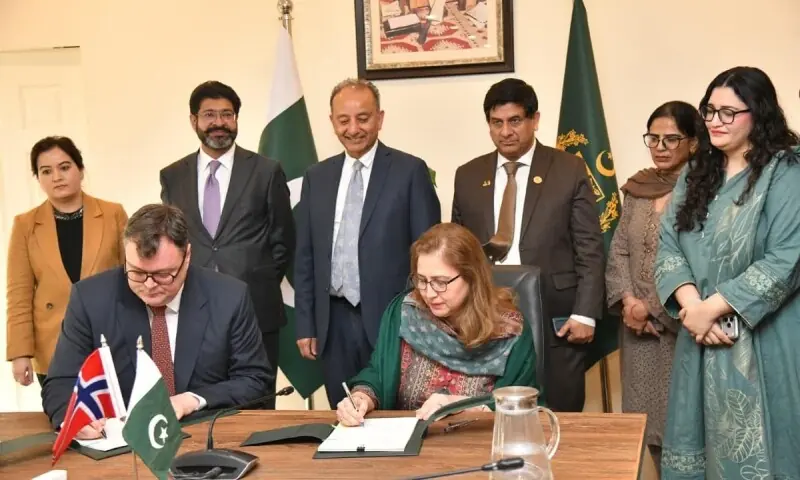
Pakistan has taken a significant step into the global climate finance ecosystem by signing its first bilateral carbon market agreement with Norway under Article 6 of the Paris Agreement. The agreement, formalized through a memorandum of understanding at the Ministry of Climate Change in Islamabad, marks a transition from policy preparation to active participation in international carbon markets.
This development represents more than a diplomatic milestone—it signals Pakistan’s entry into a rapidly evolving financial system where emissions reductions are monetized and traded across borders. By engaging in this mechanism, Pakistan is positioning itself to access new streams of climate finance while contributing to global emission reduction efforts.
The agreement also highlights the increasing importance of carbon markets as a tool for aligning environmental objectives with economic incentives. For countries like Pakistan, which face both development and climate challenges, such frameworks offer a pathway to balance growth with sustainability.
Markets move fast; don’t get left behind. We’ve paired the Serrari Group Market Index with a curated Marketplace and a comprehensive Wealth Builder Course to ensure you have the data—and the skills—to act on it.
Understanding Article 6 and Carbon Credit Mechanisms
At the core of the agreement is Article 6 of the Paris Agreement, which allows countries to collaborate on emissions reductions through market-based mechanisms. Under this framework, Pakistan can generate carbon credits by reducing emissions and transfer these reductions to Norway in the form of internationally transferred mitigation outcomes (ITMOs).
These credits represent verified reductions in greenhouse gas emissions and can be used by purchasing countries to meet or exceed their climate commitments. In this case, Norway intends to use the credits not only to meet its targets but to go beyond them, aiming for climate neutrality by 2030.
This mechanism creates a mutually beneficial arrangement. Pakistan gains access to financial resources and investment, while Norway secures high-quality emissions reductions to support its climate goals.
Expanding Climate Investment Across Key Sectors
The agreement opens the door for Pakistan to develop carbon credit projects across multiple sectors, including renewable energy, agriculture, transport, and waste management. These sectors represent some of the country’s strongest opportunities for emissions reduction and sustainable development.
By targeting these areas, the agreement is expected to attract both public and private investment, supporting the expansion of low-carbon infrastructure and technologies. Renewable energy projects, in particular, are likely to play a central role, given their potential to deliver measurable and scalable emissions reductions.
The inclusion of diverse sectors also ensures that the benefits of climate finance are distributed across different parts of the economy, enhancing the overall impact of the initiative.
A Shift from Preparedness to Implementation
Pakistan’s Climate Change Minister Musadik Malik described the agreement as a “historic milestone,” emphasizing that it marks a decisive transition from carbon market preparedness to practical, on-the-ground implementation. This shift is particularly significant because it signals that the country is moving beyond planning and policy design into actual execution, where climate finance mechanisms begin to generate tangible outcomes.
This transition reflects several years of foundational work, including the development and approval of national policy guidelines for carbon trading in January 2025. These guidelines laid the groundwork for building a structured and credible carbon market, outlining the principles, standards, and institutional arrangements required to support emissions trading. Pakistan is now advancing this framework by establishing the regulatory systems, reporting mechanisms, and bilateral agreements necessary to operationalize the market effectively.
The move toward implementation also indicates a higher level of institutional readiness and policy maturity. It demonstrates that Pakistan is not only aligning with global climate frameworks but is also actively positioning itself to participate in them. By taking this step, the country is signaling to international partners and investors that it is prepared to engage in structured climate finance transactions, strengthening its role in global carbon markets.
Climate Finance as a Development Tool
A key theme emerging from the agreement is the recognition of carbon markets as a tool for broader economic and social development, rather than simply a mechanism for emissions reduction. This reflects a more holistic approach to climate finance, where environmental goals are integrated with economic priorities.
Minister Malik emphasized that carbon markets should not be treated as an end in themselves but as a means to finance transition pathways, create employment opportunities, attract advanced technologies, and deliver meaningful benefits to local communities. This perspective highlights the potential of climate finance to drive inclusive growth while addressing environmental challenges.
Such an approach reflects a growing understanding that climate finance must serve multiple objectives simultaneously. In addition to reducing greenhouse gas emissions, it should contribute to economic expansion, improve livelihoods, and strengthen resilience to climate-related risks. This is particularly important for developing countries, where the impacts of climate change are closely linked to economic vulnerability.
By linking carbon markets to development outcomes, Pakistan is aiming to maximize the overall value of its climate initiatives. This strategy ensures that the benefits of climate finance extend beyond environmental metrics, contributing to long-term socio-economic progress.
Context is everything. While you follow today’s updates, use the Serrari Group Market Index and Marketplace to spot emerging shifts. Need to sharpen your edge? Our Wealth Builder Course turns these insights into a professional-grade strategy.
Norway’s Role in Scaling Climate Finance
Norway’s participation in the agreement highlights its broader and more strategic approach to supporting global climate action through financial mechanisms. As a country committed to achieving climate neutrality by 2030, Norway is actively seeking high-quality carbon credits as part of its climate strategy.
Importantly, Norway has clarified that its purchases of carbon credits are not intended solely to meet its formal climate targets, but to go beyond them. This reflects a higher level of ambition and a willingness to invest in additional emissions reductions, reinforcing its leadership role in international climate efforts.
Through its Global Emission Reduction Initiative, launched in 2024 with a budget of $1.5 billion, Norway is channeling carbon finance into partner countries such as Pakistan. This initiative is designed to support emissions reduction projects while also contributing to sustainable development outcomes.
The partnership underscores the critical role that developed countries can play in supporting climate mitigation efforts in developing economies. By providing financial resources and market access, countries like Norway help bridge the global climate finance gap, enabling more inclusive and effective participation in climate action.
Moving Toward Large-Scale Climate Programs
Another important aspect of the agreement is its emphasis on large-scale, sector-wide programs rather than isolated or small-scale projects. This represents a shift toward more comprehensive and integrated approaches to emissions reduction, where entire sectors can be transformed through coordinated efforts.
Norway has expressed a clear interest in collaborating across sectors such as renewable energy, industry, and agriculture—areas where policy interventions and technological adoption can generate emissions reductions at scale. This approach recognizes that meaningful climate impact often requires systemic change rather than incremental improvements.
By focusing on broader programs, the partnership aims to create more sustainable and long-lasting outcomes. Large-scale initiatives can deliver greater efficiencies, attract larger volumes of investment, and produce more measurable results compared to fragmented projects.
This strategic focus on scale also enhances the economic viability of climate initiatives, ensuring that both environmental and financial returns are maximized over time.
Strengthening Pakistan’s Position in Carbon Markets
The agreement is expected to significantly strengthen Pakistan’s position in international carbon markets, opening new avenues for its emerging green economy. By establishing a credible and structured framework for carbon credit generation and trade, the country is creating a foundation for sustained participation in global climate finance systems.
This framework is likely to attract a diverse range of stakeholders, including project developers, institutional investors, and technology providers. As confidence in the system grows, it could lead to increased investment flows and greater innovation across climate-related sectors.
Participation in global carbon markets also enhances Pakistan’s ability to engage with international partners and influence the evolution of climate finance mechanisms. This positions the country not just as a participant, but as a contributor to the development of global carbon market systems.
Addressing Climate Risks Through Investment
Pakistan is widely recognized as one of the countries most vulnerable to climate change, consistently ranking among the highest-risk nations in the Global Climate Risk Index. In recent years, the country has experienced a noticeable increase in the frequency and intensity of extreme weather events, including floods, droughts, cyclones, torrential rainstorms, and prolonged heat waves. These events are no longer isolated occurrences but are becoming recurring challenges that place growing pressure on infrastructure, economic stability, and the livelihoods of millions of people.
The scale of impact has been both immediate and severe. During the most recent monsoon season, torrential rains and flash floods claimed the lives of over 1,000 people, highlighting the human cost of climate-related disasters. The situation was even more devastating in 2022, when unusually heavy monsoon rains—widely linked by experts to climate change—resulted in more than 1,700 fatalities and caused economic losses estimated at over $30 billion. These figures underscore the magnitude of risk facing the country and the urgent need for long-term solutions.
In this context, the Pakistan–Norway carbon agreement takes on added significance. By mobilizing climate finance through carbon markets, Pakistan has an opportunity to channel investment into both mitigation and adaptation efforts. Projects in renewable energy, sustainable agriculture, and resilient infrastructure can help reduce emissions while also strengthening the country’s ability to withstand future climate shocks. This integrated approach ensures that climate finance not only addresses environmental goals but also supports economic stability and community resilience over the long term.
Outlook: A New Pathway for Climate Finance
The Pakistan–Norway carbon agreement represents a significant step forward in the evolution of climate finance, marking a transition from policy frameworks to actionable, market-based solutions. It demonstrates how international cooperation can unlock new opportunities for both environmental and economic progress.
By linking emissions reductions with financial incentives, the agreement creates a model for collaboration that aligns the interests of both developed and developing countries. It shows how carbon markets can serve as a bridge between climate goals and economic development.
Looking ahead, the success of this initiative will depend on effective implementation, strong governance structures, and the ability to attract investment at scale. Building trust in the system and ensuring transparency will be critical to maintaining momentum.
If successful, the agreement could serve as a blueprint for other developing countries seeking to access global carbon markets and finance their transition to low-carbon economies.
Ultimately, it underscores a broader shift in climate finance—from high-level commitments to practical, results-driven solutions that deliver measurable impact while supporting sustainable development.
Your financial future isn’t something you wait for—it’s something you build.
The real question is: when do you begin?
Move beyond simply staying informed.
Navigate the markets with clarity—track trends through the Serrari Group Market Index, uncover opportunities in the Serrari Marketplace, and build practical knowledge with our Curated Wealth Builder Course.
Stay connected to what truly matters.
Get daily insights on macro trends and financial movements across Kenya, Africa, and global markets—delivered through the Serrari Newsletter.
Growth opens doors.
Advance your career through professional programs including ACCA, HESI A2, ATI TEAS 7 , HESI EXIT , NCLEX – RN and NCLEX – PN, Financial Literacy!🌟—designed to move you forward with confidence.
See where money is flowing—clearly and in real time.
Track Money Market Funds, Treasury Bills, Treasury Bonds, Green Bonds, and Fixed Deposits, alongside global and African indexes, key economic indicators, and the evolving Crypto and stablecoin landscape—all within Serrari’s Market Index.