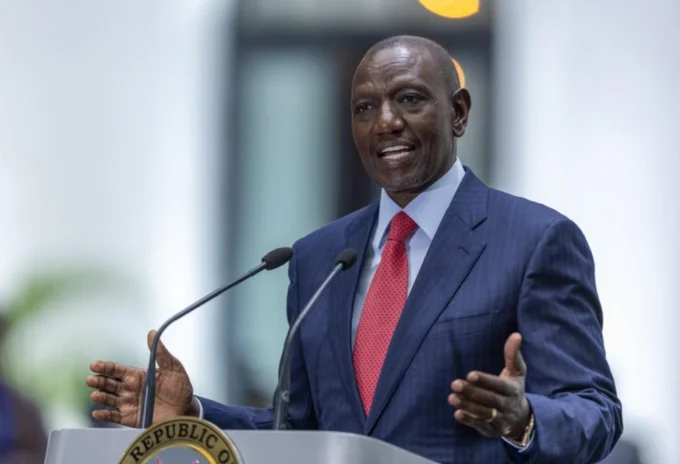
Kenya is pursuing an ambitious strategy to transform its tea from a bulk commodity traded at barely Sh100 per kilogram into a premium lifestyle product retailing at between Sh3,000 and Sh4,000 per kilogram in European markets. The initiative, announced by Equity Group CEO James Mwangi during the 19th Ambassadors and High Commissioners Conference in Nairobi, centres on a partnership with one of France’s largest tea importers to develop specialty products targeting high-end consumers. Plans include the opening of hundreds of retail outlets across Europe to stock Kenyan specialty tea as part of commitments expected to be formalised at the France-Africa Forward Summit in Nairobi in May 2026. The strategy hinges on securing Geographical Indication (GI) status for Kenyan teas — a form of intellectual property protection that links a product’s quality and reputation to its origin — similar to the protections afforded to Champagne in France and Darjeeling tea in India. The push comes at a critical moment: Kenya exported 652,792 tonnes of tea in 2025 but earned only Sh186.9 billion, constrained by an average auction price of just $2.15 per kilogram and a sector in which 99% of output is bulk CTC black tea with minimal value addition.
Key Overview
- Current average tea price: ~Sh100/kg (auction); ~$2.15/kg
- Target specialty retail price: Sh3,000 to Sh4,000/kg
- Potential price multiplier: Up to 30x current auction prices
- 2025 tea exports: 652,792 tonnes (up 4.35% from 2024)
- 2025 export earnings: Sh186.9 billion (~$1.44 billion)
- Specialty tea share of production: ~1% (15,000 tonnes in 2025)
- Government target for specialty capacity: 200,000 tonnes by 2030
- Key partner: Palais des Thés (France) — 100+ international shops
- European retail expansion: Hundreds of outlets planned
- Critical requirement: Geographical Indication (GI) legislation
- France-Africa Forward Summit: 11-12 May 2026 in Nairobi
- Largest buyer: Pakistan (~36-40% of total exports)
- March 2026 auction absorption rate: 81% (up from 75% in March 2025)
Markets move fast; don’t get left behind. We’ve paired the Serrari Group Market Index with a curated Marketplace and a comprehensive Wealth Builder Course to ensure you have the data—and the skills—to act on it.
A 30x Price Leap: From Commodity to Lifestyle
The numbers at the heart of this story are striking. Kenyan tea currently trades at just over Sh100 per kilogram at the Mombasa Tea Auction — the world’s largest black tea auction. Under the proposed strategy, specialty Kenyan teas developed through the French partnership could retail at between Sh3,000 and Sh4,000 per kilogram in European markets, representing a potential price increase of up to 30 times the current average.
Equity Group Managing Director and CEO James Mwangi laid out the vision during the 19th Ambassadors and High Commissioners Conference in Nairobi, revealing that Kenya has already partnered with a major European tea importer to develop specialty products. The importer, identified through earlier reporting as Palais des Thés — one of France’s most prominent premium tea houses — brings a network of more than 100 international retail outlets that could serve as distribution channels for Kenyan specialty products.
“We looked at French culture and asked, what if we convert tea from a commodity into a lifestyle product? We worked with one of the largest importers and developed specialty teas,” Mwangi said.
The initiative has reportedly already pushed negotiated prices significantly above current averages, with discussions underway to expand market access through the opening of hundreds of additional outlets across Europe to stock Kenyan specialty tea.
The France-Africa Forward Summit: Where Deals Become Commitments
The tea strategy is set to be formalised as part of the France-Africa Forward Summit, scheduled for 11-12 May 2026 in Nairobi and co-hosted by President William Ruto and French President Emmanuel Macron. The summit, which will focus on thematic areas including agro-processing, energy transition, digital technology, and health, is expected to culminate in a Nairobi Declaration that will subsequently be presented for adoption by the G7 under France’s presidency beginning in June 2026.
Mwangi, who is chairing private sector participation in the summit, indicated that one of the commitments expected to be signed is the opening of European retail outlets for Kenyan specialty tea.
The tea initiative builds on a broader economic partnership framework between Kenya and France. In November 2024, Equity Bank and France’s BPI France (the French public investment bank) signed a memorandum of understanding to facilitate trade finance, open lines of credit, and create a bridge between African and French businesses. Mwangi described the collaboration as aimed at bringing European companies to invest in Africa to address the challenge of exporting raw materials. The partnership spans agriculture, education, energy, technology, and construction.
Context is everything. While you follow today’s updates, use the Serrari Group Market Index and Marketplace to spot emerging shifts. Need to sharpen your edge? Our Wealth Builder Course turns these insights into a professional-grade strategy.
The Geographical Indication Imperative
The success of the premium tea strategy hinges on a specific legal and intellectual property requirement: securing Geographical Indication (GI) status for Kenyan teas.
GI certification is a form of intellectual property protection that links a product’s quality, reputation, and characteristics to its geographical origin. Globally recognised examples include Champagne from France, Darjeeling tea from India, Scotch whisky from Scotland, and Parmigiano-Reggiano cheese from Italy. Products with GI status can command significant premiums because they guarantee authenticity and origin to consumers.
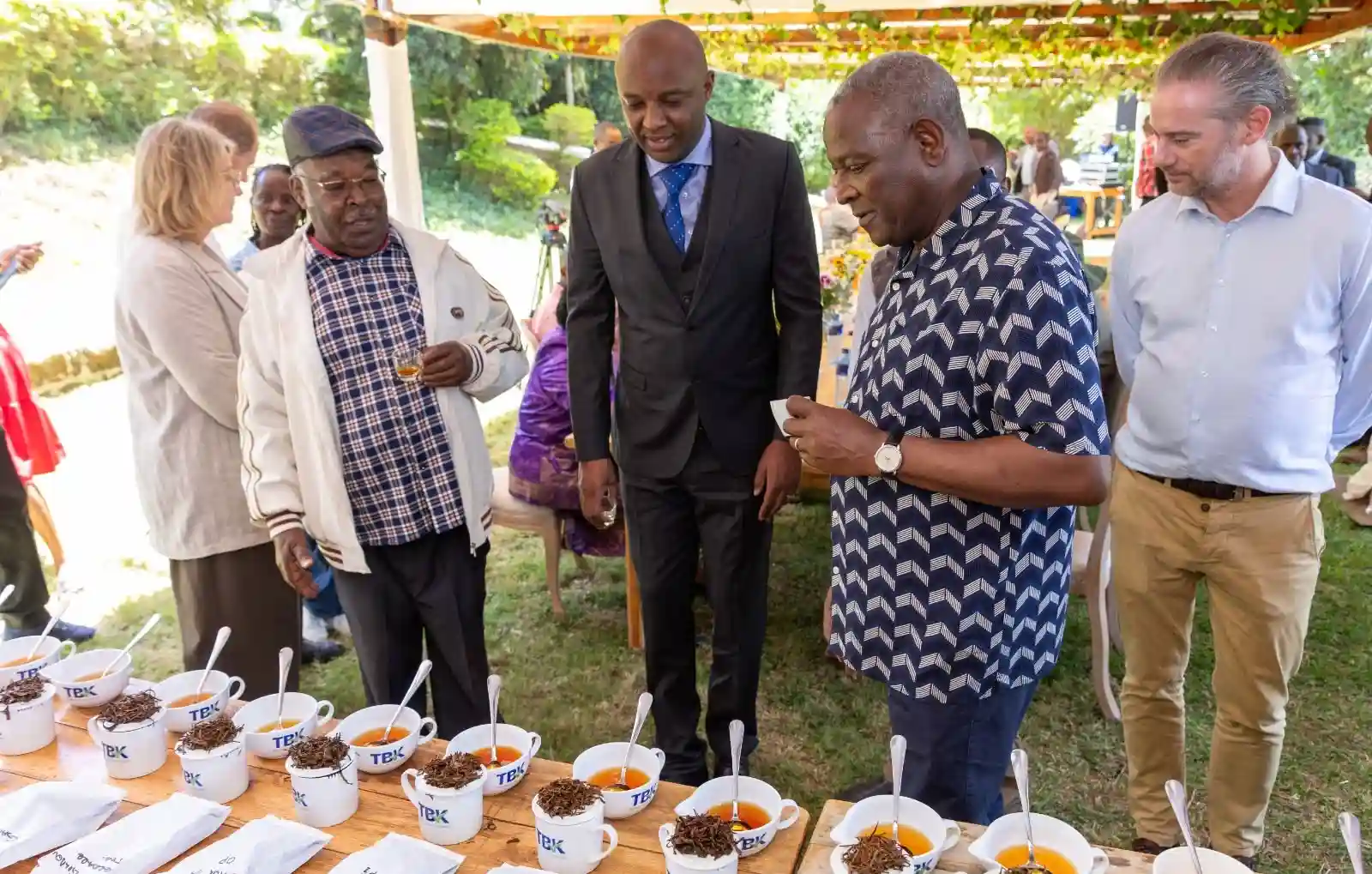
The push for Kenyan tea GI status has been gathering momentum. In January 2026, a high-level specialty tea tasting event at Gatura Greens Tea Farm in Murang’a county brought together local leaders, international partners, and industry stakeholders. French Ambassador to Kenya Arnaud Suquet attended the event and described Kenyan tea’s potential to follow a similar GI path, emphasising that the process must be driven from the bottom up and owned by farmers and local communities.
Mwangi noted that the GI journey has been guided by months of research, including the development of a baseline study. “For Kenyan tea that’s famed for its volume and quality but often sold generically, GI represents a strategic shift toward origin-based branding and higher value realisation for farmers,” he said.
However, Mwangi also flagged that Kenya needs to pass the necessary legislation to enable GI certification — a legislative process that will be critical to the strategy’s implementation.
Murang’a county is emerging as the leading candidate for Kenya’s first tea GI designation. The county produced tea worth Sh17.8 billion in 2024, accounting for 19.9% of all tea exports and operating 10 tea factories — making it Kenya’s largest tea-producing county.
Kenya’s Tea Sector: High Volume, Low Value
The premium strategy is being driven by a fundamental problem in Kenya’s tea economy: the country produces and exports enormous quantities of tea but captures remarkably little value from it.
Kenya exported 652,792 tonnes of tea in 2025, a 4.35% increase from 2024, solidifying its position as the world’s largest exporter of black tea. Yet export earnings were just Sh186.9 billion, only marginally above the Sh181.6 billion earned the previous year. The average auction price for 2025 stood at $2.15 per kilogram, down from $2.19 in 2024.
The root cause of this value trap is structural. Kenya’s tea exports are overwhelmingly dominated by CTC (Cut-Tear-Curl) black tea, which accounts for approximately 99% of production and export volumes. Specialty teas make up barely 1% of shipments — about 15,000 tonnes in 2025 — meaning Kenya captures almost none of the higher margins available in premium market segments.
The government has responded by setting an ambitious target: raising Kenya’s installed orthodox tea processing capacity to 200,000 tonnes by 2030 — more than 13 times the 2025 level. Orthodox tea was also introduced into the Mombasa auction system in September 2025, a significant structural reform that had previously reserved the platform exclusively for CTC black tea.
The Tea Board of Kenya has been actively pursuing European market expansion, including recent strategic discussions in Poland — which imported over one million kilograms of Kenyan tea in 2024, placing it among the top 10 export destinations — and knowledge-sharing sessions with Sri Lankan producers on orthodox tea production.
The Iran War’s Shadow Over Export Markets
The premium tea push comes at a particularly sensitive moment for Kenya’s traditional export markets. President Ruto acknowledged during the Ambassadors’ Conference that the ongoing Middle East conflict is having a significant impact on global supply chains and economies.
Several of Kenya’s key tea buyers — including the UAE, Saudi Arabia, and Yemen — are in or adjacent to the conflict zone. Iran and Sudan, which were significant markets, have already been lost to diplomatic disputes that predated the current war, with tea dealers blaming the government for failing to resolve these issues.
However, Ruto pointed to resilience in the sector. “The latest data indicates that we exported 81% of tea offered for auction this month, compared to 75% in March 2025,” he said — a notable improvement in the auction absorption rate that suggests demand from remaining markets has strengthened even as some destinations have been disrupted.
Pakistan remains the single largest buyer of Kenyan tea, accounting for approximately 36-40% of total exports. Egypt, the United Kingdom, the UAE, and Russia are among the other major destinations. But the concentration of exports in a relatively small number of markets — and the vulnerability demonstrated by Pakistan’s sharp reduction in orders that contributed to a 13.4% drop in export earnings in the year to June 2025 — underscores the urgency of diversifying into higher-value markets like Europe.
Diplomacy Meets Economics: Ruto’s Trade-Driven Vision
The tea initiative reflects a broader strategic pivot in Kenya’s diplomatic approach. President Ruto has been explicit about aligning diplomacy with economic outcomes, urging Kenyan diplomats to focus on translating the country’s potential into tangible partnerships.
“Our diplomacy must remain rooted in the everyday interests of Kenyans — the farmer seeking better prices and the entrepreneur seeking access to new markets,” Ruto told the Ambassadors’ Conference.
The France-Africa summit partnership exemplifies this approach. Rather than treating diplomatic engagements as ceremonial exercises, the Kenyan government is using them to secure specific commercial outcomes — from tea retail commitments and GI frameworks to trade finance partnerships and investment facilitation.
The Kenya-EU Economic Partnership Agreement, signed in August 2024, provides the wider trade architecture for this strategy. The agreement grants Kenya duty-free and quota-free access to the EU — its biggest export market — while European goods receive progressive tariff reductions. For tea, this means that specialty products developed through the French partnership would enter EU markets without the tariff barriers that constrain many developing-country exports.
What Implementation Looks Like
If the proposed strategy is fully implemented, the implications for Kenyan tea farmers could be transformative. Moving even a fraction of the country’s output from bulk CTC trading at $2.15 per kilogram to specialty products retailing at the equivalent of $23-31 per kilogram would dramatically alter the economics of tea farming.
However, several significant hurdles remain. The GI legislation must be passed and a certification framework established — a process that requires sustained political will and regulatory capacity. Orthodox and specialty tea processing capacity needs to be scaled rapidly from a small base. Quality control systems must be strengthened to meet the exacting standards of premium European markets. And the retail partnerships need to move from negotiation to operation, establishing consistent supply chains and brand recognition among European consumers.
The involvement of Palais des Thés, with its established network of more than 100 international shops, provides a ready-made distribution platform that could accelerate market entry. But the commitment to open hundreds of additional outlets suggests ambitions that go well beyond a single partnership — pointing toward a systematic effort to establish Kenyan specialty tea as a recognised premium category in European consumer markets.
For a sector that has long been characterised by high volumes and low returns, the stakes could not be higher. As Mwangi put it, the choice is between continuing to sell a commodity and building a lifestyle brand — and the difference is measured in thousands of shillings per kilogram.
Your financial future isn’t something you wait for—it’s something you build.
The real question is: when do you begin?
Move beyond simply staying informed.
Navigate the markets with clarity—track trends through the Serrari Group Market Index, uncover opportunities in the Serrari Marketplace, and build practical knowledge with our Curated Wealth Builder Course.
Stay connected to what truly matters.
Get daily insights on macro trends and financial movements across Kenya, Africa, and global markets—delivered through the Serrari Newsletter.
Growth opens doors.
Advance your career through professional programs including ACCA, HESI A2, ATI TEAS 7 , HESI EXIT , NCLEX – RN and NCLEX – PN, Financial Literacy!🌟—designed to move you forward with confidence.
See where money is flowing—clearly and in real time.
Track Money Market Funds, Treasury Bills, Treasury Bonds, Green Bonds, and Fixed Deposits, alongside global and African indexes, key economic indicators, and the evolving Crypto and stablecoin landscape—all within Serrari’s Market Index.