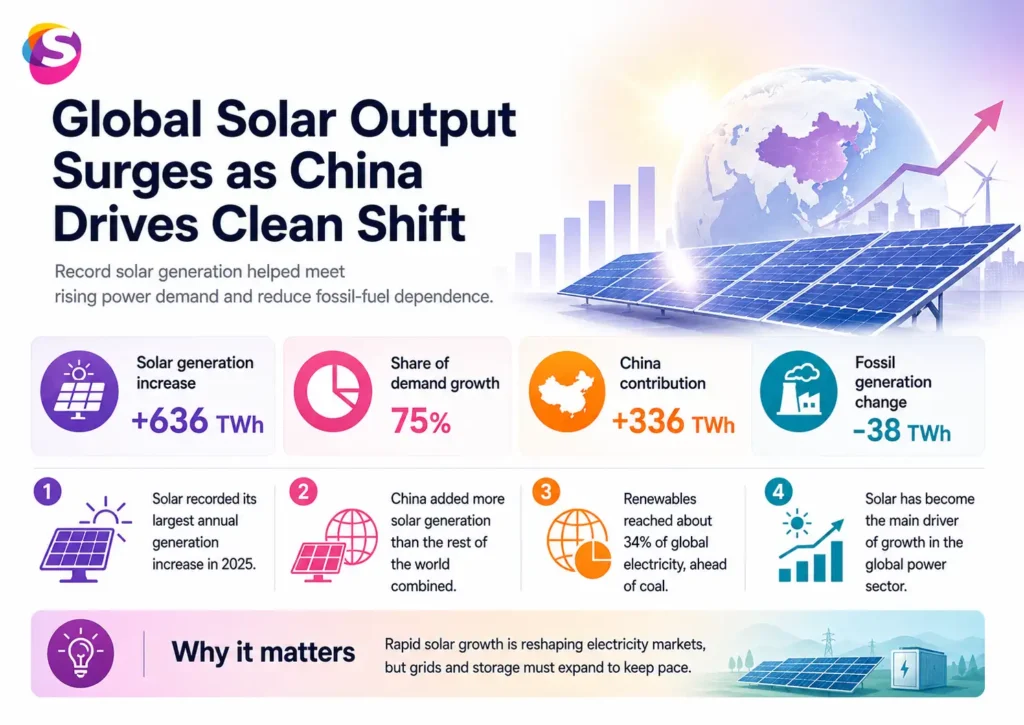
Global solar electricity generation recorded its largest annual increase in 2025, rising by 636 terawatt-hours and supplying about three-quarters of the growth in worldwide power demand. China accounted for more than half of the expansion, adding 336 TWh of solar generation—more than the rest of the world combined.
The surge helped clean electricity grow faster than global demand and contributed to a small decline in fossil-fuel generation. Renewables also overtook coal in the global electricity mix, signalling that solar and wind are increasingly capable of meeting rising power consumption without a corresponding increase in fossil generation.
Key Overview
- Solar generation increased by a record 636 TWh in 2025.
- The annual addition was 33% larger than the previous record increase of 479 TWh.
- Total solar output rose by about 30% and reached roughly 2,778 TWh.
- Solar supplied approximately 75% of the 849 TWh increase in global electricity demand.
- China added 336 TWh of solar generation, more than all other countries combined.
- Global fossil-fuel electricity generation fell by about 38 TWh, or 0.2%.
- Renewables generated approximately 34% of global electricity, moving ahead of coal at about 33%.
Solar Becomes the Main Source of New Electricity
The Global Electricity Review 2026 shows that solar was the dominant source of new electricity generation in 2025. Its 636 TWh increase was larger than the combined contribution of most other power sources and represented about 75% of global demand growth.
Worldwide electricity demand increased by approximately 849 TWh during the year. Clean electricity sources expanded by about 887 TWh, meaning their growth was sufficient to cover the full increase in consumption.
Solar generation reached around 2,778 TWh, lifting its share of global electricity to approximately 8.7%. This was a tenfold increase from 2015 and continued a pattern in which global solar output has roughly doubled every three years.
The frequently reported 33% figure describes how much larger the 2025 annual addition was than the previous record increase. It does not mean that installed solar capacity or total generation rose by 33%. Total solar electricity production increased by approximately 30% year on year.
China Accounts for More Than Half of Solar Growth
China remained the decisive force behind the global expansion. According to the report’s 2025 electricity analysis, the country added about 336 TWh of solar generation and deployed approximately 378 GW of new solar capacity.
That represented more than half of the worldwide increase in both solar generation and installed capacity. China’s 2025 solar installations alone exceeded the United States’ total operating solar capacity.
The country’s clean-power expansion also helped reduce its reliance on fossil generation. Solar, wind, hydro and nuclear sources generated about 42% of China’s electricity during the year, broadly matching the global clean-power share.
India also recorded strong growth in clean electricity. Increased solar and wind output helped the country reduce fossil-fuel generation despite continued growth in electricity demand, demonstrating how rapidly expanding clean capacity can begin to displace coal and gas rather than merely supplement them.
Context is everything. Stay ahead of shifting trends with today’s market updates, and uncover emerging opportunities using the Serrari Group Market Index and Marketplace. Then, take control of your own financial future by exploring our Money & Life Reset Transformation Blueprint ™ to build stronger habits, create better systems, and design a path toward lasting wealth.
Fossil-Fuel Generation Records a Small Decline
The growth of low-carbon electricity exceeded the increase in demand, pushing global fossil-fuel generation down by approximately 38 TWh, or 0.2%. Coal generation fell, while gas-fired output rose only modestly.
The independent analysis of the findings reported that coal generation declined by about 63 TWh, while gas generation increased by roughly 36–38 TWh. Solar’s annual increase was therefore about 17 times greater than the rise in gas-fired electricity.
The decline was small and does not yet establish a permanent downward trend. Electricity demand can fluctuate with economic activity, industrial production, weather conditions, electric-vehicle adoption and data-centre growth. Lower hydropower or nuclear output in a future year could also increase the need for fossil generation.
However, the 2025 result shows that clean-power additions have reached a scale capable of meeting rising global demand and reducing fossil generation at the same time.
Renewables Overtake Coal in the Global Power Mix
Renewable sources supplied close to 34% of global electricity in 2025, moving ahead of coal’s approximately 33% share. This marked the first time in more than a century that renewables generated more electricity worldwide than coal.
Clean electricity, including renewables and nuclear power, reached approximately 43% of the global mix. Wind generation increased by about 205 TWh, making it the second-largest contributor to additional electricity after solar.
Battery storage deployment also accelerated, helping power systems absorb more daytime solar production and shift electricity into evening demand periods. Falling battery costs are improving the economics of pairing solar farms with storage, although grid investment and market reform remain essential.
Grid Expansion Is the Next Major Challenge
Rapid solar installation does not automatically guarantee that all available electricity can be used. Many markets face delays in connecting projects to transmission networks, while periods of excess midday production can lead to curtailment or negative wholesale prices.
Governments and utilities will need to expand transmission lines, modernise distribution networks and develop flexible demand. Additional battery storage, pumped hydropower, interconnectors and responsive industrial loads can reduce the mismatch between solar production and consumption.
The International Energy Agency’s 2026 assessment similarly found that solar delivered the largest annual generation increase ever observed for a single electricity source outside exceptional post-crisis rebounds. It expects solar to remain the leading source of renewable growth through the end of the decade.
The 2025 record therefore represents both a major clean-energy milestone and a test of whether electricity systems can adapt quickly enough. Solar is no longer a marginal contributor: it has become the principal driver of growth in the global power sector.
Sources: Ember / International Energy Agency / Carbon Brief / The Guardian
Your financial future isn’t something you wait for—it’s something you build.
The real question is: when do you begin?
Move beyond simply staying informed.
Navigate the markets with clarity—track trends through the Serrari Group Market Index, uncover opportunities in the Serrari Marketplace, and build practical knowledge with our Curated Wealth Builder Platform.
Stay connected to what truly matters.
Get daily insights on macro trends and financial movements across Kenya, Africa, and global markets—delivered through the Serrari Newsletter.
Growth opens doors.
Advance your career through professional programs including ACCA, HESI A2, ATI TEAS 7 , HESI EXIT , NCLEX – RN and NCLEX – PN, Financial Literacy!🌟—designed to move you forward with confidence.
See where money is flowing—clearly and in real time.
Track Money Market Funds, Treasury Bills, Treasury Bonds, Green Bonds, and Fixed Deposits, alongside global and African indexes, key economic indicators, and the evolving Crypto and stablecoin landscape—all within Serrari’s Market Index.