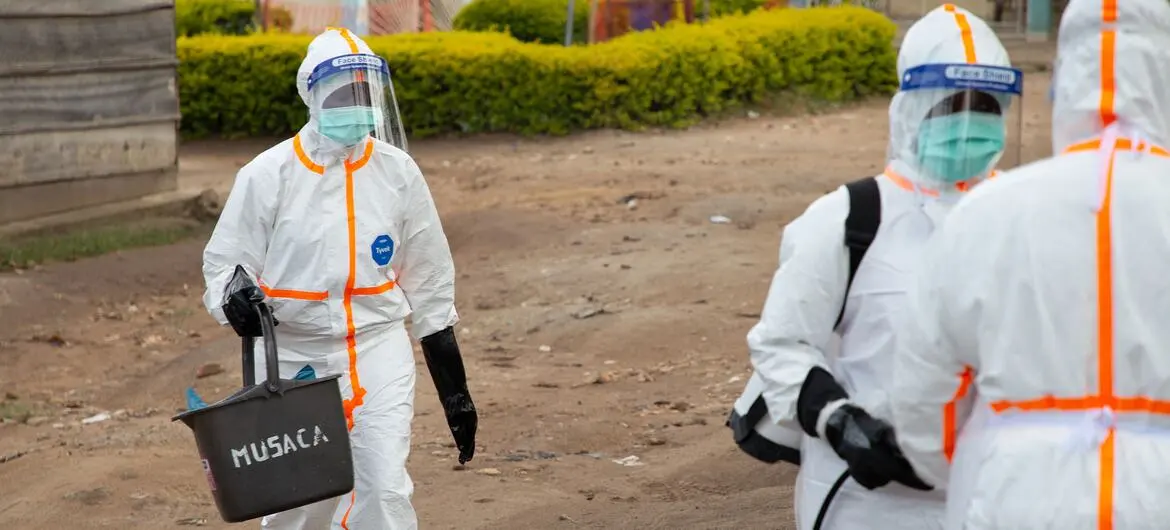
The United States Centers for Disease Control and Prevention has activated $107 million in emergency funding to expand its response to the Bundibugyo Ebola outbreak in the Democratic Republic of the Congo and Uganda. The money will support field operations, laboratory testing, surveillance, border health measures and domestic preparedness in the United States.
The funding comes as the outbreak continues to expand rapidly. The latest World Health Organization update reports 915 confirmed cases and 234 deaths across the two affected countries, including 896 cases in the DRC and 19 in Uganda. The response remains severely underfunded despite hundreds of millions of dollars in international pledges.
Key Overview
- The CDC has accessed $107 million from an infectious-disease emergency reserve.
- More than 125 CDC personnel are supporting the response in the DRC and Uganda.
- Twenty-three CDC field staff are working directly with epidemiological teams and health authorities.
- WHO reports 915 confirmed cases and 234 deaths across the DRC and Uganda.
- Donors pledged approximately $910 million, but less than $90 million had been released.
- The risk to the United States remains low, according to the CDC.
- The Bundibugyo virus currently has no approved strain-specific vaccine or treatment.
Emergency Funding Expands the CDC Response
The CDC said it had accessed $107 million in emergency funding from the Infectious Disease Rapid Response Reserve Fund. The allocation is intended to accelerate activities in the affected countries while strengthening readiness inside the United States.
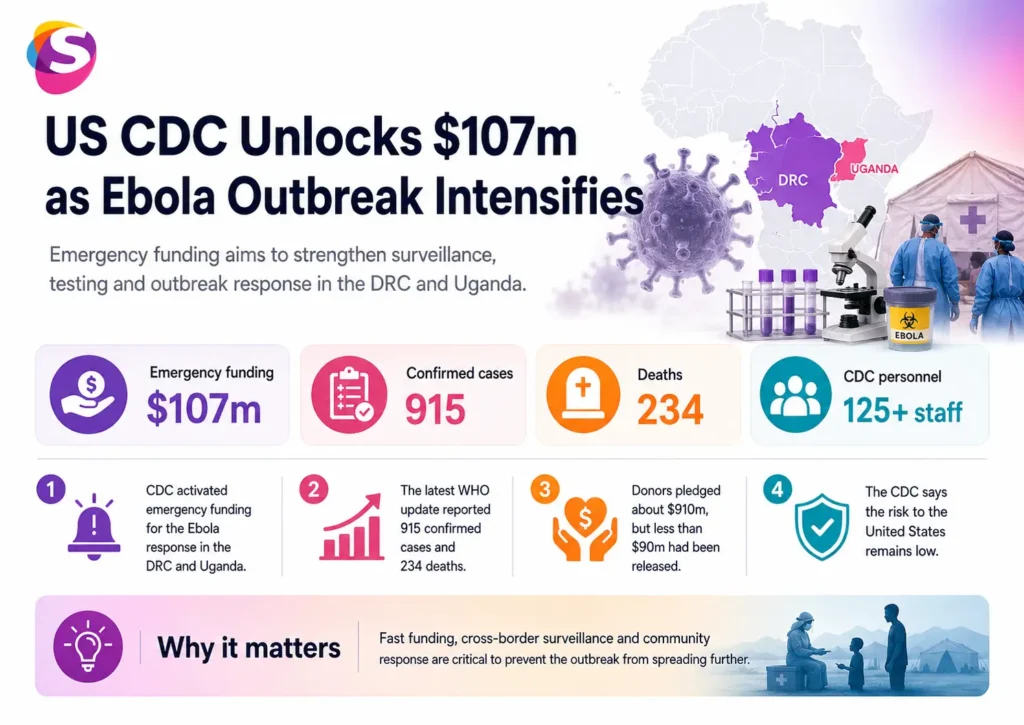
The agency has 23 field staff supporting epidemiological investigations and working with the DRC’s health ministry. More than 125 CDC personnel are involved across the DRC and Uganda, including staff providing technical, laboratory, surveillance and border-health support.
In the DRC, CDC teams are supporting contact tracing, isolation, safe burials, diagnostic testing and assessments at ports of entry. They are also helping provinces west of the main outbreak zone improve early detection and limit further spread.
Confirmed Cases Rise Beyond 900
The outbreak is caused by Bundibugyo virus, a less common Ebola species that previously caused outbreaks in Uganda and the DRC. Unlike the more frequently reported Zaire Ebola virus, there is currently no approved Bundibugyo-specific vaccine or treatment.
The latest WHO outbreak update records 915 confirmed infections and 234 deaths. The DRC accounts for 896 cases, while Uganda has reported 19 cases. At least 88 patients have recovered.
These totals are already above the 875 cases and 202 deaths cited when the funding announcement was first reported, showing how quickly the outbreak is changing. WHO declared it a public health emergency of international concern in May after cases crossed into Uganda.
Donor Funds Fall Far Short of Pledges
Africa CDC said donors had pledged approximately $910 million for the response, including $80 million from African Union member states. However, less than $90 million had been released to the affected countries by mid-June.
Fewer than 10% of pledged funds were therefore available for immediate operations, limiting staffing, protective equipment, ambulances and treatment facilities. The United States says it is the largest donor and has urged others to release promised funding.
The funding challenge is especially serious because the joint continental response plan requires $518 million to strengthen detection and preparedness across countries that may be exposed to cross-border transmission.
Context is everything. Stay ahead of shifting trends with today’s market updates, and uncover emerging opportunities using the Serrari Group Market Index and Marketplace. Then, take control of your own financial future by exploring our Money & Life Reset Transformation Blueprint ™ to build stronger habits, create better systems, and design a path toward lasting wealth.
Border Surveillance Intensifies in Uganda
CDC teams in Uganda are supporting border-health operations and reviewing airport screening arrangements. Cross-border movement between eastern Congo and Uganda is extensive, increasing the need for coordinated surveillance and rapid information sharing.
Health authorities must trace contacts, isolate suspected cases and move samples to laboratories quickly. Preparedness is also being strengthened in neighbouring provinces and countries because new clusters could emerge beyond the original transmission zones.
United States Maintains Low-Risk Assessment
The CDC continues to assess the risk to the American public as low. No cases linked to the outbreak have been confirmed in the United States, and the agency says it is preparing for the unlikely event that an infected traveller arrives in the country.
Domestic readiness includes coordination with hospitals, laboratories and local health departments. The CDC’s World Cup team is also briefing officials in the 11 US host cities on Ebola, measles and heat-related illness.
Speed of Funding Will Shape the Outcome
The $107 million CDC allocation provides urgently needed operational support, but the scale of the outbreak means it cannot close the wider funding gap alone. The effectiveness of the response will depend on how quickly pledged resources reach frontline teams.
Containing Bundibugyo Ebola requires intensive contact tracing, treatment, diagnostics, community cooperation and safe burials. With infections still rising, the goal is to prevent the emergency from overwhelming already strained health systems.
Sources: Centers for Disease Control and Prevention / World Health Organization / Reuters / Africa Centres for Disease Control and Prevention
Your financial future isn’t something you wait for—it’s something you build.
The real question is: when do you begin?
Move beyond simply staying informed.
Navigate the markets with clarity—track trends through the Serrari Group Market Index, uncover opportunities in the Serrari Marketplace, and build practical knowledge with our Curated Wealth Builder Platform.
Stay connected to what truly matters.
Get daily insights on macro trends and financial movements across Kenya, Africa, and global markets—delivered through the Serrari Newsletter.
Growth opens doors.
Advance your career through professional programs including ACCA, HESI A2, ATI TEAS 7 , HESI EXIT , NCLEX – RN and NCLEX – PN, Financial Literacy!🌟—designed to move you forward with confidence.
See where money is flowing—clearly and in real time.
Track Money Market Funds, Treasury Bills, Treasury Bonds, Green Bonds, and Fixed Deposits, alongside global and African indexes, key economic indicators, and the evolving Crypto and stablecoin landscape—all within Serrari’s Market Index.