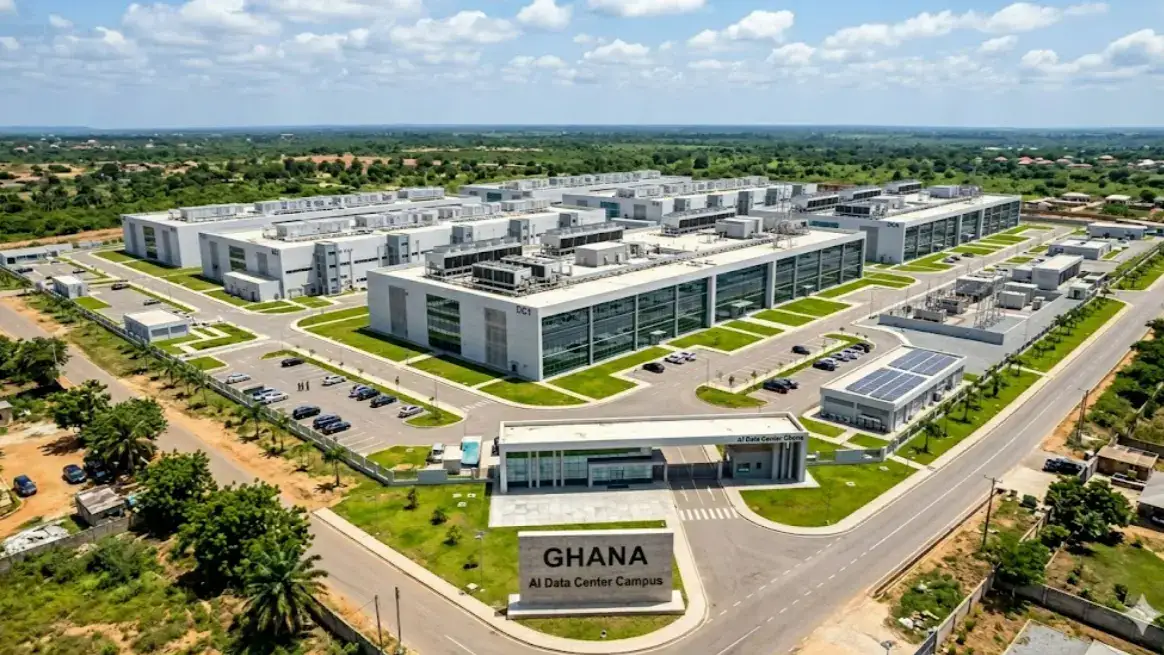
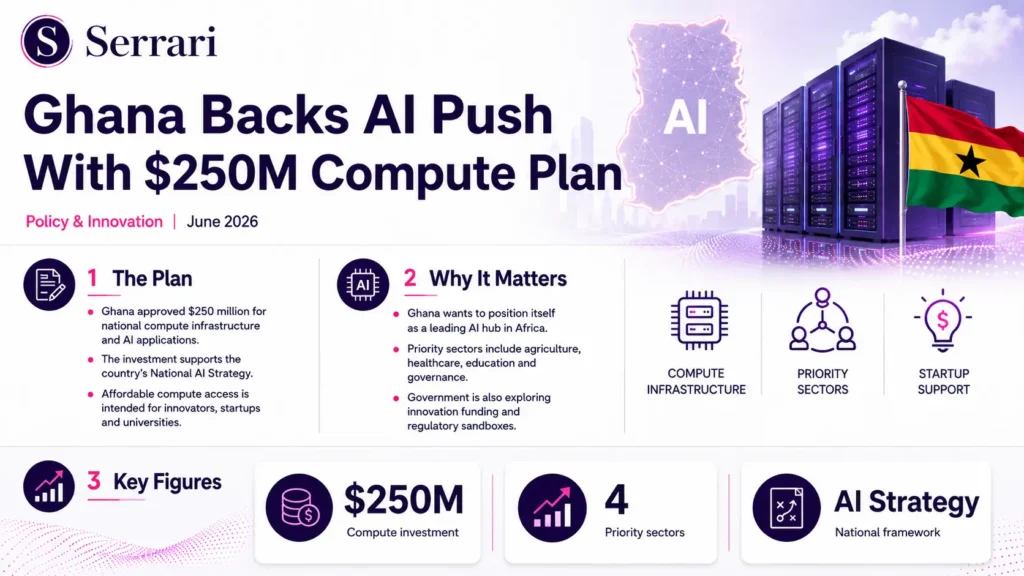
Ghana is moving to position itself as one of Africa’s leading artificial intelligence hubs after Cabinet approved a $250 million investment to develop national compute infrastructure and AI-driven applications. The disclosure was made by Minister for Communication, Digital Technology and Innovations Samuel Nartey George during a stakeholder meeting with PwC Ghana in Accra.
The engagement focused on how public and private sector collaboration can support Ghana’s newly launched National AI Strategy. The government wants the strategy to accelerate innovation, improve public services, strengthen regulation and make advanced computing more accessible to local innovators, universities and startups.
Key Overview
- Ghana has approved $250 million for national compute infrastructure and AI applications.
- The investment is tied to the country’s National AI Strategy and broader digital transformation agenda.
- Priority sectors include agriculture, healthcare, education and public administration.
- Government is exploring innovation financing, regulatory reform and sector sandboxes.
- PwC Ghana expressed interest in supporting AI deployment, advisory services, capacity building and startup financing.
Ghana’s AI Ambition Moves From Policy to Infrastructure
Ghana’s AI plans are shifting from strategy design to implementation. During the meeting with PwC Ghana, the Communication Minister said Cabinet had approved funding for national compute infrastructure that would support high-performance computing access for innovators and academic institutions.
That matters because AI development depends heavily on compute power, data access and technical capacity. Without affordable infrastructure, many African startups and universities are forced to rely on expensive external platforms, limiting local experimentation and product development. Ghana’s proposed compute investment could reduce that barrier by creating shared national capacity for research, product testing and AI deployment.
The move builds on the government’s official launch of the National AI Strategy, where President John Dramani Mahama outlined Ghana’s ambition to become a leading AI hub in West Africa. The strategy frames AI as a tool for innovation, jobs and inclusive development, while emphasizing human-centred adoption rather than simple automation.
Context is everything. Stay ahead of shifting trends with today’s market updates, and uncover emerging opportunities using the Serrari Group Market Index and Marketplace. Then, take control of your own financial future by exploring our Money & Life Reset Transformation Blueprint ™ to build stronger habits, create better systems, and design a path toward lasting wealth.
Priority Sectors: Food, Health, Education and Governance
The Ministry identified agriculture, healthcare, education and governance systems as key areas where AI can deliver national impact. In agriculture, AI could support crop monitoring, weather-informed planning, pest detection and productivity improvements, helping strengthen food security. In healthcare, AI-enabled diagnostics and telemedicine could expand access, especially in underserved communities.
Education is another priority. Ghana’s strategy highlights AI education, youth employment and future skills, aligning with the country’s broader push to prepare young people for digital jobs. According to the OECD policy profile, Ghana’s AI strategy includes pillars such as AI training, youth jobs, digital infrastructure, data governance, applied research and public sector adoption.
In public administration, AI could improve service delivery, reduce paperwork and support more efficient decision-making. However, these gains will depend on strong data governance, clear procurement rules and safeguards against bias, exclusion or misuse.
Financing Startups and Building Trust
Beyond infrastructure, Ghana is also looking at how to finance innovation. Minister George highlighted the need for patient capital, noting that traditional bank lending often does not fit the risk profile of early-stage technology companies. The government is therefore exploring a revolving innovation fund designed to de-risk private investment and attract venture capital into Ghana’s technology ecosystem.
Regulation is also part of the plan. The Ministry pointed to legislative reforms that could reposition key agencies as full regulators and create innovation sandboxes for emerging sectors such as fintech, healthtech and agritech. Sandboxes can help startups test new products under regulatory supervision before launching at scale.
PwC Ghana’s delegation, led by Country Senior Partner Vish Ashiagbor, welcomed the government’s vision and signalled interest in deeper collaboration around AI deployment, digital advisory, capacity building and connecting startups with private capital.
What This Means for Africa’s AI Race
Ghana’s $250 million compute plan could strengthen its position in Africa’s emerging AI economy, especially if the investment is matched by skills training, private-sector participation and strong governance. Several African countries are developing AI strategies, but infrastructure remains one of the biggest gaps between policy ambition and practical deployment.
If Ghana succeeds, it could create a model for how African governments can combine national AI policy, compute access, innovation financing and regulatory reform. The challenge now is execution: ensuring that the investment reaches local innovators, supports useful applications and builds trust across citizens, businesses and public institutions.
Sources used: Ministry of Communication, Digital Technology and Innovations Ghana / Republic of Ghana National Artificial Intelligence Strategy / OECD.AI / PwC Ghana
Your financial future isn’t something you wait for—it’s something you build.
The real question is: when do you begin?
Move beyond simply staying informed.
Navigate the markets with clarity—track trends through the Serrari Group Market Index, uncover opportunities in the Serrari Marketplace, and build practical knowledge with our Curated Wealth Builder Platform.
Stay connected to what truly matters.
Get daily insights on macro trends and financial movements across Kenya, Africa, and global markets—delivered through the Serrari Newsletter.
Growth opens doors.
Advance your career through professional programs including ACCA, HESI A2, ATI TEAS 7 , HESI EXIT , NCLEX – RN and NCLEX – PN, Financial Literacy!🌟—designed to move you forward with confidence.
See where money is flowing—clearly and in real time.
Track Money Market Funds, Treasury Bills, Treasury Bonds, Green Bonds, and Fixed Deposits, alongside global and African indexes, key economic indicators, and the evolving Crypto and stablecoin landscape—all within Serrari’s Market Index.