The Global Environment Facility has approved $13.46 million for the African Development Bank-led Green Mobility Financing Facility for Africa, strengthening efforts to move electric transport projects beyond isolated pilots and into commercially scalable investments.
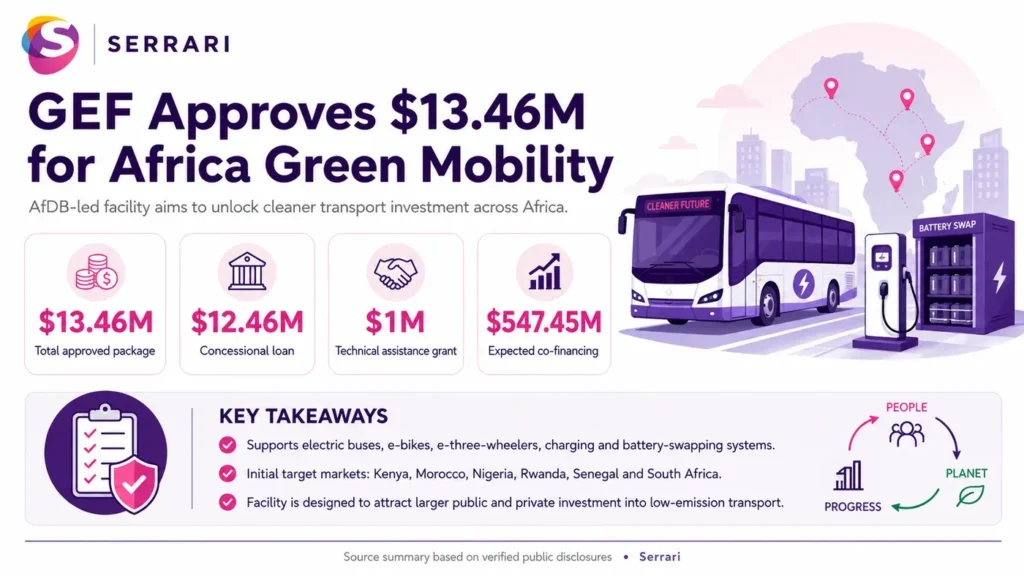
The package, approved on June 18, 2026, combines a $12.46 million concessional loan with a $1 million technical-assistance grant. It will support project preparation, risk reduction and financing for electric public transport, two- and three-wheelers, charging systems, battery-swapping networks and vehicle manufacturing.
Key Overview
- The funding package totals $13.46 million.
- It includes a $12.46 million concessional loan and $1 million grant.
- The facility will use blended finance and credit enhancement to attract private investors.
- Six initial markets are targeted: Kenya, Morocco, Nigeria, Rwanda, Senegal and South Africa.
- The broader programme lists $547.45 million in expected co-financing.
- Supported technologies include electric buses, motorcycles, three-wheelers and renewable-powered charging systems.
New Funding Targets Africa’s E-Mobility Finance Gap
The newly approved financing package is intended to operationalise the Green Mobility Financing Facility for Africa and make more sustainable transport projects attractive to commercial lenders and investors.
High vehicle costs, unfamiliar technology, limited long-term debt and uncertainty over charging demand have kept many African e-mobility ventures small or dependent on pilot funding. The facility plans to address these constraints through concessional and senior debt, credit-enhancement instruments and technical support.
Concessional capital can absorb risks that private financiers may be unwilling to accept during the early stages of a new market. This can lower financing costs, strengthen project economics and enable commercial investors to participate alongside development-finance institutions.
Electric Buses and Two-Wheelers Lead the Investment Scope
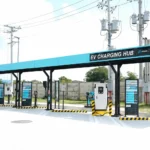
According to the facility’s project record, supported investments may include electric buses, electric two- and three-wheelers, renewable-energy-powered charging infrastructure, battery-swapping stations and electric vehicle manufacturing.
This focus reflects how transport operates across many African cities. Public buses, minibuses, motorcycles and three-wheelers provide essential mobility and commercial services, making fleet electrification potentially more impactful than relying solely on private passenger cars.
The programme is expected to begin across Kenya, Morocco, Nigeria, Rwanda, Senegal and South Africa. These markets will be used to test financing structures, business models and regulatory approaches that could later be replicated elsewhere on the continent.
Context is everything. Stay ahead of shifting trends with today’s market updates, and uncover emerging opportunities using the Serrari Group Market Index and Marketplace. Then, take control of your own financial future by exploring our Money & Life Reset Transformation Blueprint ™ to build stronger habits, create better systems, and design a path toward lasting wealth.
Technical Assistance Will Prepare Investable Projects
The $1 million grant will support more than vehicle purchases. It is intended to strengthen policy and regulatory frameworks, develop viable business models, prepare transactions and create a pipeline of bankable projects.
Earlier support for the facility focused on creating market-ready e-mobility projects, including public- and private-sector guidance, regional coordination and knowledge sharing. The new package adds concessional investment capital to those upstream activities.
Technical assistance is particularly important where operators need help assessing routes, fleet utilisation, charging requirements, power availability, battery performance and revenue models before lenders can evaluate a project.
Broader Capital Mobilisation Could Reach $547.45 Million
Although the GEF contribution is $13.46 million, the programme information lists $547.45 million in expected co-financing. This indicates that the facility is designed to use a relatively small pool of catalytic funding to mobilise significantly larger commitments from the African Development Bank, development partners and private investors.
The final amount deployed will depend on the quality of the project pipeline, country-level reforms and investor participation. The programme is also being supported through mechanisms including KOAFEC, the Sustainable Energy Fund for Africa and the Fund for African Private Sector Assistance.
Rapid Urban Growth Raises the Need for Cleaner Transport
Africa’s urban population is projected to reach about 1.4 billion by 2050, while more than half of the urban infrastructure the continent will need has not yet been built. That expansion increases the urgency of developing transport systems that reduce pollution, congestion and dependence on imported fossil fuels.
The continent’s cities are expected to more than double in population by 2050. Financing electric public and commercial transport now could help cities avoid locking themselves into higher-emission infrastructure while supporting local manufacturing, jobs and cleaner urban air.
The facility’s success will ultimately depend on whether its blended-finance model can turn promising technologies into reliable, investable transport businesses at scale.
Sources: African Development Bank / Global Environment Facility / Minamata Convention / UN-Habitat
Your financial future isn’t something you wait for—it’s something you build.
The real question is: when do you begin?
Move beyond simply staying informed.
Navigate the markets with clarity—track trends through the Serrari Group Market Index, uncover opportunities in the Serrari Marketplace, and build practical knowledge with our Curated Wealth Builder Platform.
Stay connected to what truly matters.
Get daily insights on macro trends and financial movements across Kenya, Africa, and global markets—delivered through the Serrari Newsletter.
Growth opens doors.
Advance your career through professional programs including ACCA, HESI A2, ATI TEAS 7 , HESI EXIT , NCLEX – RN and NCLEX – PN, Financial Literacy!🌟—designed to move you forward with confidence.
See where money is flowing—clearly and in real time.
Track Money Market Funds, Treasury Bills, Treasury Bonds, Green Bonds, and Fixed Deposits, alongside global and African indexes, key economic indicators, and the evolving Crypto and stablecoin landscape—all within Serrari’s Market Index.