














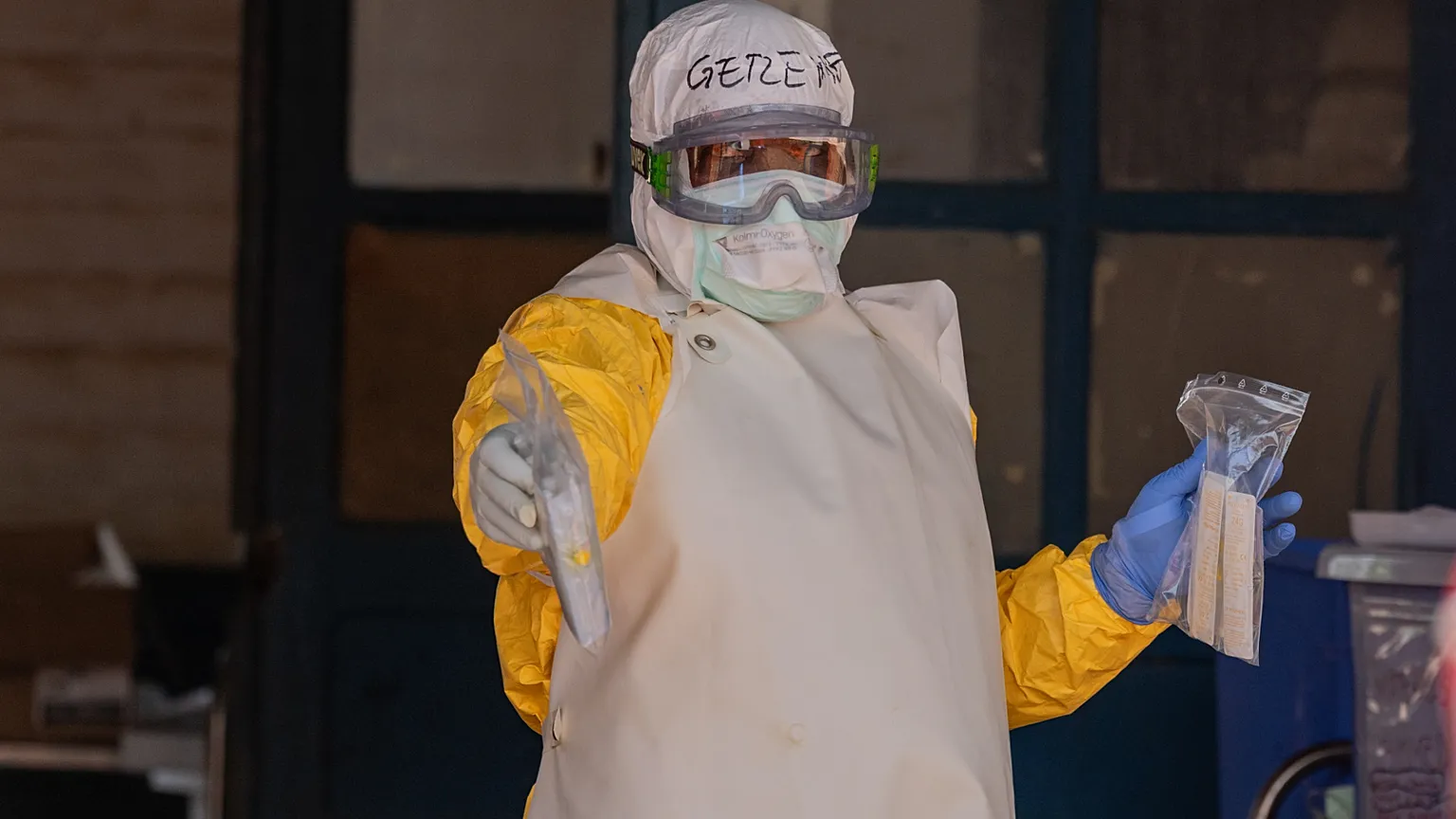
The European Commission has announced a €493 million ($572 million) package to support the response to the Ebola outbreak in Central Africa. The funding will cover immediate medical support, humanitarian assistance, vaccine and treatment research, and longer-term investment in health preparedness.
The outbreak, caused by the Bundibugyo strain of Ebola, has intensified in the Democratic Republic of Congo and Uganda, raising concern among global health agencies. While European authorities currently assess the risk to people in Europe as very low, the EU says the response requires coordinated international support.
Key Overview
- The EU has announced €493 million, equivalent to about $572 million, for Ebola response efforts.
- The package includes frontline medical support, humanitarian aid, research and health-system strengthening.
- The outbreak is linked to the Bundibugyo strain of Ebola.
- The Democratic Republic of Congo and Uganda are the main affected countries.
- WHO declared the outbreak a Public Health Emergency of International Concern on May 17, 2026.
- ECDC currently assesses the risk to people in Europe as very low.
- The EU says the response is being coordinated with member states, international bodies and health partners.
EU Expands Support as Ebola Response Intensifies
The European Commission said it will provide €493 million in financial aid to support the Ebola response in Central Africa. The package is designed to address both urgent outbreak-control needs and longer-term gaps in health preparedness.
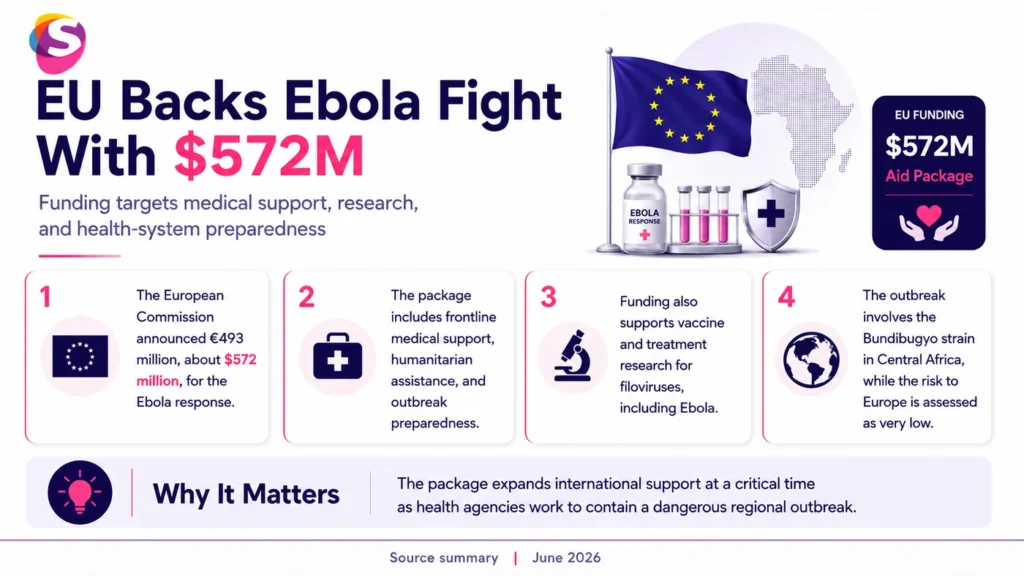
The funding includes frontline medical support for affected areas, humanitarian assistance across the Great Lakes region and Uganda, and research into vaccines and treatments for filoviruses, the virus family that includes Ebola. It also supports health-system strengthening, which is critical in regions where weak infrastructure, insecurity and displacement make disease control more difficult.
European Commissioner for Crisis Management Hadja Lahbib said the outbreak was a test of global solidarity, adding that the EU remained engaged as a reliable partner.
Bundibugyo Strain Creates Added Challenge
The current outbreak is caused by the Bundibugyo virus, a less common Ebola strain that presents a more difficult response environment because approved vaccines and treatments are limited compared with the better-known Zaire strain.
WHO declared the outbreak a Public Health Emergency of International Concern on May 17, 2026, after cases and suspected deaths were reported in eastern Democratic Republic of Congo and Uganda. Early data showed the outbreak was centred in Ituri Province, with affected health zones including Bunia, Rwampara and Mongbwalu.
The situation has since worsened. Reuters reported that the outbreak response remains strained, with shortages of staff, transport, isolation facilities, protective equipment and safe burial teams. The virus has also reached areas affected by conflict and displacement, making contact tracing and community engagement more difficult.
Context is everything. Stay ahead of shifting trends with today’s market updates, and uncover emerging opportunities using the Serrari Group Market Index and Marketplace. Then, take control of your own financial future by exploring our Money & Life Reset Transformation Blueprint ™ to build stronger habits, create better systems, and design a path toward lasting wealth.
Humanitarian Conditions Raise Transmission Risk
The outbreak has spread in areas where large numbers of displaced people live in crowded and fragile conditions. Reuters reported that Ebola had reached a crowded displacement camp in eastern Congo, increasing concern that poor sanitation, limited clean water and high population movement could accelerate transmission.
These conditions make the response more complex than a standard public-health operation. Health teams must manage infection control while also navigating insecurity, community mistrust, logistical barriers and limited treatment capacity.
The outbreak has also crossed borders, with Uganda included in the regional response. This makes surveillance, case detection and cross-border coordination essential for slowing transmission.
Europe Sees Low Risk but High Global Stakes
The European Centre for Disease Prevention and Control has said the risk to Europe remains very low, but European agencies are still increasing monitoring and support. The concern is not only direct importation risk, but also the broader global health threat posed by a fast-growing Ebola outbreak in fragile settings.
The EU had already announced smaller rounds of support before this larger package, including additional emergency funding for outbreak control. The new €493 million package significantly expands that response by combining emergency aid, scientific research and longer-term health-system resilience.
Outlook
The EU’s package signals that the Ebola response in Central Africa is moving from short-term containment into a broader emergency and preparedness effort. Immediate priorities remain case detection, isolation, contact tracing, safe burials and frontline worker protection.
However, the longer-term challenge is equally important. Without stronger health systems, better surveillance and accelerated vaccine and treatment research, future outbreaks could continue to overwhelm communities before international support arrives.
For Central Africa, the package offers critical support at a dangerous moment. For the global health system, it is a reminder that infectious disease threats in one region can quickly become international priorities.
Sources used: Reuters / European Commission / European Centre for Disease Prevention and Control / World Health Organization
Your financial future isn’t something you wait for—it’s something you build.
The real question is: when do you begin?
Move beyond simply staying informed.
Navigate the markets with clarity—track trends through the Serrari Group Market Index, uncover opportunities in the Serrari Marketplace, and build practical knowledge with our Curated Wealth Builder Platform.
Stay connected to what truly matters.
Get daily insights on macro trends and financial movements across Kenya, Africa, and global markets—delivered through the Serrari Newsletter.
Growth opens doors.
Advance your career through professional programs including ACCA, HESI A2, ATI TEAS 7 , HESI EXIT , NCLEX – RN and NCLEX – PN, Financial Literacy!🌟—designed to move you forward with confidence.
See where money is flowing—clearly and in real time.
Track Money Market Funds, Treasury Bills, Treasury Bonds, Green Bonds, and Fixed Deposits, alongside global and African indexes, key economic indicators, and the evolving Crypto and stablecoin landscape—all within Serrari’s Market Index.