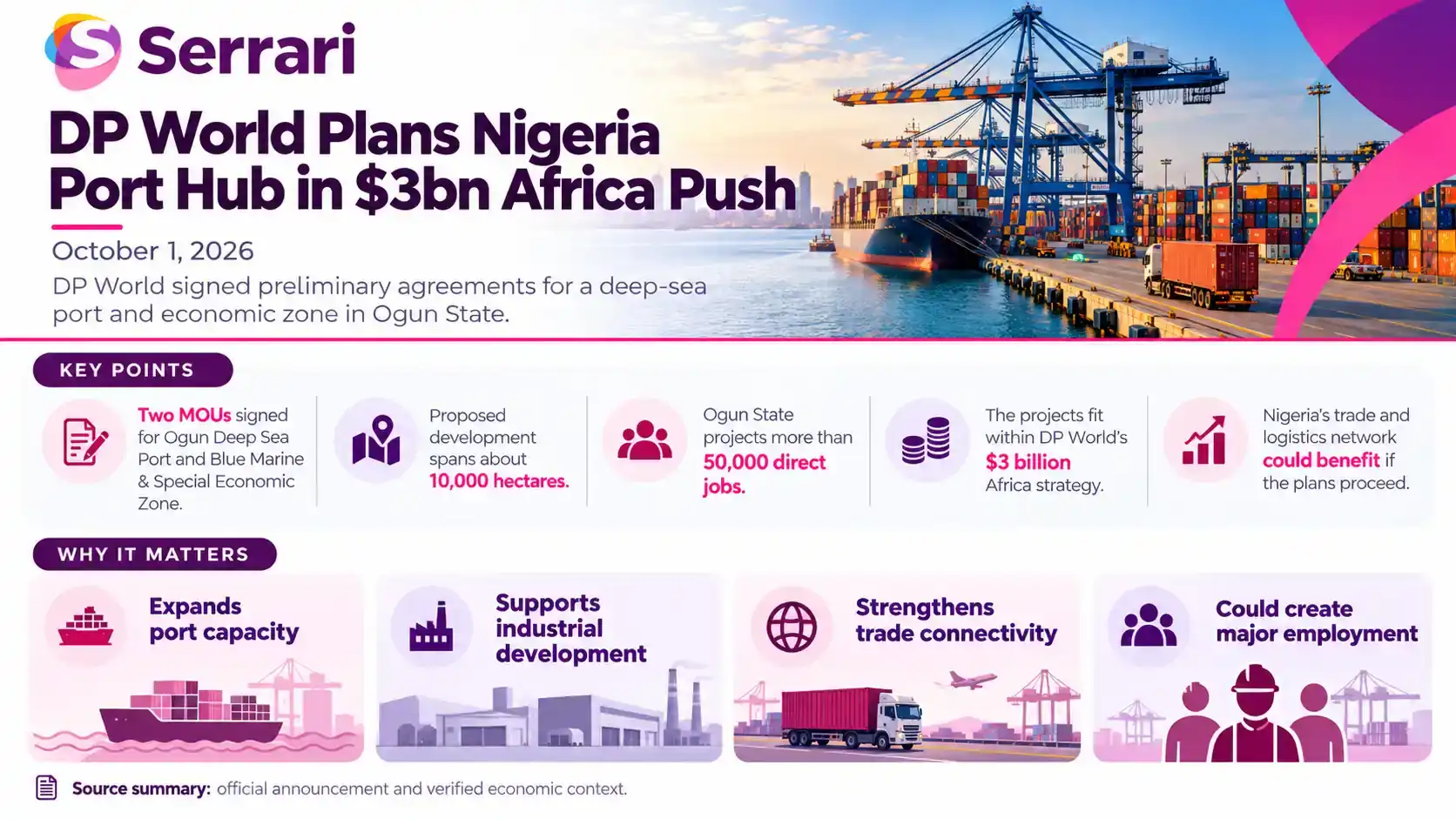
DP World has signed preliminary agreements to explore a major new port and industrial development in Ogun State, Nigeria, as the Dubai-based logistics group expands its African infrastructure footprint. The proposed development combines a greenfield deep-sea port with a special economic zone across approximately 10,000 hectares, with the state government projecting more than 50,000 direct jobs if the projects proceed.
The Ogun Deep Sea Port and Ogun State Blue Marine and Special Economic Zone form part of DP World’s wider Africa strategy, under which the company says it has committed around $3 billion to ports and logistics infrastructure across the continent.
Key Overview
- DP World has signed two Memorandums of Understanding covering proposed projects in Ogun State.
- The planned development would combine the Ogun Deep Sea Port with the Ogun State Blue Marine and Special Economic Zone.
- The combined site is expected to span about 10,000 hectares.
- Ogun State estimates the developments could create more than 50,000 direct jobs.
- The agreements are preliminary and are intended to explore development of the projects rather than represent completed construction contracts.
- DP World says it has committed around $3 billion to port and logistics infrastructure across Africa.
- Nigeria’s economy is projected to grow by 4.1% in 2026, supporting longer-term demand for trade and logistics capacity.
Ogun State Targets a New Maritime and Industrial Hub
The agreements were signed by Ogun State Governor Dapo Abiodun and DP World Group Chief Executive Yuvraj Narayan, with Nigerian President Bola Tinubu attending the ceremony. They cover a proposed deep-sea port and an adjacent economic zone designed to integrate maritime infrastructure, manufacturing, warehousing and logistics.
The development is planned along the Lagos-Calabar Coastal Highway, giving it potential links to Nigeria’s largest commercial region and major domestic transport corridors. DP World says the concept would connect manufacturing and industry directly with port infrastructure and global markets, reducing the distance between production, logistics and export facilities.
The projects remain at a preliminary stage. The MOUs establish a framework for further assessment and development work, meaning final investment amounts, construction schedules and commissioning dates will depend on subsequent agreements, approvals and project studies.
More Than 50,000 Direct Jobs Projected
Ogun State expects the two projects to provide more than 50,000 direct employment opportunities if fully developed. Job creation could span port operations, construction, manufacturing, transport, warehousing, customs services and other businesses established within the economic zone.
The scale reflects the proposed 10,000-hectare footprint, which would make the development much broader than a conventional container terminal. By placing an economic zone beside the port, planners aim to attract factories and processing businesses that can import inputs or export finished products more efficiently.
DP World already has a sizeable presence in Nigeria, employing more than 7,000 people across its existing operations, including businesses serving healthcare, consumer industries and logistics.
Context is everything. Stay ahead of shifting trends with today’s market updates, and uncover emerging opportunities using the Serrari Group Market Index and Marketplace. Then, take control of your own financial future by exploring our Money & Life Reset Transformation Blueprint ™ to build stronger habits, create better systems, and design a path toward lasting wealth.
Project Forms Part of DP World’s $3bn Africa Strategy
The Ogun development sits within a broader expansion programme across Africa. DP World says it has committed about $3 billion to port infrastructure and logistics on the continent, including the Port of Ndayane in Senegal, Banana Port in the Democratic Republic of Congo and expansions in Maputo and Dar es Salaam.
The company has described Africa’s supply-chain costs and infrastructure gaps as major barriers to trade, and its strategy increasingly combines ports with inland logistics, industrial parks and economic zones. DP World says it moves about 10% of global trade each day through a network that stretches across more than 80 countries.
Its ports and terminals network has around 110 million twenty-foot equivalent units of annual capacity, providing the group with experience operating large-scale maritime infrastructure across multiple regions.
Nigeria’s Logistics Bottlenecks Create Investment Demand
The proposed projects also address persistent constraints in Nigeria’s logistics system. Poor road networks, customs delays, port congestion and high operating costs continue to weaken supply-chain efficiency. Recent assessments describe infrastructure deficits and costly logistics as continuing barriers even as investment in ports, rail and digital logistics expands.
Maritime transport is particularly important to Nigeria’s trade flows, making efficient ports central to the movement of imports and exports. A new deep-sea port linked directly to an industrial zone could provide additional capacity while allowing manufacturers to locate closer to international shipping routes.
Nigeria’s underlying economic scale also supports the investment case. The country’s real GDP is projected to grow by 4.1% in 2026, although high transport costs and infrastructure shortages remain obstacles to broader growth.
What Comes Next for the Ogun Projects
The signing marks the beginning of a development process rather than the start of full construction. Further technical studies, commercial negotiations, regulatory approvals, financing arrangements and detailed project agreements will be required before the proposed port and economic zone can move into implementation.
If completed at the planned scale, the development would add another major deep-sea logistics hub to south-west Nigeria and could strengthen links between local manufacturers, West African markets and global shipping networks.
For DP World, the Ogun agreements deepen a Nigerian presence built over more than a decade while extending a wider African strategy focused on combining ports, logistics and industrial infrastructure in major trade corridors.
Sources: DP World / The National / International Monetary Fund / International Trade Administration
Your financial future isn’t something you wait for—it’s something you build.
The real question is: when do you begin?
Move beyond simply staying informed.
Navigate the markets with clarity—track trends through the Serrari Group Market Index, uncover opportunities in the Serrari Marketplace, and build practical knowledge with our Curated Wealth Builder Platform.
Stay connected to what truly matters.
Get daily insights on macro trends and financial movements across Kenya, Africa, and global markets—delivered through the Serrari Newsletter.
Growth opens doors.
Advance your career through professional programs including ACCA, HESI A2, ATI TEAS 7 , HESI EXIT , NCLEX – RN and NCLEX – PN, Financial Literacy!🌟—designed to move you forward with confidence.
See where money is flowing—clearly and in real time.
Track Money Market Funds, Treasury Bills, Treasury Bonds, Green Bonds, and Fixed Deposits, alongside global and African indexes, key economic indicators, and the evolving Crypto and stablecoin landscape—all within Serrari’s Market Index.