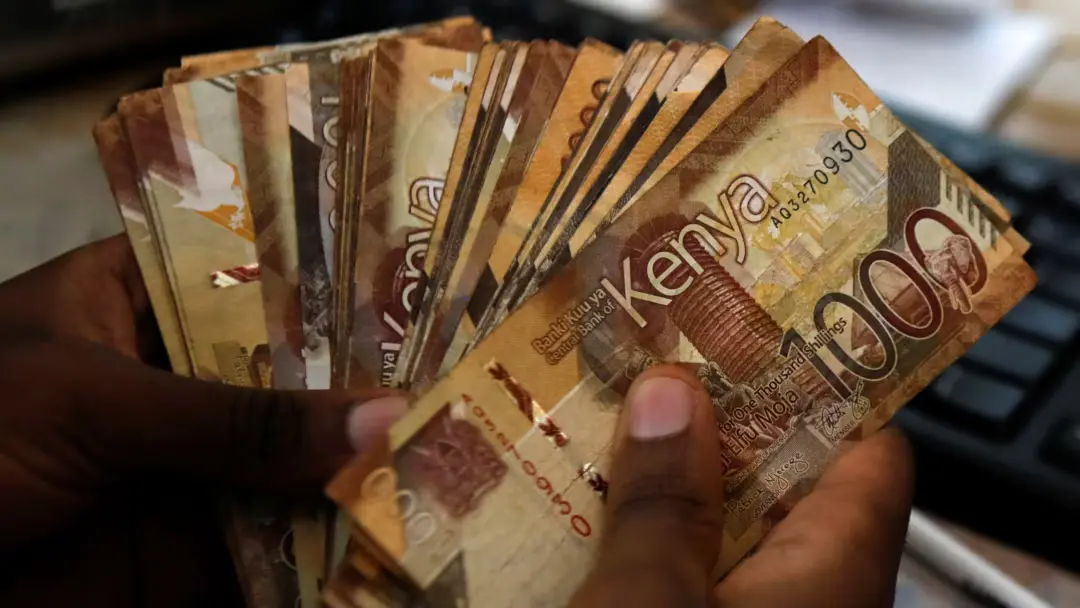
Kenyan households received an estimated Ksh931.8 billion in remittances between June 2024 and May 2025, but most of the money was used for immediate needs rather than investments. The findings show that diaspora funds are playing a major role in helping families meet daily expenses, especially food, education and healthcare.
The 2025 Remittances Household Survey also highlights a missed wealth-building opportunity. While remittances remain one of Kenya’s most important financial inflows, only a small share of recipient households reported using the money for real estate, construction, formal savings or other investment channels.
Key Overview
- Kenyan households received Ksh931.8 billion in remittances between June 2024 and May 2025.
- Food and household goods were the top use, cited by 73.1% of recipient households.
- Education accounted for 31.4% of household remittance use.
- Medical expenses accounted for 23.9%.
- Only 2.2% of households used remittances for real estate investment.
- Construction projects accounted for just 2.6% of remittance use.
- The survey was Kenya’s first nationwide household remittances study.
Remittances Are Supporting Daily Survival
Kenya’s diaspora money is increasingly functioning as a household safety net. According to the 2025 Remittances Household Survey, households received Ksh931.8 billion in remittance inflows during the survey period from June 2024 to May 2025.
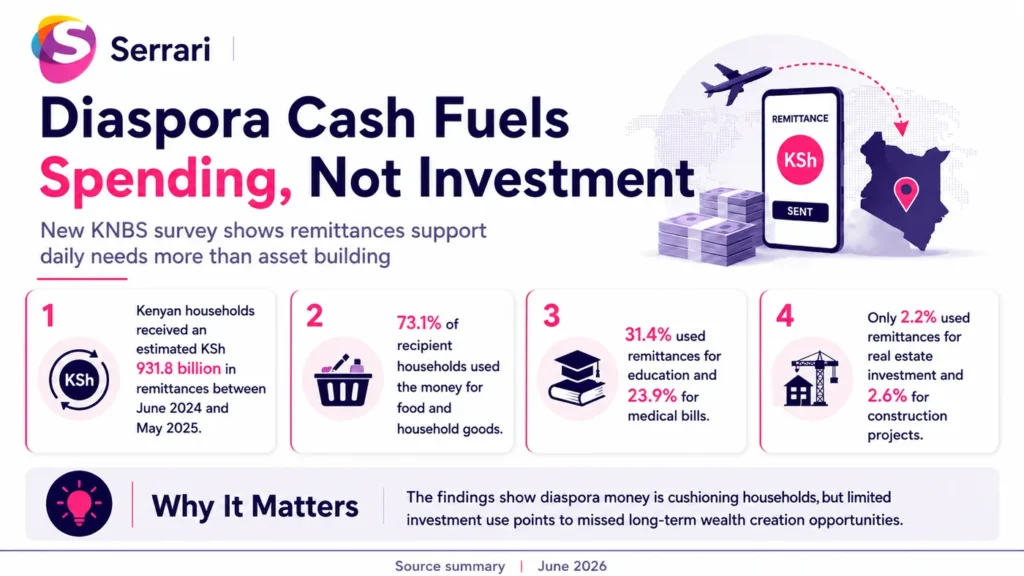
The data shows that most recipients used the money to meet everyday living costs. Food and household goods were the most common use, with 73.1% of households reporting that remittances helped them cover these expenses. Education followed at 31.4%, while healthcare-related spending accounted for 23.9%, according to reporting on the survey findings.
This pattern suggests that remittances are helping families absorb pressure from high living costs, school fees and medical bills. However, it also shows that many households have limited room to convert diaspora support into long-term assets.
Investment Use Remains Very Low
Despite the large size of remittance inflows, the survey found limited use of the funds for investment. Only 2.2% of recipient households used remittances for real estate investment, while 2.6% used the money for construction projects, according to additional coverage of the KNBS data.
This challenges the common assumption that diaspora money is mainly used to buy land, build homes or start businesses. Instead, the findings show that remittances are more often consumed immediately because households are dealing with urgent financial needs.
The low investment allocation also points to a broader financial planning gap. If households receive regular remittances but lack accessible savings, investment and advisory products, the funds may continue to support consumption without building long-term wealth.
Context is everything. Stay ahead of shifting trends with today’s market updates, and uncover emerging opportunities using the Serrari Group Market Index and Marketplace. Then, take control of your own financial future by exploring our Money & Life Reset Transformation Blueprint ™ to build stronger habits, create better systems, and design a path toward lasting wealth.
First National Survey Gives Clearer Data
The survey is significant because it is Kenya’s first nationwide household remittances study. It was designed to capture both formal and informal remittance flows, including cash and in-kind transfers, and to better understand how households send, receive and use the funds.
According to details from the survey launch, the study was intended to close data gaps around household remittance flows and provide policymakers with stronger evidence on how diaspora money moves through the economy.
This matters because official remittance data usually captures money sent through formal channels such as banks and authorised money transfer providers. The household survey adds another layer by examining how families experience and use remittances once they receive them.
Why the Findings Matter for Kenya’s Economy
Remittances have become one of Kenya’s most important sources of foreign exchange. The Central Bank of Kenya says remittances are recognised as an important contributor to national growth and development, and it tracks inflows monthly through formal remittance channels.
However, the KNBS findings show that the economic impact of remittances depends not only on how much money enters the country, but also on how it is used. If most funds are absorbed by basic needs, remittances will continue to protect households from financial stress but may have limited impact on asset creation.
This raises important questions for banks, fintechs, SACCOs, investment firms and policymakers. Products that help remittance recipients save automatically, invest in small amounts, insure against medical shocks or build assets gradually could help turn diaspora inflows into a stronger engine for household wealth.
Outlook
Kenya’s remittance story is no longer just about record inflows. The new survey shows that diaspora money is deeply important to household welfare, but its investment potential remains underused.
For remittances to drive long-term wealth creation, financial institutions may need to design products around the actual behaviour of recipient households. That means recognising that many families first need stability, then building simple pathways from consumption support into savings, insurance, business growth and formal investment.
Sources used: Kenya National Bureau of Statistics / Central Bank of Kenya / People Daily / Kenyans.co.ke
Your financial future isn’t something you wait for—it’s something you build.
The real question is: when do you begin?
Move beyond simply staying informed.
Navigate the markets with clarity—track trends through the Serrari Group Market Index, uncover opportunities in the Serrari Marketplace, and build practical knowledge with our Curated Wealth Builder Platform.
Stay connected to what truly matters.
Get daily insights on macro trends and financial movements across Kenya, Africa, and global markets—delivered through the Serrari Newsletter.
Growth opens doors.
Advance your career through professional programs including ACCA, HESI A2, ATI TEAS 7 , HESI EXIT , NCLEX – RN and NCLEX – PN, Financial Literacy!🌟—designed to move you forward with confidence.
See where money is flowing—clearly and in real time.
Track Money Market Funds, Treasury Bills, Treasury Bonds, Green Bonds, and Fixed Deposits, alongside global and African indexes, key economic indicators, and the evolving Crypto and stablecoin landscape—all within Serrari’s Market Index.