
















A new study by the Euro-Mediterranean Center on Climate Change (CMCC) warns that climate change could reduce Italy’s GDP by up to 6% by 2050 while worsening public debt sustainability and increasing sovereign borrowing costs. The findings highlight the growing economic risks posed by extreme weather and the importance of accelerating climate adaptation and mitigation measures.
Key Overview
- CMCC warns Italy’s GDP could fall by up to 6% by 2050 due to climate change.
- Climate impacts could increase sovereign debt risks and raise government borrowing costs.
- Researchers estimate refinancing risks on public debt could eventually double.
- Italy’s public debt already stands at around 138% of GDP.
- The study calls for faster climate adaptation and mitigation efforts to reduce long-term economic losses.
Climate Change Could Weaken Italy’s Economy and Public Finances
Climate change could significantly slow Italy’s long-term economic growth while making its already substantial public debt more difficult to sustain, according to a new study released by the Euro-Mediterranean Center on Climate Change (CMCC).
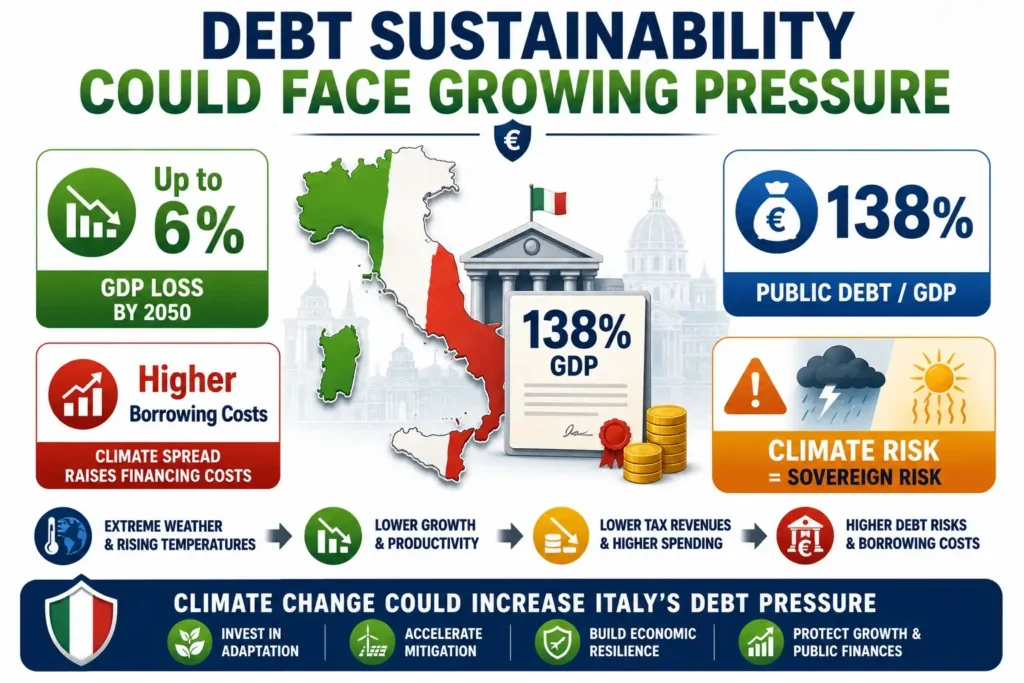
The research estimates that, without additional climate mitigation and adaptation measures, Italy’s gross domestic product (GDP) could be between 2.2% and 6.0% lower by 2050 compared with a scenario in which climate-related damage does not occur.
Even under a more optimistic economic growth scenario, the study projects GDP losses ranging between 1.6% and 4.2%, underscoring the long-term economic costs associated with climate change.
Climate Risk Extends Beyond Physical Damage
According to the researchers, climate change poses far greater risks than direct damage from extreme weather events.
The study argues that climate impacts also weaken government finances by reducing economic activity, shrinking tax revenues, increasing public spending pressures, and raising sovereign borrowing costs through what researchers describe as a “climate spread.”
Massimo Tavoni, Director of the European Institute on Economics and the Environment at CMCC and one of the study’s authors, said climate risks should increasingly be viewed as financial risks for governments.
“We find that climate risk is also a sovereign risk,” Tavoni said.
The report suggests that investors could begin demanding higher returns for lending to governments perceived as increasingly exposed to climate-related economic shocks.
Debt Sustainability Could Face Growing Pressure
Italy already carries one of the highest public debt burdens in Europe.
Public debt is expected to stand at approximately 138% of its gross domestic product this year, making the country particularly vulnerable to weaker economic growth and rising financing costs.
The researchers estimate that climate-related impacts could eventually double refinancing risks associated with Italy’s sovereign debt, although they note that the final outcome will depend heavily on future climate policies and adaptation investments.
Higher refinancing risks could make it more expensive for the government to issue new debt, placing additional pressure on public finances and limiting fiscal flexibility.
Southern Europe Faces Greater Climate Exposure
The study notes that climate impacts are expected to be uneven across Europe, with southern and eastern European nations projected to experience greater economic losses than many northern economies.
Italy has already experienced decades of relatively weak economic growth, consistently recording some of the lowest growth rates within the euro area.
Economists have long argued that this weak underlying growth leaves the country particularly exposed to external shocks that reduce tax revenues while increasing government spending and borrowing costs.
Climate change, the researchers warn, could further amplify these long-standing structural challenges.
Context is everything. Stay ahead of shifting trends with today’s market updates, and uncover emerging opportunities using the Serrari Group Market Index and Marketplace. Then, take control of your own financial future by exploring our Money & Life Reset Transformation Blueprint ™ to build stronger habits, create better systems, and design a path toward lasting wealth.
Heatwaves Highlight Rising Economic Costs
The report was released as much of Europe experiences another severe summer heatwave.
Temperatures across several countries have climbed well above seasonal averages, with recent extreme heat linked to thousands of deaths across the continent while disrupting economic activity, agriculture, transport, and energy systems.
These increasingly frequent climate events demonstrate that the economic impacts of climate change are no longer limited to future projections but are already affecting productivity, infrastructure, public health, and government finances.
The researchers argue that such events illustrate why adaptation investments are becoming increasingly important for protecting long-term economic resilience.
Researchers Call for Faster Climate Action
The authors emphasize that delaying climate action will significantly increase future economic costs.
Matteo Calcaterra, another author of the report, said prompt investment in climate mitigation and adaptation would help safeguard both Italy’s economic growth and fiscal stability.
“Delaying action means increasing the economic cost of global warming.”
He added that acting early would help protect the country’s long-term growth trajectory while improving the sustainability of its public finances.
The study concludes that stronger climate policies, combined with investments that improve resilience against extreme weather and accelerate emissions reductions, could significantly reduce future economic losses.
Outlook
The CMCC study reinforces the growing consensus that climate change has become not only an environmental challenge but also a major macroeconomic and financial risk. For countries with high debt levels such as Italy, weaker economic growth and rising borrowing costs could significantly increase fiscal pressures over the coming decades. As extreme weather events become more frequent across Europe, policymakers are expected to place greater emphasis on climate adaptation, resilience investments, and emissions reduction strategies to protect long-term economic stability and public finances.
FAQs
1. How much could climate change reduce Italy’s economy?
The CMCC study estimates Italy’s GDP could be between 2.2% and 6.0% lower by 2050 without additional climate mitigation and adaptation measures.
2. Why does climate change affect government debt?
Climate change can reduce economic activity and tax revenues while increasing public spending and borrowing costs, making public debt harder to manage.
3. What is meant by “climate spread”?
It refers to the higher borrowing costs governments may face as investors price in increased financial risks associated with climate change.
4. What solutions does the study recommend?
The researchers recommend accelerating climate mitigation, investing in adaptation measures, strengthening economic resilience, and implementing policies that reduce future climate-related financial risks.
Sources: Euronext Markets, U.S. News & World Report, Offshore Engineer Magazine, AOL
Your financial future isn’t something you wait for—it’s something you build.
The real question is: when do you begin?
Move beyond simply staying informed.
Navigate the markets with clarity—track trends through the Serrari Group Market Index, uncover opportunities in the Serrari Marketplace, and build practical knowledge with our Curated Wealth Builder Platform.
Stay connected to what truly matters.
Get daily insights on macro trends and financial movements across Kenya, Africa, and global markets—delivered through the Serrari Newsletter.
Growth opens doors.
Advance your career through professional programs including ACCA, HESI A2, ATI TEAS 7 , HESI EXIT , NCLEX – RN and NCLEX – PN, Financial Literacy!🌟—designed to move you forward with confidence.
See where money is flowing—clearly and in real time.
Track Money Market Funds, Treasury Bills, Treasury Bonds, Green Bonds, and Fixed Deposits, alongside global and African indexes, key economic indicators, and the evolving Crypto and stablecoin landscape—all within Serrari’s Market Index.