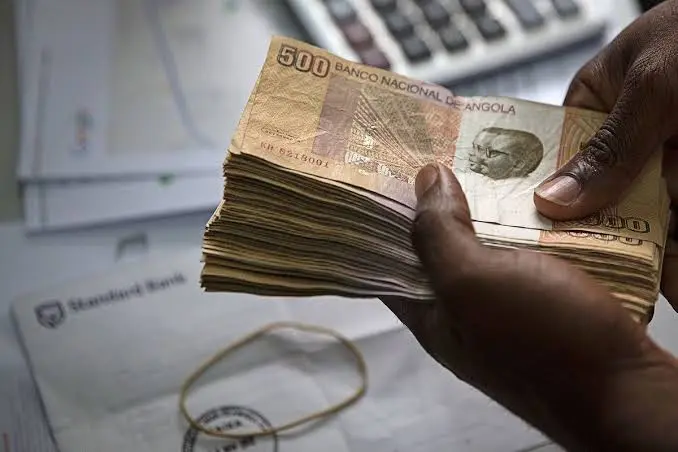
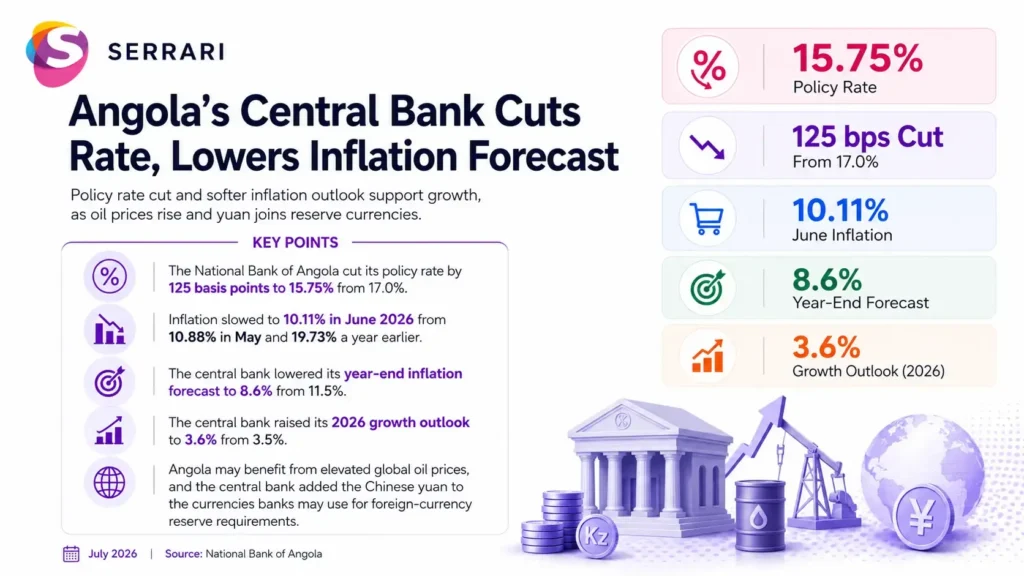
Angola’s central bank has cut its benchmark interest rate by 125 basis points to 15.75%, accelerating monetary easing as inflation continues to retreat from the elevated levels recorded a year earlier.
The decision follows a 50-basis-point reduction in May and reflects growing confidence that price pressures will continue moderating. Annual inflation declined to 10.11% in June 2026, down from 10.88% in May and 19.73% in June 2025.
The National Bank of Angola also lowered its year-end inflation forecast to 8.6% and marginally raised its 2026 economic growth projection to 3.6%.
Key Overview
- Angola reduced its benchmark interest rate by 125 basis points to 15.75%.
- The previous rate was 17%, following a 50-basis-point cut in May.
- Annual inflation slowed to 10.11% in June 2026.
- Inflation stood at 10.88% in May and 19.73% in June 2025.
- The year-end inflation forecast was lowered from 11.5% to 8.6%.
- The 2026 economic growth forecast was raised from 3.5% to 3.6%.
- Higher global oil prices could support export revenue, although geopolitical and currency risks remain.
Central Bank Accelerates Its Easing Cycle
The National Bank of Angola delivered a larger-than-previous rate reduction by cutting its policy rate from 17% to 15.75%.
The 125-basis-point move followed a 50-basis-point cut in May, when policymakers lowered the rate from 17.5% to 17%. The latest decision indicates that the central bank is becoming more comfortable supporting economic activity as inflation moves closer to single digits.
Governor Manuel Tiago Dias said the bank expected price growth to continue slowing in the near term despite an uncertain international environment. However, the pace of future easing will likely depend on inflation, exchange-rate movements, global commodity prices and domestic liquidity conditions.
Lower policy rates can gradually reduce borrowing costs for businesses and households, although the effect will depend on how quickly commercial banks adjust their lending rates.
Inflation Falls to Its Lowest Level in Years
Angola’s national consumer inflation rate declined to 10.11% in June, representing a reduction of 0.76 percentage points from May.
The June figure was also 9.62 percentage points below the rate recorded during the same month of 2025, demonstrating the scale of Angola’s disinflation over the past year.
In May 2026, annual inflation had stood at 10.88%, continuing a sustained downward trend supported by tighter monetary conditions and easing price pressures.
The central bank responded by lowering its expected year-end inflation rate to 8.6%, from its previous forecast of 11.5%. Reaching that projection would return Angola to single-digit inflation and provide additional room for monetary easing.
Nevertheless, households may continue experiencing pressure from food, transport and imported-goods prices even as the overall inflation rate declines.
Economic Growth Forecast Edges Higher
Alongside the rate reduction, the central bank raised its 2026 economic growth projection from 3.5% to 3.6%.
The relatively modest revision suggests that policymakers expect Angola’s economy to remain resilient but not accelerate dramatically. Growth continues to depend heavily on oil production, export earnings and government spending, despite efforts to expand agriculture, manufacturing, mining and services.
Lower interest rates could support non-oil activity by reducing financing costs and encouraging investment. However, Angola’s financial system must still contend with limited credit access, high borrowing costs and exposure to foreign-currency movements.
The rate cut therefore represents an attempt to balance price stability with the need to stimulate private-sector activity and broader economic diversification.
Context is everything. Stay ahead of shifting trends with today’s market updates, and uncover emerging opportunities using the Serrari Group Market Index and Marketplace. Then, take control of your own financial future by exploring our Money & Life Reset Transformation Blueprint ™ to build stronger habits, create better systems, and design a path toward lasting wealth.
Higher Oil Prices Offer Support and Risk
As a major oil exporter, Angola could benefit from elevated global energy prices through higher export earnings and stronger government revenue.
Improved oil receipts may support the kwanza, increase foreign-currency availability and strengthen the government’s fiscal position. These developments could reinforce the decline in inflation by reducing the cost of imported goods.
However, Angola’s dependence on petroleum also creates vulnerability. Any fall in oil prices, disruption to production or deterioration in global demand could weaken revenue and place renewed pressure on the currency.
The Middle East conflict adds further uncertainty. While supply disruptions may lift oil prices and benefit exporters, they can also increase global transport, food, fertiliser and insurance costs.
Yuan Added to Foreign Reserve Requirements
The rate decision follows another change in Angola’s monetary framework. The central bank recently added the Chinese yuan to the currencies commercial banks may use to meet foreign-currency reserve requirements.
The yuan joins the US dollar, euro and South African rand in the framework. The move reflects the importance of China to Angola as a trade, financing and investment partner.
Allowing banks to hold required reserves in yuan may improve settlement efficiency for transactions involving Chinese companies. It could also reduce reliance on a narrower group of foreign currencies within Angola’s banking system.
The change does not remove the dollar’s dominant role in Angola’s oil trade and financial system, but it demonstrates the gradual expansion of the yuan’s use in African markets.
Outlook Depends on Sustained Price Stability
Angola’s larger rate cut signals confidence that the country’s inflation surge is continuing to fade. The revised 8.6% year-end forecast strengthens the case for lower borrowing costs and a more supportive monetary-policy stance.
However, the outlook remains sensitive to oil prices, the kwanza, geopolitical tensions and imported inflation. A renewed currency decline or increase in global food and energy costs could slow the disinflation process.
For now, falling inflation and a slightly improved growth forecast have given the central bank room to support the economy. Sustaining that progress will require disciplined monetary management alongside continued efforts to reduce Angola’s dependence on oil.
Sources
Reuters / National Statistics Institute of Angola
Your financial future isn’t something you wait for—it’s something you build.
The real question is: when do you begin?
Move beyond simply staying informed.
Navigate the markets with clarity—track trends through the Serrari Group Market Index, uncover opportunities in the Serrari Marketplace, and build practical knowledge with our Curated Wealth Builder Platform.
Stay connected to what truly matters.
Get daily insights on macro trends and financial movements across Kenya, Africa, and global markets—delivered through the Serrari Newsletter.
Growth opens doors.
Advance your career through professional programs including ACCA, HESI A2, ATI TEAS 7 , HESI EXIT , NCLEX – RN and NCLEX – PN, Financial Literacy!🌟—designed to move you forward with confidence.
See where money is flowing—clearly and in real time.
Track Money Market Funds, Treasury Bills, Treasury Bonds, Green Bonds, and Fixed Deposits, alongside global and African indexes, key economic indicators, and the evolving Crypto and stablecoin landscape—all within Serrari’s Market Index.