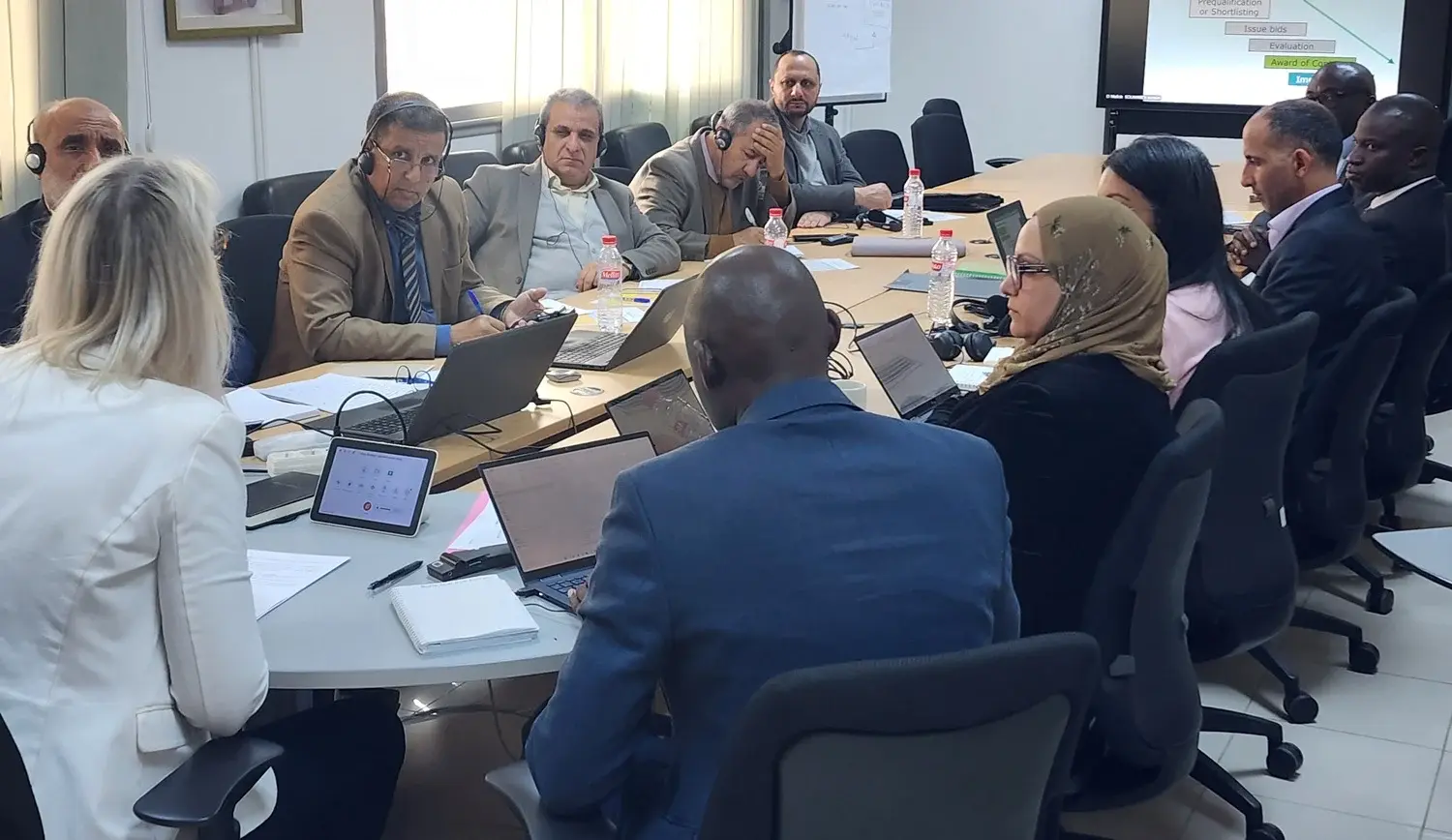
The African Development Bank (AfDB) and Libya’s Ministry of Transportation have wrapped up a three-day workshop in Tunis designed to chart a concrete roadmap for implementing a strategic transport-sector study that officials hope will anchor Libya’s broader economic recovery. Held from 15 to 17 April 2026 at the Bank’s North Africa regional office, the meeting brought together Bank experts, Libya’s finance and transport ministries, the executing agency and the project implementation unit to hash out delivery arrangements. The study itself — financed through a $340,000 grant from the AfDB’s Middle-Income Country Technical Assistance Fund (MIC-TAF) and topped up by counterpart funding from the Libyan government — is meant to produce a full situational diagnosis of Libya’s roads, ports, rail, aviation and logistics sectors, a prioritised action plan, policy and institutional reform proposals, a private-sector participation strategy and a bankable pipeline of future projects. The initiative sits squarely inside the AfDB’s new 2025–2028 country strategy for Libya, which it approved in December 2025 and which identifies transport as one of the central levers for moving the country beyond its oil-dependent, conflict-scarred status quo.
Key Overview
- The AfDB and Libya’s Ministry of Transportation concluded a three-day workshop in Tunis (15–17 April 2026) to define implementation arrangements for a strategic transport-sector study.
- The study is financed by a $340,000 MIC-TAF grant from the AfDB, supplemented by counterpart funding from the Libyan government.
- The study will produce a situational and gap analysis, a prioritised short- to medium-term action plan, policy and institutional reform recommendations, a private-sector participation strategy and indicative financing options.
- Outputs are intended to identify bankable projects and build a stronger pipeline for future AfDB engagement in Libya’s transport and logistics infrastructure.
- Reports will be produced in Arabic, English and French to secure broad ownership across Libyan institutions and development partners.
- The Libyan delegation was led by Issam Abdallah Al-Qouri, Chair of the Preparatory Committee at the Ports and Maritime Transport Authority, alongside officials from the Land Transport Authority and the Roads and Bridges Implementation Authority.
- The project is aligned with the Bank’s Ten-Year Strategy and its newly approved 2025–2028 country strategy for Libya, which prioritises reconstruction and economic diversification.
Markets move fast; don’t get left behind. We’ve paired the Serrari Group Market Index with a curated Marketplace and a comprehensive Wealth Builder Platform to ensure you have the data—and the skills—to act on it.
A $340,000 Bet on a Roadmap
The African Development Bank and Libya’s Ministry of Transportation have turned a three-day working session at the Bank’s North Africa regional office in Tunis into the launch pad for one of Libya’s more consequential recent development exercises — a full strategic review of the country’s transport sector, underwritten by a targeted technical-assistance grant.
The workshop, held from 15 to 17 April 2026, brought together Bank experts and representatives from Libya’s ministries of finance and transportation, the executing agency and the dedicated project implementation unit. Discussions, according to the AfDB’s own readout, focused squarely on implementation arrangements and the way forward — the unglamorous but decisive plumbing work that determines whether a strategic study ends up on a shelf or in procurement documents.
The study is being financed through a $340,000 grant from the Bank’s Middle-Income Country Technical Assistance Fund — known as MIC-TAF — plus counterpart funding from the Libyan government. The MIC-TAF itself is a relatively modest instrument by AfDB standards but one the Bank has repeatedly defended as disproportionately high-leverage: an independent evaluation cited on the Bank’s own information page found that every $1.38 of MIC-TAF deployed has, on average, catalysed $20 in subsequent AfDB investment, generating $2.1 billion of Bank-financed projects between 2002 and 2018. That is the logic Libya is now banking on.
What the Study Will Actually Produce
The strategic study will produce several interlocking outputs, each designed to address a specific weakness in how Libya currently plans and invests in transport infrastructure.
It will start with a situational and gap analysis — essentially a diagnostic of what Libya has, what it needs and where the biggest distances between the two lie. It will then sketch a strategic plan with prioritised short- to medium-term actions, plus recommendations for policy and institutional reform, areas where Libya’s transport system has been repeatedly flagged as fragmented across competing authorities and eastern and western administrations.
Beyond that, the study will set out an action plan to strengthen private-sector participation — long treated in Libya as an aspiration rather than a live operating model — and indicative financing options for future investments. Crucially, the AfDB has also designed the work to help identify bankable public and private sector projects and, in doing so, build a stronger pipeline for future Bank engagement in transport and logistics infrastructure.
To make sure that pipeline is actually usable by Libyan counterparts, the AfDB has committed to producing key reports in Arabic, English and French, a trilingual approach intended to support broad ownership across both Libyan institutions and development partners.
Malinne Blomberg, the AfDB’s Deputy Director General for North Africa and Country Manager for Libya, framed the stakes in human rather than purely economic terms. “An efficient and integrated transport system connects people to opportunities, facilitates trade, and enhances quality of life,” she said. Blomberg has overseen the Bank’s Libya portfolio alongside her regional role since being named Country Manager for Tunisia in October 2023, adding that role to her prior responsibilities for Libya and Mauritania.
Who’s at the Table
The Libyan side of the workshop was led by Issam Abdallah Al-Qouri, Chair of the Preparatory Committee at the Ports and Maritime Transport Authority, and the delegation included representatives of the Land Transport Authority, the Roads and Bridges Implementation Authority and the Ministry of Transportation headquarters.
That composition is revealing. Libya’s transport administration is spread across a constellation of authorities covering roads, ports and land transport, and a strategic review with credibility needs all of them in the room, not just the ministry at the top. The involvement of Libya’s Ministry of Finance alongside the Ministry of Transportation also signals that the study is intended to feed directly into budget and investment decisions rather than remain a pure technical document.
Context is everything. While you follow today’s updates, use the Serrari Group Market Index and Marketplace to spot emerging shifts. Need to sharpen your edge? Our Wealth Builder Platform turns these insights into a professional-grade strategy.
The Bigger Picture: A Transport System Shaped by Conflict
The political and economic backdrop to the study explains why even a $340,000 workshop matters. Libya’s transport system has been systematically neglected, damaged or left incomplete by more than a decade of conflict and institutional fragmentation. Roads that once linked desert towns have been narrowed to single lanes or faded into rough tracks, while airports and ports are either outdated or bearing the physical scars of war. For businesses, this drives up costs and delays; for citizens, it deepens isolation and unequal access to services, particularly in the south.
The problem compounds itself: derelict transport connections make it harder to mobilise private capital, which in turn means less investment flowing into upgrades, and so on.
There are green shoots. The Maritime Executive has reported that a $2 billion road project linking Sirte port with southern cities including Sabha and Sokna is part of Libya’s Vision 2030, a framework aimed at boosting north-south connectivity and extending corridors to landlocked neighbours. A range of road and airport rehabilitation projects led by the Eastern Libyan Government’s Reconstruction and Stabilization Committee is already underway, including a new Benghazi airport with 12 gates, a free zone and air-cargo infrastructure. In parallel, a Chinese consortium, BFI, has partnered with Tripoli-based Libyan Railroads on a new railway development in eastern Libya, and plans for a $4.5 billion, 554-kilometre Sirte–Benghazi rail project linking the two Mediterranean port cities have been revived.
Libya’s ports are going through their own parallel revival. Libya Economic Review has documented how port expansion at Benghazi is back in motion after years of conflict-induced shutdown, with the Tarros/Messina LEX shipping service now including Benghazi and the Port of Antwerp consulting on modernising Misrata. But the same analysis flags how piecemeal the sector remains — a constellation of bilateral partnerships without a unifying national plan, which is precisely the gap the AfDB study is designed to fill.
A Sector Tied to a Still-Oil-Dependent Economy
The transport push matters in part because Libya’s macro story is unusually lopsided. The World Bank’s most recent Libya Economic Monitor projected GDP growth of 9.6 percent in 2025 and 8.4 percent in 2026 assuming oil output recovers toward 1.3 million barrels per day, while simultaneously warning that non-oil GDP would grow at a much more modest pace. The IMF’s 2025 Article IV concluding statement likewise projected a rebound in real GDP driven by an expansion of oil production before moderating to around 2 percent over the medium term, noting that risks remain tilted to the downside from domestic political instability.
The AfDB’s own Libya Economic Outlook presents a slightly different but directionally similar picture: growth of 6.9 percent in 2025 and 2.9 percent in 2026, with a fiscal surplus projected at 5.2 percent of GDP in 2025 moderating to 4.1 percent in 2026. Behind the positive headline number lies a structurally vulnerable economy: hydrocarbons still account for the overwhelming bulk of government revenue and exports, the banking sector remains saddled with a high nonperforming loan ratio, and the country still counts more than 800,000 people in need of humanitarian assistance.
That is precisely why a credible, bankable transport pipeline matters. An efficient logistics and connectivity backbone is a precondition for the kind of non-oil private-sector activity — agribusiness, light manufacturing, tourism, services — that Libya’s macro forecasts implicitly assume but that the country’s shaky infrastructure currently struggles to support.
Where This Fits in the AfDB’s Libya Strategy
The transport study is not a one-off intervention. It is an early operational expression of the AfDB’s 2025–2028 country strategy for Libya, approved by the Bank’s Board of Directors in December 2025 and designed to prioritise Libya’s recovery and long-term economic transformation.
That strategy explicitly names water and security, agriculture and food systems, transport, renewable energy, and value-chain development in non-oil sectors as the priority areas where the Bank intends to concentrate its resources. It also flags public financial management, economic and financial governance, and the investment climate as cross-cutting reform priorities, recognising that without institutional repair, even the best-designed infrastructure study will struggle to get projects into implementation.
The Bank followed the strategy in the same month with a Country Focus Report for Libya titled “Making Libya’s Capital Work Better for its Development,” which analysed medium-term macro trends and the country’s options for mobilising domestic capital through innovative financing instruments.
The transport study can be read as a natural next step: turning the broad strategic direction into sector-specific, priced-up proposals that ministries and the Bank’s Board can act on. It builds on earlier engagements, including a November 2024 grant agreement with the Libyan government to strengthen public financial management through the Fund for African Private Sector Assistance (FAPA).
What to Watch Next
With implementation arrangements now agreed in Tunis, the question becomes how quickly the diagnostic and planning work can translate into specific projects. Three things will determine whether this $340,000 exercise punches above its weight. First, institutional follow-through: whether Libya’s Ports and Maritime Transport Authority, the Land Transport Authority and the Roads and Bridges Implementation Authority can remain jointly engaged through the life of the study and then into implementation. Second, political continuity: Libya’s divided governance structure has repeatedly stalled infrastructure programmes in the past, and maintaining coherence across competing authorities will be a persistent challenge. Third, and most importantly, financing: the study’s value ultimately hinges on whether the bankable project pipeline it produces can attract substantive follow-on capital, whether from the AfDB’s own balance sheet, other multilateral partners or private investors.
On the last point, the MIC-TAF’s track record offers grounds for optimism but not guarantees. The Fund’s historical leverage ratios have been impressive, but those averages hide enormous variance country by country. Libya, with its unique blend of hydrocarbon wealth, fragile institutions and reconstruction needs, is very different from the other Middle-Income Countries where MIC-TAF has delivered.
What is clear, however, is that the AfDB sees transport as one of the most tractable entry points into Libya’s reconstruction story. Roads, ports and logistics are easier to finance and deliver than, say, constitutional reform or judicial overhaul, and they produce visible, measurable outcomes that can build the political capital needed for deeper reforms. In that sense, the Tunis workshop was less a technical meeting than a quiet test run for a much bigger question: whether a country still defined by oil and conflict can be helped, piece by infrastructural piece, back into the wider global economy.
Your financial future isn’t something you wait for—it’s something you build.
The real question is: when do you begin?
Move beyond simply staying informed.
Navigate the markets with clarity—track trends through the Serrari Group Market Index, uncover opportunities in the Serrari Marketplace, and build practical knowledge with our Curated Wealth Builder Platform.
Stay connected to what truly matters.
Get daily insights on macro trends and financial movements across Kenya, Africa, and global markets—delivered through the Serrari Newsletter.
Growth opens doors.
Advance your career through professional programs including ACCA, HESI A2, ATI TEAS 7 , HESI EXIT , NCLEX – RN and NCLEX – PN, Financial Literacy!🌟—designed to move you forward with confidence.
See where money is flowing—clearly and in real time.
Track Money Market Funds, Treasury Bills, Treasury Bonds, Green Bonds, and Fixed Deposits, alongside global and African indexes, key economic indicators, and the evolving Crypto and stablecoin landscape—all within Serrari’s Market Index.