The United Kingdom and European Union have concluded an agreement to link their respective emissions trading systems (ETS), with implementation targeted for 1 January 2028. The arrangement will allow companies covered by either scheme to use emissions allowances issued in the UK or EU to meet compliance obligations across both markets. It is expected to create a larger carbon market, improve trading liquidity and reduce carbon-related trade barriers. The agreement also expands the UK’s carbon pricing coverage for maritime emissions and could pave the way for reciprocal exemptions from the two markets’ Carbon Border Adjustment Mechanisms (CBAMs).
Key Takeaways
- The UK and EU are targeting 1 January 2028 for linking their emissions trading systems, subject to legislative and ratification procedures.
- Allowances issued in either market will be accepted for compliance across both systems, giving companies access to a larger carbon market.
- The UK government estimates that linking the schemes could add up to £3.8 billion to the UK economy annually by 2040.
- The agreement could reduce carbon-related trade barriers and pave the way for exemptions from the EU and UK Carbon Border Adjustment Mechanisms.
- From 2028, the UK ETS will expand to cover 50% of emissions from international voyages between UK ports and ports outside the UK.
- Shipping companies will face closer alignment of monitoring, reporting, verification and compliance requirements.
UK and EU Move to Reconnect Carbon Markets After Brexit
The European Commission and UK government have agreed to link their emissions trading systems, reuniting carbon markets that have operated separately since Brexit.
Announced at the 20 November 2026 summit in Brussels, the agreement aims to remove a major barrier to trade in goods subject to carbon pricing and import taxes while creating a larger, more liquid carbon market.
The two parties are targeting 1 January 2028 for the link to become operational. Once implemented, ETS allowances issued in either the UK or EU can be used for compliance across either scheme. This means companies in one jurisdiction will be able to purchase allowances in the other jurisdiction’s ETS to meet obligations under their home system.
Both systems operate on a cap-and-trade basis. Companies covered by the schemes must hold allowances for each tonne of greenhouse gas emissions they produce. The systems put a price on emissions, creating a financial incentive for businesses to reduce pollution and invest in lower-carbon technologies.
The EU ETS was established in 2005 and covers emissions-intensive sectors including electricity and heat generation, oil refineries, steel, cement, paper, chemicals and commercial aviation.
Following Brexit, the UK launched its own Emissions Trading Scheme in 2021 to replace its participation in the EU system. The two markets have therefore operated separately, with their own carbon allowances and compliance arrangements.
The agreement is intended to reconnect the systems and allow businesses covered by either scheme to access allowances across both markets.
European Commission President Ursula von der Leyen said:
“The agreement will cut emissions and generate investment in cleaner industries. This will help us advance our shared climate goals.”
A Larger Carbon Market Could Improve Liquidity and Price Stability
One of the main expected benefits of linking the systems is the creation of a larger carbon market.
Under the current arrangements, companies operating under the UK and EU schemes meet their emissions obligations through separate markets. Linking them would allow participants to use allowances issued in either jurisdiction, potentially increasing the number of buyers and sellers participating in the combined market.
The anticipated benefits include a larger carbon market, price stability, reduced trade barriers, lower administrative costs and greater incentives for industrial investment.
The UK Government estimates that linking the systems could add up to £3.8bln to the UK economy annually by 2040.
Energy-intensive industries, including cement, steel and aluminium manufacturing, could benefit from the arrangement. These businesses face significant costs associated with their carbon emissions, making carbon pricing an important part of their operating expenses.
A carbon price also changes the financial case for investment. When companies have to pay for emissions, investments in lower-carbon production technologies can become more financially viable.
Access to a larger carbon market could potentially increase trading liquidity and improve carbon pricing security for manufacturers. However, the actual benefits will depend on how the linked systems operate, the level of market participation and future carbon prices.
Carbon Border Taxes and the Cost of Cross-Border Trade
The agreement also addresses the relationship between the two emissions trading systems and their respective Carbon Border Adjustment Mechanisms.
The EU introduced its Carbon Border Adjustment Mechanism (CBAM) to address carbon leakage. This occurs when companies move production of emissions-intensive goods to countries with less stringent environmental and climate policies, potentially undermining domestic emissions-reduction efforts.
CBAM is designed to equalise the carbon price paid on certain imported goods with the cost faced by comparable products produced within the EU under its emissions trading system.
The UK has also announced plans to introduce its own CBAM in 2027.
The UK–EU agreement paves the way for reciprocal exemptions from the two Carbon Border Adjustment Mechanisms. The European Commission said the UK would need to be added to the EU’s list of exempt countries once the link enters into force, while a corresponding exemption is expected under the UK regime.
The UK government said the agreement could create the conditions for an exemption for UK companies from the EU CBAM for £6.5 billion worth of exports.
For businesses trading goods such as cement, steel and other emissions-intensive products between the two markets, the possibility of exemptions could reduce additional carbon-related costs and administrative requirements.
However, the exemptions are not yet operational. The agreement provides for a possible future mutual exemption, and the precise timing and implementation arrangements remain important questions for companies preparing for the new rules.
Context is everything. Stay ahead of shifting trends with today’s market updates, and uncover emerging opportunities using the Serrari Group Market Index and Marketplace. Then, take control of your own financial future by exploring our Money & Life Reset Transformation Blueprint ™ to build stronger habits, create better systems, and design a path toward lasting wealth.
Cement and Clinker Traders Face an Interim Period Before 2028
Despite the longer-term prospect of a linked carbon market, businesses will still need to manage the transition period before the agreement takes effect.
The UK CBAM is due to start on 1 January 2027, a year before the target date for linking the UK and EU emissions trading systems.
For cement and clinker traders, this creates an immediate question: how will shipments be treated during the period between the introduction of the UK CBAM and the planned implementation of the ETS link?
The summit announcement did not specify when the exemptions would take effect or how shipments made before the link becomes operational would be treated.
This matters because companies involved in cross-border trade may still face carbon-related obligations during the interim period. Businesses will need clarity on whether goods moving between the UK and EU before 2028 qualify for any transitional arrangements or remain subject to the applicable CBAM requirements.
The agreement therefore offers a longer-term direction for trade between the two markets, but it does not remove every immediate compliance uncertainty.
UK Expands Carbon Pricing to International Shipping
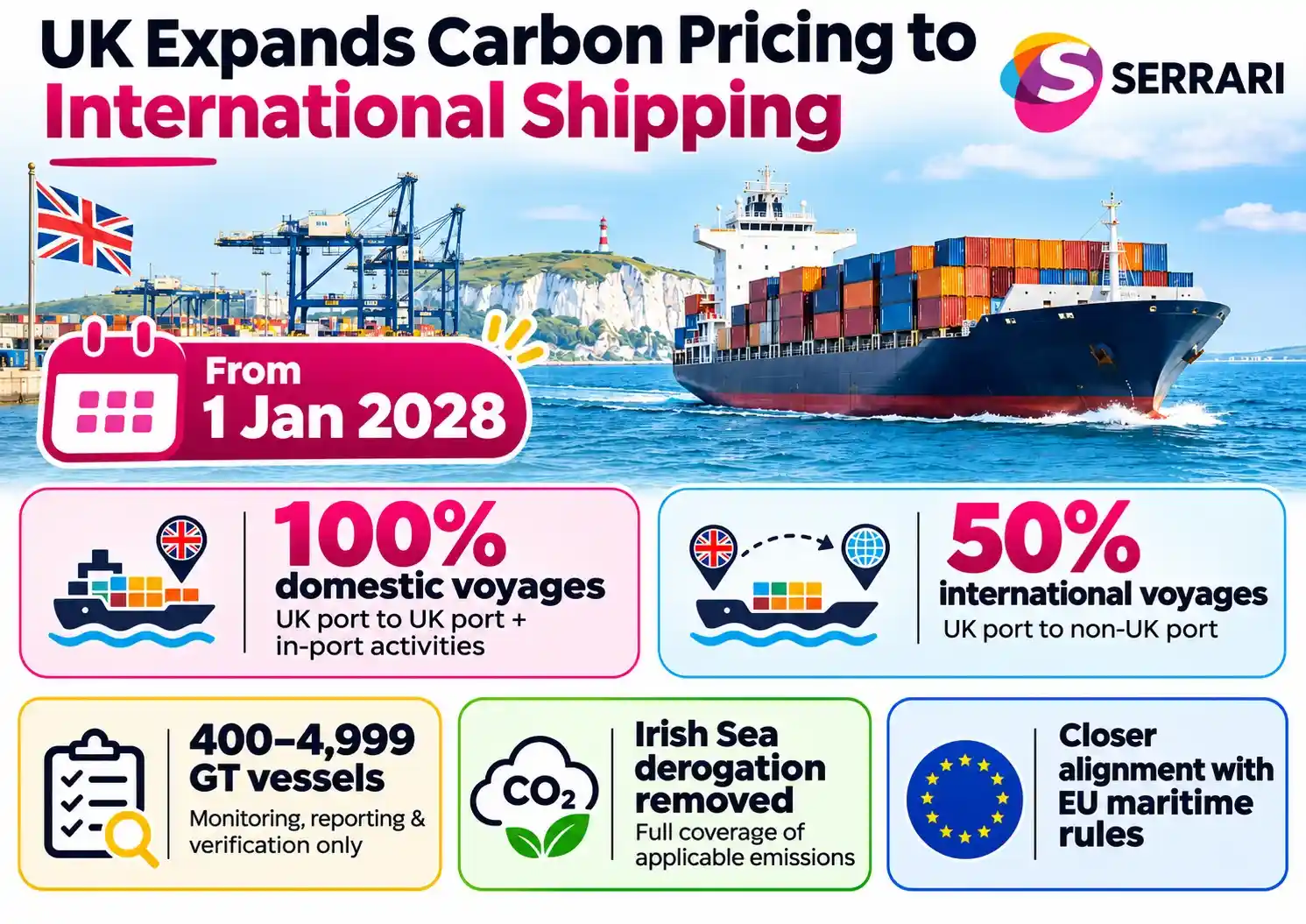
Beyond trade and industrial emissions, the agreement introduces significant changes to the maritime scope of the UK ETS.
The UK government has agreed to expand its emissions trading scheme to cover additional maritime activities and align its rules more closely with the EU ETS.
Since 1 July 2026, the UK ETS has covered emissions from domestic voyages and in-port activities involving ships of 5,000 gross tonnage (GT) and above, subject to limited exemptions.
From 1 January 2028, the following provisions will apply:
- Domestic voyages: The UK ETS will continue covering 100% of emissions from voyages between UK ports and in-port activities.
- International voyages: The scheme will expand to cover 50% of emissions from voyages between UK ports and ports outside the UK.
- Smaller vessels: Offshore and general cargo vessels between 400 and 4,999 GT will face monitoring, reporting and verification requirements, without an obligation to surrender allowances.
- Irish Sea operations: The temporary 50% surrender derogation for voyages between Great Britain and Northern Ireland will be removed, resulting in full coverage of applicable emissions.
The agreement also provides for certain exemptions and temporary derogations, including provisions for eligible island ferry services and ice-class ships.
The expansion means shipping companies operating across UK waters and international routes will need to account for additional emissions under the UK carbon pricing framework.
The wider agreement also provides for the inclusion of additional maritime and aviation emissions in the system, with the UK committing to expand coverage in line with the EU ETS. The first article estimates that this will result in an additional 10 million tonnes of CO2 emissions included in the system.
Shipping Companies Face Closer Compliance Requirements
Linking the carbon markets will also bring greater alignment between UK and EU maritime emissions rules.
The UK ETS will align with EU ETS maritime requirements covering emissions monitoring, reporting, verification and other operational procedures.
Shipping companies will continue reporting through the UK’s Managing Your UK ETS Service (METS). However, the agreement introduces additional requirements, including:
- Ship-level monitoring plans.
- Verified emissions reports.
- UK Documents of Compliance that must be carried on board when visiting UK ports.
- A mandate document signed by both the shipowner and the ISM company where the latter assumes ETS obligations on behalf of the shipowner.
The agreement also provides for enforcement measures in cases of non-compliance, including the detention and expulsion of ships.
For shipping operators, these requirements mean that carbon compliance will involve more than purchasing and surrendering emissions allowances. Companies will also need to maintain the required documentation, monitor emissions accurately and ensure that responsibilities between shipowners and ISM companies are properly recorded.
The UK and EU will also cooperate on developing a one-stop-shop approach to simplify administrative processes for shipping companies operating under both schemes.
How the Agreement Fits Into Global Shipping Decarbonisation
The agreement comes as the UK continues to support international efforts to reduce emissions from shipping through the International Maritime Organization (IMO).
The UK government has reaffirmed its support for international decarbonisation measures and said that, should a global emissions reduction measure be adopted at the IMO, it intends to review how that measure interacts with UK carbon pricing requirements.
The objective is to avoid double charging and minimize administrative burdens for shipping companies.
This interaction will matter as maritime operators increasingly face emissions-related requirements across different jurisdictions. Companies operating internationally may have to manage overlapping carbon pricing and reporting obligations, making coordination between regional and global frameworks important.
The UK–EU agreement is therefore not only about connecting two carbon markets. It also represents a step towards closer alignment of emissions regulations affecting international shipping.
The Bigger Picture: Carbon Markets Are Becoming More Connected to Trade and Industry
The agreement reflects the growing role of carbon pricing in industrial competitiveness and international trade.
Emissions trading systems place a financial cost on greenhouse gas emissions, encouraging companies to reduce their carbon footprint. However, differences between carbon pricing systems can create additional costs and administrative challenges for businesses operating across borders.
By linking their systems, the UK and EU aim to reduce some of those differences while allowing businesses to access a wider market for emissions allowances.
The potential CBAM exemptions are also significant because carbon pricing is increasingly connected to the cost of importing and exporting emissions-intensive goods.
For manufacturers, the combined effect of carbon pricing, border adjustment measures and investment in cleaner production technologies could influence where products are manufactured, how supply chains are organised and which markets businesses choose to serve.
The maritime provisions extend this regulatory alignment beyond manufacturing. Shipping companies will have to consider carbon pricing alongside their operational costs, reporting responsibilities and international compliance obligations.
However, the agreement’s benefits will depend on its implementation. A larger market does not automatically guarantee lower carbon prices, and the expected economic gains remain government estimates rather than confirmed outcomes.
Why Does This Matter Now?
The timing is important because the UK CBAM is scheduled to begin on 1 January 2027, while the ETS link is targeted for January 2028.
That leaves businesses with an interim period in which carbon-related trade requirements may apply before the two markets are connected. Cement and clinker traders, in particular, need clarity on how shipments will be treated and when any CBAM exemptions will take effect.
For energy-intensive manufacturers, the agreement could eventually provide access to a larger carbon market and reduce some cross-border compliance barriers. For shipping companies, the expanded UK ETS coverage from 2028 means preparations for emissions monitoring, reporting and allowance obligations will become increasingly important.
The agreement also matters for investment decisions. Greater alignment between the UK and EU carbon markets could improve the conditions for companies considering investments in lower-carbon technologies, although the extent of that benefit will depend on future carbon prices and regulatory implementation.
Outlook
The UK and EU are targeting 1 January 2028 to bring the linked emissions trading systems into operation. Before then, the agreement remains subject to the necessary legislative and ratification procedures, as well as changes to both systems’ registries.
Businesses will be watching for further details on how allowances will be recognised across the two markets, how the CBAM exemptions will work and how shipments will be treated during the transition period.
Shipping companies will also need to prepare for the expanded maritime coverage and closer alignment of monitoring, reporting and verification requirements.
The agreement could create a more connected carbon market and reduce some of the barriers created by separate emissions trading systems. However, its practical impact will depend on the final implementation arrangements, the timing of exemptions and how businesses adapt to the new compliance requirements.
Frequently Asked Questions
1. When will the UK and EU link their emissions trading systems?
The UK and EU are targeting 1 January 2028 for the link to become operational, subject to legislative and ratification procedures.
2. What does linking the UK and EU ETS mean for businesses?
Companies covered by either system will be able to use emissions allowances issued in the UK or EU to meet compliance obligations across both markets. This could improve access to allowances, increase market liquidity and reduce some administrative and trade barriers.
3. Will the agreement remove the UK and EU Carbon Border Adjustment Mechanisms?
No. The agreement paves the way for possible reciprocal exemptions from the two CBAMs for eligible goods traded between the markets. The timing and implementation of these exemptions have not yet been fully specified.
4. How will the agreement affect shipping companies?
From January 2028, the UK ETS will cover 50% of emissions from international voyages between UK ports and ports outside the UK, alongside existing domestic coverage. Shipping companies will also face aligned monitoring, reporting, verification and documentation requirements.
Your financial future isn’t something you wait for—it’s something you build.
The real question is: when do you begin?
Move beyond simply staying informed.
Navigate the markets with clarity—track trends through the Serrari Group Market Index, uncover opportunities in the Serrari Marketplace, and build practical knowledge with our Curated Wealth Builder Platform.
Stay connected to what truly matters.
Get daily insights on macro trends and financial movements across Kenya, Africa, and global markets—delivered through the Serrari Newsletter.
Growth opens doors.
Advance your career through professional programs including ACCA, HESI A2, ATI TEAS 7 , HESI EXIT , NCLEX – RN and NCLEX – PN, Financial Literacy!🌟—designed to move you forward with confidence.
See where money is flowing—clearly and in real time.
Track Money Market Funds, Treasury Bills, Treasury Bonds, Green Bonds, and Fixed Deposits, alongside global and African indexes, key economic indicators, and the evolving Crypto and stablecoin landscape—all within Serrari’s Market Index.