Bangladesh and the United Kingdom have discussed expanding climate investment and clean energy cooperation following high-level engagements at the COP31 climate summit. During a meeting in Dhaka on 23 November 2026, British High Commissioner Sarah Cooke briefed State Minister for Foreign Affairs Shama Obaed Islam on the UK’s inaugural £400 million contribution to a new Climate Investment Funds mechanism aimed at boosting private investment in clean energy. The discussions also covered early warning systems, climate-induced displacement, the effects of climate change on women and children, and promoting natural fibres such as jute. The meeting further addressed the Rohingya crisis, trade, investment and cultural cooperation.
Key Takeaways
- The UK has announced an inaugural £400 million contribution to a new Climate Investment Funds mechanism aimed at mobilising private investment in clean energy.
- Bangladesh is a priority country under the mechanism, with both governments discussing ways to attract additional climate investment.
- Climate cooperation will also focus on early warning systems, climate-induced displacement and the effects of climate change on women and children.
- Both countries discussed promoting eco-friendly natural fibres, including jute, as part of wider cooperation.
- The meeting also addressed the Rohingya crisis, with Bangladesh urging the UK to intensify international pressure for implementation of the recent ICJ judgment concerning Myanmar.
- Trade, investment, women’s empowerment and cultural exchanges were also part of the discussions.
Bangladesh and UK Seek to Expand Climate Investment Following COP31
Bangladesh and the United Kingdom have discussed ways to attract more climate investment to Bangladesh and strengthen cooperation on clean energy following high-level engagements at the COP31 climate summit.
The discussions took place on 23 November 2026, when British High Commissioner Sarah Cooke paid a courtesy call on State Minister for Foreign Affairs Shama Obaed Islam at Bangladesh’s Ministry of Foreign Affairs in Dhaka.
During the meeting, Cooke briefed the state minister on the UK’s inaugural contribution of £400 million to a new mechanism under the Climate Investment Funds (CIF). The mechanism aims to boost private investment in clean energy.
The discussions focused on how Bangladesh could attract more climate investment through the initiative, with the country identified as a priority under the mechanism.
The two sides also reviewed high-level contacts at COP31 and discussed how to turn them into concrete cooperation.
The UK contribution is intended to support a mechanism that encourages private-sector investment in clean energy. For Bangladesh, attracting more climate finance could help strengthen its ability to pursue clean energy development and respond to climate-related challenges.
However, the meeting did not announce specific projects, investment commitments for Bangladesh or a timeline for the allocation of funding to the country.
Climate Cooperation Extends to Early Warning Systems and Displacement
Beyond clean energy investment, Bangladesh and the UK discussed several areas of climate cooperation, including early warning systems, climate-induced displacement and the effects of climate change on women and children.
Early warning systems are an important area of climate resilience because they help communities prepare for potential hazards and respond to extreme weather events. Cooperation in this area could support efforts to improve preparedness and reduce the effects of climate-related emergencies.
The discussions also covered climate displacement, reflecting concerns about people forced to leave their homes because of environmental and climate-related pressures.
Women and children were another focus of the meeting. The two sides discussed the impact of climate change on these groups, recognising the need to consider their experiences and vulnerabilities when developing climate-related responses.
The discussions also included the promotion of eco-friendly natural fibres such as jute.
Jute is an important natural fibre in Bangladesh, and its promotion could support cooperation around sustainable materials and the country’s natural fibre sector. However, the sources did not identify specific programmes, funding allocations or targets for expanding jute production or trade.
What the £400 Million Climate Investment Funds Contribution Means
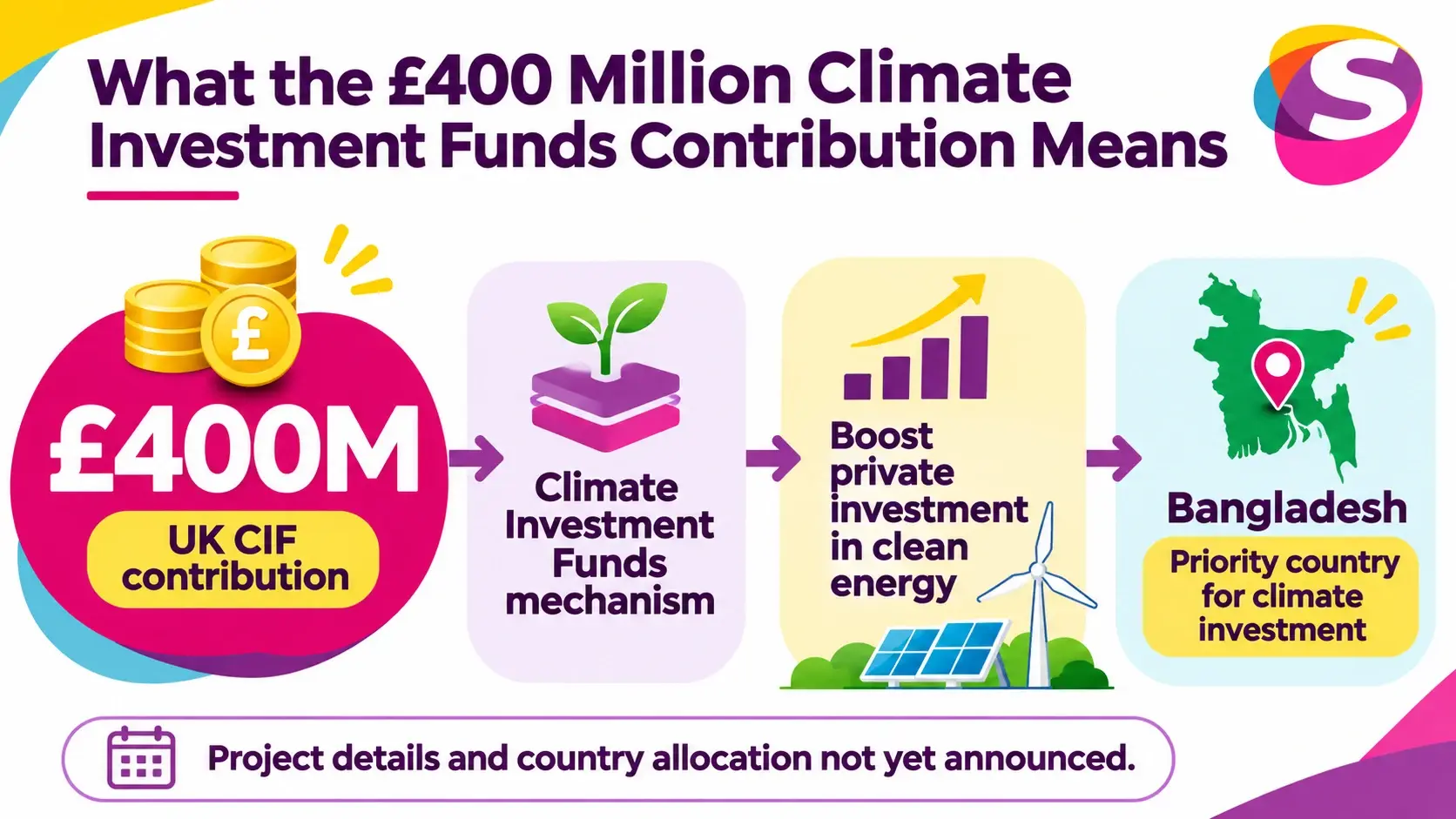
The UK’s £400 million contribution is directed towards a new mechanism under the Climate Investment Funds, with the stated objective of boosting private investment in clean energy.
The emphasis on private investment is significant because the mechanism is designed to mobilise capital beyond direct government funding. Attracting private-sector participation can help support clean energy investment, although the sources do not specify the financial structure, eligible projects or expected investment multiplier associated with the contribution.
Bangladesh’s status as a priority country under the mechanism places it within the initiative’s focus for attracting climate investment.
The discussions between Cooke and Shama Obaed therefore centred not only on the UK’s contribution but also on how Bangladesh could attract more investment through the mechanism.
For Bangladesh, the next important step will be translating the discussions into concrete cooperation and identifying opportunities that can attract investment into clean energy and climate resilience.
The meeting itself, however, did not confirm how much of the £400 million would be allocated to Bangladesh or when individual projects would receive funding.
Rohingya Crisis Also Features in Bangladesh–UK Discussions
Alongside climate investment, the meeting addressed the Rohingya crisis and the international response to the situation in Myanmar.
Shama Obaed welcomed the recent International Court of Justice judgment in the case brought by The Gambia against Myanmar, which the Bangladesh Foreign Ministry said found Myanmar responsible for committing genocide against the Rohingya.
She thanked the UK for its continued support for the Rohingya community and urged London to help intensify international pressure on Myanmar to implement the judgment.
The state minister also acknowledged Sophie, the Duchess of Edinburgh, for her advocacy on behalf of the Rohingya, including her recent visit to refugee camps in Cox’s Bazar.
Cooke assured the state minister of the UK’s continued cooperation in supporting the safe, voluntary, dignified and sustainable repatriation of Rohingya refugees to Myanmar.
The Rohingya issue remains a significant part of Bangladesh’s diplomatic engagement with international partners, particularly as the country seeks support for a sustainable solution that would allow refugees to return safely and voluntarily.
The meeting did not announce a new repatriation agreement or a timetable for returns. Instead, the discussions reaffirmed the UK’s continued cooperation and Bangladesh’s call for stronger international pressure surrounding implementation of the ICJ judgment.
Trade, Investment and Cultural Cooperation
The discussions also covered broader areas of Bangladesh–UK relations, including trade and investment, the creative economy, cultural exchanges, parliamentary diplomacy, women’s empowerment and people-to-people ties.
Shama Obaed, referring to her recent visit to the UK, expressed interest in exploring cooperation with the Ashmolean Museum in Oxford to promote Bangladeshi art, culture and heritage.
The proposed collaboration could create opportunities for cultural exchanges and greater international exposure for Bangladesh’s artistic and historical heritage. However, the meeting did not confirm a formal partnership or specific programme involving the museum.
Both sides reaffirmed their commitment to strengthening Bangladesh–UK relations and expanding cooperation on regional and global issues of mutual interest.
The Bigger Picture: Climate Finance and International Cooperation
The discussions illustrate how climate investment is increasingly being addressed alongside wider diplomatic and economic relationships.
For Bangladesh, attracting climate investment is connected to the country’s clean energy ambitions and the need to strengthen resilience against climate-related challenges. The discussions on early warning systems, climate displacement and the effects on women and children show that cooperation extends beyond financing energy projects.
The UK’s £400 million contribution to the Climate Investment Funds mechanism also highlights the role of private investment in the clean energy transition. Rather than focusing only on public funding, the initiative aims to encourage private-sector participation in clean energy investment.
The meeting also demonstrates the broader scope of bilateral cooperation. Climate finance, trade, cultural exchanges and the Rohingya crisis were all addressed in the same diplomatic engagement.
However, the discussions remain at the cooperation and planning stage. The sources do not identify specific investments secured for Bangladesh, projects approved under the new mechanism or financial commitments arising directly from the meeting.
Why Does This Matter Now?
The discussions follow high-level engagements at COP31 and come as Bangladesh seeks to attract more climate investment through the new Climate Investment Funds mechanism.
The UK’s £400 million contribution provides a financing initiative around which the two countries can explore further cooperation. Bangladesh’s designation as a priority country makes the discussions particularly relevant to its efforts to attract investment in clean energy.
At the same time, the focus on early warning systems and climate displacement highlights the importance of climate resilience alongside the transition to cleaner energy.
For investors and businesses, the next developments to watch will be how the mechanism mobilises private capital, which countries and projects receive support, and whether the discussions lead to identifiable investment opportunities in Bangladesh.
Outlook
Bangladesh and the UK have reaffirmed their interest in expanding cooperation on climate investment, clean energy, climate resilience and wider bilateral relations following their COP31 engagements.
The immediate focus will be on identifying ways to attract climate investment to Bangladesh through the new Climate Investment Funds mechanism and translating the discussions into practical cooperation.
Further developments may clarify the funding arrangements, the projects eligible for support and the role of private investors. Cooperation on early warning systems, climate displacement and natural fibres such as jute also remains part of the wider agenda.
On the diplomatic front, Bangladesh will continue seeking UK support for international pressure on Myanmar and the safe, voluntary, dignified and sustainable return of Rohingya refugees.
For now, the meeting marks a renewed discussion of shared priorities rather than confirmation of new project-level investments or a formal agreement on repatriation.
Frequently Asked Questions
1. How much has the UK contributed to the new Climate Investment Funds mechanism?
The UK announced an inaugural contribution of £400 million to a new mechanism under the Climate Investment Funds, aimed at boosting private investment in clean energy.
2. Why is Bangladesh important to the climate investment discussions?
Bangladesh is identified as a priority country under the new mechanism. The UK and Bangladesh discussed ways to attract more climate investment to the country.
3. What other climate issues did Bangladesh and the UK discuss?
The discussions covered early warning systems, climate-induced displacement, the effects of climate change on women and children, and promoting eco-friendly natural fibres such as jute.
4. Did the meeting result in a new Rohingya repatriation agreement?
The sources do not report a new repatriation agreement. The UK reaffirmed its continued cooperation in supporting the safe, voluntary, dignified and sustainable return of Rohingya refugees to Myanmar.
Your financial future isn’t something you wait for—it’s something you build.
The real question is: when do you begin?
Move beyond simply staying informed.
Navigate the markets with clarity—track trends through the Serrari Group Market Index, uncover opportunities in the Serrari Marketplace, and build practical knowledge with our Curated Wealth Builder Platform.
Stay connected to what truly matters.
Get daily insights on macro trends and financial movements across Kenya, Africa, and global markets—delivered through the Serrari Newsletter.
Growth opens doors.
Advance your career through professional programs including ACCA, HESI A2, ATI TEAS 7 , HESI EXIT , NCLEX – RN and NCLEX – PN, Financial Literacy!🌟—designed to move you forward with confidence.
See where money is flowing—clearly and in real time.
Track Money Market Funds, Treasury Bills, Treasury Bonds, Green Bonds, and Fixed Deposits, alongside global and African indexes, key economic indicators, and the evolving Crypto and stablecoin landscape—all within Serrari’s Market Index.