Global Citizen and USDC issuer Circle have announced a multi-year partnership to bring digital-dollar payments to vendors supporting Move Afrika concerts, beginning in Rwanda in 2027. The arrangement, announced on November 10, 2026, will combine an additional payment option with practical financial training for caterers, technicians, designers and other local enterprises. The objective is to ease the cash-flow problems created by delayed cross-border transfers and costly currency conversions while building skills that remain useful after major events. But the programme is still prospective: no payment savings or transaction volumes have been demonstrated, and its implementation must comply with Rwanda’s developing virtual-asset rules. The broader significance is whether blockchain-based settlement can deliver measurable benefits to African businesses rather than remaining principally a financial-market innovation.
Key Overview
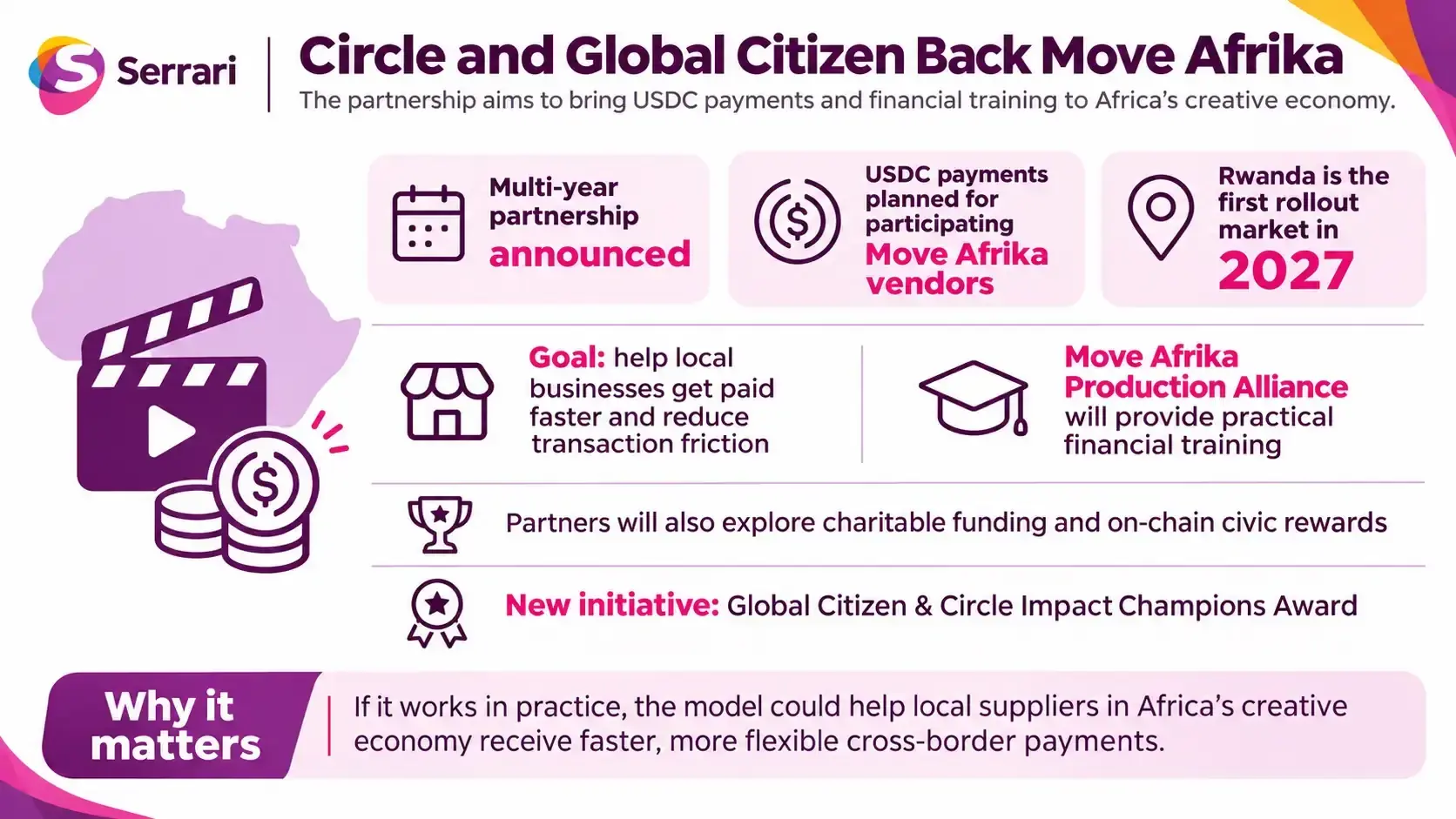
- Partnership: Circle and Global Citizen will introduce USDC as an additional payment option for participating Move Afrika vendors.
- Starting market: Rwanda is scheduled for the first rollout in 2027; the arrangement does not establish that payments are already live.
- Business objective: Faster, more predictable settlement could help production suppliers manage staff, equipment and inventory expenses.
- Training: The Move Afrika Production Alliance will support financial education, technical guidance and safer use of digital tools.
- Additional initiatives: The partners will explore digital charitable funding and on-chain civic rewards, alongside a new Impact Champions Award.
- Regulatory test: Rwanda’s 2026 virtual-asset law places conditions on crypto-related payments, making authorisation and operating arrangements central to the rollout.
Why the Partnership Focuses on Businesses Behind the Concerts
The most economically important part of a major concert may not be what happens on stage. Touring events need local lighting crews, sound engineers, caterers, transport operators, security companies, printers and accommodation providers. Many are relatively small businesses that must pay workers, rent equipment or purchase supplies before receiving final payment from international organisers. A delay of several days can disrupt their ability to take another job, even when the underlying contract is profitable.
That cash-flow problem helps explain the choice of Move Afrika as a starting point. In its November 10 partnership announcement, Global Citizen said the programme would offer participating vendors USDC as a new means of receiving funds, initially in Rwanda. Its subsequent explanation of the planned rollout also describes paying vendors ahead of events. Earlier payment could be valuable independently of the technology used: it shifts some working-capital pressure away from the small supplier.
The partnership has a practical audience because Move Afrika already organises large events involving artists and local production teams in Rwanda, Nigeria and South Africa. Nevertheless, a concert-based pilot is not evidence that every creative business can immediately use digital dollars. Results will depend on who is eligible, how payment is made and whether vendors can convert the proceeds into money accepted by their employees and suppliers.
How USDC Could Change Cross-Border Payments
USDC is a dollar-denominated stablecoin designed to maintain a value of one US dollar per token. Unlike an ordinary bank balance, it can be transferred on supported blockchains between compatible wallets. The idea is that a payer and recipient can exchange value without every transfer passing through the same series of traditional correspondent-banking steps. This may shorten the time between sending money and its arrival in a recipient’s wallet.
But speed at the blockchain level is not the same as cheap, immediately spendable local currency. A Rwandan production company may still need to exchange USDC for francs, pay a conversion spread and transfer money into a bank or mobile-money account. Wallet fees, service-provider charges, security checks and compliance requirements also influence the final cost. These are the variables the pilot needs to measure against the conventional payment alternative.
According to Circle’s published USDC terms, direct redemption with the issuer depends on holding an eligible Circle Mint account; other token holders may need an intermediary to convert their holdings. Its reserve disclosures and assurance arrangements describe the liquid assets backing the tokens. Those protections are relevant, but they do not mean every vendor will have a direct redemption relationship with Circle or that conversion into local currency will always be instantaneous.
If the programme works, the benefit could be a smaller financing gap between accepting a job and paying its expenses. If conversion costs and operational hurdles remain high, digital settlement alone may make little difference to the business’s usable cash.
Why Rwanda’s Regulatory Framework Is Crucial
The starting location makes this more than a question of financial technology. Rwanda enacted a dedicated virtual-assets law in May 2026, creating a legal framework for businesses handling digital assets. The law also distinguishes regulated virtual-asset activity from the unrestricted use of cryptocurrency as everyday money. Direct use of virtual assets to settle payments requires authorisation from the National Bank of Rwanda.
The regulatory system was still evolving when the partnership was announced. On November 5, the country’s regulator invited comments on implementing regulations, including rules for issuance, service-provider licensing and supervision. The consultation deadline is November 18, with a stakeholder meeting planned later that month. That timing makes the legal structure of the 2027 rollout particularly important.
The legislative explanation of the new framework stresses consumer protection, prevention of fraud and controls against money laundering. The Circle–Global Citizen announcement does not identify the exact local licensing pathway, the conversion provider or any central bank payment authorisation. It would therefore be inaccurate to say that Rwanda has already approved unrestricted USDC payments to concert vendors.
For participating businesses, regulatory clarity will affect the identity of the payment provider, dispute resolution, record-keeping and whether funds can be accessed without violating local rules. A successful pilot must demonstrate compliance as well as technical convenience.
Context is everything. Stay ahead of shifting trends with today’s market updates, and uncover emerging opportunities using the Serrari Group Market Index and Marketplace. Then, take control of your own financial future by exploring our Money & Life Reset Transformation Blueprint ™ to build stronger habits, create better systems, and design a path toward lasting wealth.
Why Financial Training Is as Important as the Payment Rail
The partnership also includes support through the Move Afrika Production Alliance. Local businesses and production professionals are expected to receive practical financial education, technical training and guidance on managing digital payments securely. That component recognises an important adoption barrier: a technology can be fast but still unsuitable for users who do not understand wallets, transaction confirmation or account security.
Business owners will need to know how invoices and taxes are recorded, what exchange rate applies, how to confirm the correct recipient and what to do after sending funds to an incorrect address. They must also understand phishing, impersonation and the risk of losing access to credentials. A payment that cannot easily be reversed requires different safeguards from one that can be queried through a conventional bank.
Financial education may therefore produce value even if a vendor ultimately prefers bank or mobile-money settlement. Better cash-flow forecasting, basic digital security and an understanding of cross-border charges can strengthen a supplier’s business beyond the concert season. That longer-term effect is consistent with Move Afrika’s aim of helping local production industries develop a deeper pool of skilled workers and enterprises.
How the Deal Fits the Wider African Payments Debate
Cross-border transfers remain expensive in many African corridors, and the cost of moving relatively small payments can be especially burdensome. A global assessment of remittance costs put the average charge for sending $200 to sub-Saharan Africa at 7.9% in 2023. Remittances are not identical to commercial vendor payments, so this figure should not be presented as the fee Move Afrika suppliers currently pay. It nevertheless illustrates the broader challenge of transferring value affordably across borders.
Stablecoins are one of several approaches to that problem, alongside improved bank connectivity, regional payment networks and mobile-money interoperability. Their appeal is particularly clear when buyers and sellers operate in different countries but can agree on a dollar-denominated invoice. However, wider adoption also introduces questions about exchange-rate exposure and increased dependence on a foreign currency for local business activity.
Circle has an obvious strategic interest in demonstrating real-world use beyond digital-asset trading. Global Citizen, meanwhile, can use an existing network of event suppliers to test whether the promised improvement is visible in actual business outcomes. The partners’ goals overlap, but they are not identical: broader token circulation benefits a stablecoin network, while suppliers primarily need predictable, affordable payments in a form they can use.
The announcement also includes plans to explore faster funding for charities, a Global Citizen & Circle Impact Champions Award providing USDC grants to qualified organisations, and possible use of blockchain records in civic-action rewards. These are initiatives or areas of exploration, not evidence of an operating continent-wide donation or rewards system.
What Will Determine Whether the Pilot Succeeds?
The most useful evidence will come after the Rwanda rollout begins. Partners could report how many vendors receive USDC, what proportion choose it over other methods, the time taken to receive usable local currency and the total fees paid from invoice to final settlement. Repeated use by vendors would be more persuasive than a single successful demonstration.
It will also matter whether vendors gain earlier access to funds without accepting new costs or responsibilities they cannot manage. A supplier paid before an event may improve its working-capital position, but that advantage comes from payment timing as well as the choice of token. Separating those two effects will help establish whether digital dollars themselves improve the process.
For Africa’s creative economy, the bigger opportunity is to make participation in international projects financially practical for smaller suppliers. Global Citizen and Circle are proposing a test of that idea, not announcing that the continent’s payment barriers have already been solved. If the 2027 pilot delivers transparent savings, secure access and compliant local-currency conversion, it could offer a model for other industries. If it does not, the experience will still reveal where the real obstacles to inclusive cross-border commerce remain.
Sources
Global Citizen / Circle / Capital Market Authority Rwanda / Parliament of Rwanda / World Bank / The Paypers
Your financial future isn’t something you wait for—it’s something you build.
The real question is: when do you begin?
Move beyond simply staying informed.
Navigate the markets with clarity—track trends through the Serrari Group Market Index, uncover opportunities in the Serrari Marketplace, and build practical knowledge with our Curated Wealth Builder Platform.
Stay connected to what truly matters.
Get daily insights on macro trends and financial movements across Kenya, Africa, and global markets—delivered through the Serrari Newsletter.
Growth opens doors.
Advance your career through professional programs including ACCA, HESI A2, ATI TEAS 7 , HESI EXIT , NCLEX – RN and NCLEX – PN, Financial Literacy!🌟—designed to move you forward with confidence.
See where money is flowing—clearly and in real time.
Track Money Market Funds, Treasury Bills, Treasury Bonds, Green Bonds, and Fixed Deposits, alongside global and African indexes, key economic indicators, and the evolving Crypto and stablecoin landscape—all within Serrari’s Market Index.