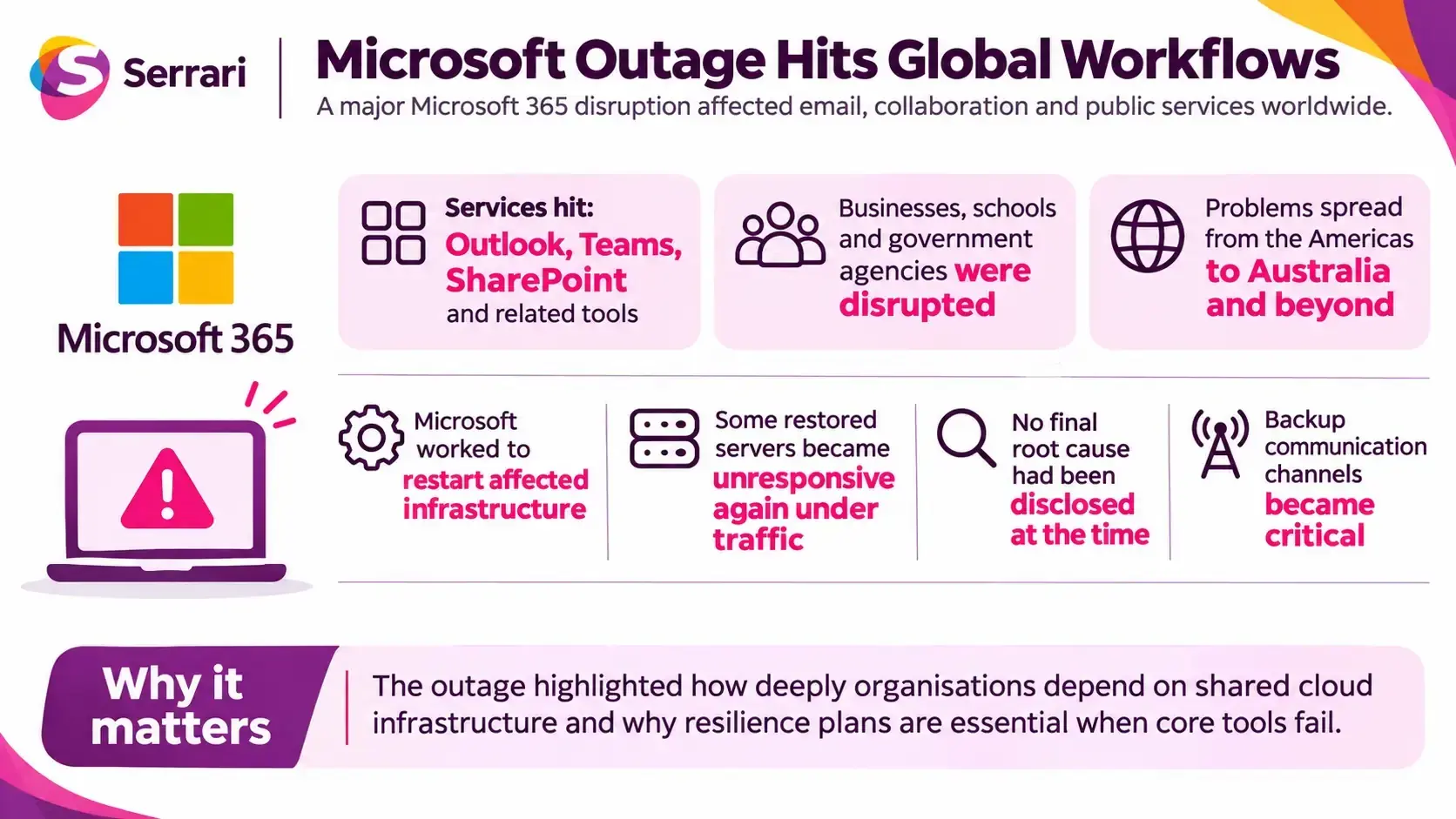
A widespread Microsoft 365 outage beginning on November 12, 2026 disrupted access to Outlook, Teams and other cloud services used by businesses, schools and government agencies across several regions. What initially appeared to be a connectivity problem in Exchange Online developed into a broader disruption as unavailable servers increased pressure on the remaining infrastructure. Microsoft worked to restart servers and redirect traffic, but some systems became unresponsive again when connections returned. The episode demonstrates how a failure in one widely shared technology platform can interrupt routine commerce and public services, while raising questions about continuity planning, cloud concentration and the resilience of critical digital infrastructure.
Key Overview
- Global disruption: Users reported problems accessing Outlook email and Microsoft 365 services from the Americas to Australia, with different services and organisations affected to different degrees.
- Initial technical findings: Microsoft identified unexpectedly unavailable servers and overloaded processes, but had not established a final root cause in the updates reviewed.
- Cascading effects: Exchange Online connectivity issues affected some functions dependent on email and identity workflows, including Teams, SharePoint and other business tools.
- Public-service impact: Australian schools, courts and government bodies reported disruptions, while the country’s weather bureau said its forecasts and warnings remained available.
- Recovery difficulties: Returning servers to service proved insufficient when some became unresponsive after traffic resumed.
- Business lesson: Backup communication channels and tested recovery procedures matter even when organisations use major cloud providers.
Why Microsoft’s Systems Failed and Recovery Took So Long
The disruption began around midday on Thursday in the eastern United States and spread into the working day in other regions. Microsoft’s early Exchange Online incident notices described connectivity errors affecting infrastructure that processes requests to access mailboxes. Users encountered problems in webmail, desktop clients and mobile services, making the disruption harder to work around simply by switching devices.
As technicians investigated, they discovered that a large number of servers had unexpectedly become unavailable. Rather than a straightforward surge in normal user demand, the loss of capacity caused traffic to move onto fewer functioning machines. These remaining machines then faced additional strain, contributing to further failures. That distinction matters: increasing the number of connections to a damaged pool of servers does not solve the underlying capacity problem.
Microsoft attempted to redistribute connections, isolate affected components and restart servers in stages. But subsequent service-health updates showed that some recovery measures were less effective than expected. Engineers identified a process responsible for establishing secure connections that was becoming overwhelmed, preventing affected servers from processing requests. They also investigated a recent network configuration change that correlated with the start of the incident.
A correlation is not a completed root-cause finding. At the time of these updates, Microsoft had not published a final account explaining exactly why so many servers became unavailable. It is therefore premature to present a software update, a configuration change or an external attack as the definitively established cause. The available evidence instead points to a complex infrastructure failure whose effects were amplified by traffic concentration and the difficulty of safely reintroducing users.
Why Email Trouble Spread Into Other Workplace Services
Email is no longer an isolated application. Many organisations use it to receive purchase orders, approve invoices, confirm appointments, send authentication codes and coordinate work across different software products. Microsoft 365 also brings together messaging, document storage, meetings, security and productivity tools, so a failure in a shared component can reach well beyond an inbox.
The company’s wider service advisory identified potential connectivity problems involving Teams, SharePoint, Copilot and other services, although the extent varied. Some functions continued operating while others depended on affected Exchange Online connections. That difference matters: calling the incident a failure of every Microsoft product would exaggerate what was established.
For a small business, the practical effects can be immediate. A customer may be unable to request a quotation, a supplier may not receive a purchase order and finance staff may be unable to verify whether payment instructions have arrived. Larger businesses can switch temporarily to alternative channels, but that requires staff to know which tools are authorised and how to preserve a record of important decisions. Informal workarounds can introduce privacy, security and record-keeping risks if sensitive documents are moved to personal accounts.
The outage also shows why recovery can be uneven. Even after servers return, applications may need to reconnect, rebuild sessions and process delayed requests. A service that briefly becomes available may slow again if thousands of clients reconnect simultaneously. Restoration should therefore be assessed by whether normal work can proceed reliably, rather than by whether an isolated login succeeds.
Context is everything. Stay ahead of shifting trends with today’s market updates, and uncover emerging opportunities using the Serrari Group Market Index and Marketplace. Then, take control of your own financial future by exploring our Money & Life Reset Transformation Blueprint ™ to build stronger habits, create better systems, and design a path toward lasting wealth.
How Schools and Government Agencies Were Affected
The effects were visible in Australia as Friday began. Reports described schools unable to conduct some remote learning activities, companies struggling to process invoices and public institutions losing access to routine communications. An Australian account of the disruption also documented interrupted telehealth services and business administration, showing how cloud software has become an operational dependency outside conventional office environments.
Australia’s cybersecurity coordinator was briefed as agencies assessed the incident. Importantly, the country’s weather bureau issued its own notice stating that customers and media could have trouble contacting it by email, while forecasts and warnings remained available through its website and app. That is a useful distinction between disrupted support communications and a failure of the core public-facing service.
The economic cost of an outage is not measured only by workers unable to read email. Missed interviews, delayed transactions, postponed meetings and staff time spent on manual workarounds create indirect costs. In public services, delays may also affect citizens who cannot easily change the time of a medical consultation, court appearance or administrative deadline.
No reliable worldwide dollar loss or verified number of individual people affected had been established in the reports reviewed. A peak of more than 130,000 US Outlook reports on an outage-monitoring service represents user-submitted complaints, not the total number of people unable to work. One corporate technology failure can affect far more accounts than the number of people who choose to file a report.
Why This Outage Matters for the Cloud Business Model
Organisations move to cloud platforms partly because they provide sophisticated security, collaboration tools and infrastructure that would be costly to maintain independently. Centralisation also makes services easier to update and administer across offices and countries. Yet the same shared architecture can concentrate operational risk. When many companies depend on the same platform, a technical fault may produce disruptions across otherwise unrelated sectors.
The Australian investigation and expert commentary highlighted this trade-off between the economies of scale offered by large providers and the limited redundancy available when a common service fails. Geographic distribution can protect against some failures, but it does not automatically prevent problems involving shared software, configuration or connection-management systems.
For businesses, the lesson is not necessarily to abandon cloud computing or maintain full duplicates of every system. Both would be expensive, and duplicating infrastructure can introduce fresh complexity. More targeted resilience may be practical: independent emergency contact lists, alternative meeting channels, offline access to priority documents and procedures for paying suppliers or serving customers when company email is unavailable.
A continuity plan needs testing. If an organisation’s emergency instructions are stored only in the inaccessible application, or if the alternative system depends on authentication messages sent to the same failed inbox, a backup may offer little protection. Firms should identify the few processes whose interruption would cause the greatest damage and ensure those processes have workable alternatives.
What Microsoft Must Explain After Services Recover
Beyond restoring access, Microsoft faces questions about how servers failed health checks, why capacity became unavailable across regions and whether safeguards intended to prevent overload contributed to the problem. The company will also need to demonstrate that its corrective actions can withstand normal connection traffic without restarting the cycle of failed recovery.
Microsoft’s published incident-review process describes post-incident reports for significant disruptions, including timelines, root-cause analysis and actions intended to reduce recurrence. Those findings will be more useful to technology managers than broad assurances that a service has recovered. They can inform decisions about redundancy, monitoring and whether existing service-level commitments are sufficient.
Affected businesses may also examine contractual remedies, but financial compensation should not be assumed. Eligibility for service credits depends on subscription terms and evidence of impact. Microsoft’s credit-request guidance emphasises incident identifiers, documented downtime and the affected customer account. Even where credits are available, they may not fully compensate businesses for lost productivity or missed sales.
The broader issue is accountability in an economy where email, collaboration software and digital workflows are increasingly essential infrastructure. Organisations need reliable providers, but they also need the ability to continue serving people when a provider experiences an exceptional failure. The November disruption is a reminder that operational resilience depends on both sides of that relationship: technology companies must engineer for failure, and customers must plan for the possibility that even a major cloud platform will sometimes be unavailable.
Sources
Microsoft / University of Pennsylvania / University of Wisconsin-Milwaukee / Reuters / ABC News / Bureau of Meteorology / Microsoft Learn
Your financial future isn’t something you wait for—it’s something you build.
The real question is: when do you begin?
Move beyond simply staying informed.
Navigate the markets with clarity—track trends through the Serrari Group Market Index, uncover opportunities in the Serrari Marketplace, and build practical knowledge with our Curated Wealth Builder Platform.
Stay connected to what truly matters.
Get daily insights on macro trends and financial movements across Kenya, Africa, and global markets—delivered through the Serrari Newsletter.
Growth opens doors.
Advance your career through professional programs including ACCA, HESI A2, ATI TEAS 7 , HESI EXIT , NCLEX – RN and NCLEX – PN, Financial Literacy!🌟—designed to move you forward with confidence.
See where money is flowing—clearly and in real time.
Track Money Market Funds, Treasury Bills, Treasury Bonds, Green Bonds, and Fixed Deposits, alongside global and African indexes, key economic indicators, and the evolving Crypto and stablecoin landscape—all within Serrari’s Market Index.