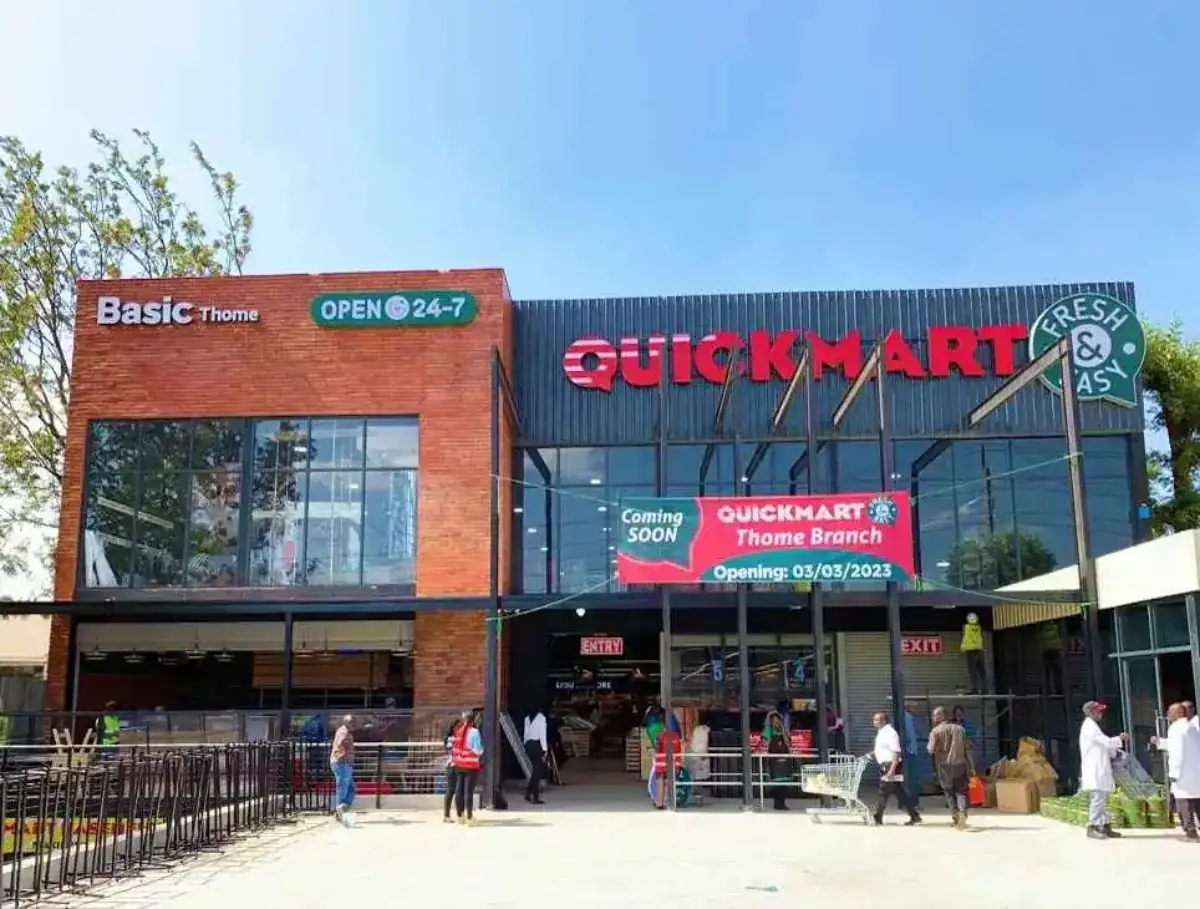
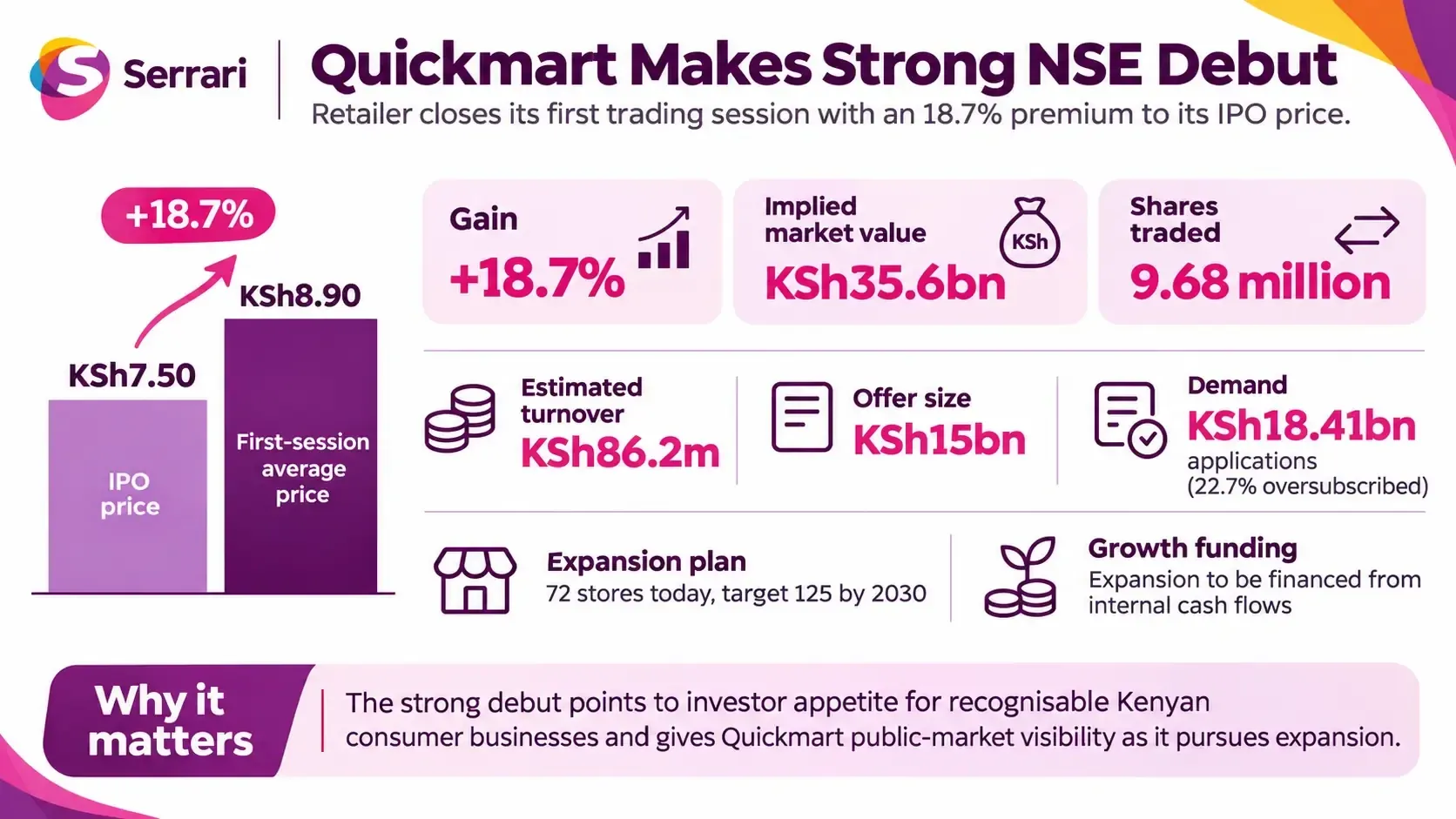
Quickmart’s debut on the Nairobi Securities Exchange (NSE) on November 12, 2026, lifted its implied market value to KSh35.6 billion, KSh5.6 billion above its initial public offering valuation. The supermarket operator’s shares traded as high as KSh10, compared with the KSh7.50 offer price, before recording a first-day volume-weighted average of KSh8.90, an 18.7% premium. The enthusiastic reception followed an oversubscribed KSh15 billion sale by existing shareholders, showing investor demand for profitable, recognisable Kenyan consumer businesses. Yet the listing also raises important questions about what investors are paying for, how Quickmart will fund expansion and whether Kenya’s stock market can become a dependable exit route for private equity and family-owned enterprises.
LIVENSE market summarySee NSE data →Key Overview
- First-day valuation: A KSh8.90 volume-weighted average price implied a KSh35.6 billion market capitalisation, compared with KSh30 billion at the IPO price.
- Trading activity: Some 9.68 million shares changed hands, with prices ranging from KSh8 to KSh10 and estimated turnover of approximately KSh86.2 million.
- IPO demand: Applications worth KSh18.41 billion exceeded the KSh15 billion offer by 22.7%, with 18,492 applications received.
- Ownership: Sokoni Retail Kenya sold two billion existing shares, representing half of Quickmart, and retained a 50% holding after the offer.
- Financial base: Quickmart reported FY2025 revenue of KSh50.4 billion and adjusted after-tax profit of KSh1.7 billion.
- Growth ambition: The chain plans to grow from 72 stores to 125 by 2030, primarily using cash generated by its operations rather than IPO proceeds.
Why Quickmart Shares Jumped on Their First Trading Day
Quickmart entered the market with demand already exceeding the shares available in its public offer. Its official IPO allocation results show investors applied for about 2.45 billion shares against the two billion offered. That imbalance helps explain why some buyers were prepared to pay more once secondary-market trading began: investors who received fewer shares than they wanted could seek additional holdings on the exchange.
The first trade occurred at KSh10, or 33.3% above the offer price. The share subsequently traded within a KSh8–KSh10 range, with 9,682,062 shares changing hands. According to first-session market data, the KSh8.90 figure represented the day’s volume-weighted average price. Describing it precisely matters because an average trading price and the price of the final transaction are not necessarily identical.
At KSh8.90 per share, Quickmart’s four billion issued shares imply a KSh35.6 billion equity valuation. That is KSh5.6 billion above the KSh30 billion valuation set by the IPO price. For an investor allocated 1,000 shares at KSh7.50, the indicative market value rose from KSh7,500 to KSh8,900 before transaction costs. These gains were on paper unless shares were actually sold, and the opening-day premium is no guarantee of future returns.
The share-price rise reflects a combination of limited supply, a familiar retail brand and confidence in the company’s growth record. The first-day trading report also identified the prospect of investors with unmet IPO demand returning to buy shares in the secondary market. What remains to be seen is whether demand persists after the excitement surrounding the new listing fades.
Why the KSh15 Billion IPO Was a Shareholder Exit, Not New Expansion Capital
The structure of the offer is essential to understanding its economic impact. Quickmart did not issue two billion new shares to raise money for the supermarket business. Instead, Sokoni Retail Kenya Limited sold two billion existing shares at KSh7.50 each, generating KSh15 billion in gross proceeds for selling shareholders. Quickmart’s issued share count remained four billion.
The transaction therefore provided liquidity to existing owners, including private equity investor Adenia Partners and stakeholders linked to the founding families and management. According to the transaction announcement, the investment vehicle retains half of the business, meaning its shareholders still have a substantial interest in Quickmart’s longer-term performance.
That distinction matters for anyone evaluating the expansion strategy. Because sale proceeds went to the previous owners, they are not a fresh KSh15 billion cash injection into Quickmart’s stores, warehouses or inventory. Management says growth will be funded primarily from internally generated cash. The retailer must therefore balance new store openings against rent, equipment, stock, staff costs and investments in logistics and digital retail.
For the private equity industry, the listing nevertheless represents an important success. Adenia invested in Tumaini Supermarkets in 2018 and subsequently supported its combination with Quickmart. The business expanded from a small chain into a nationwide operator. A public-market sale gives earlier investors a route to realise part of their investment without requiring another private buyer to purchase the entire company.
Can Quickmart’s Earnings Justify Its Higher Valuation?
The listing is not purely a bet on future store openings. Quickmart’s published operating figures show FY2025 revenue of KSh50.4 billion and adjusted profit after tax of KSh1.7 billion. Those results establish a sizable existing operation rather than a start-up seeking capital before proving its business model.
Using the first-session implied market value of KSh35.6 billion, the company trades at approximately 0.71 times FY2025 revenue and 20.9 times FY2025 adjusted after-tax profit. The latter is only an indicative valuation comparison: adjusted profit is not necessarily equivalent to statutory net earnings, and the historical period does not capture subsequent changes in performance.
Investors must assess whether future earnings growth warrants paying that multiple. A retailer can grow sales by opening outlets but still disappoint shareholders if operating margins deteriorate, stock losses rise or cash gets tied up in expansion. Grocery retail is particularly sensitive to purchasing power, competition, supply-chain efficiency and the ability to sell inventory quickly while managing payments to suppliers.
Quickmart’s investment case ahead of the offering highlighted growth from 64 stores at the end of 2025 to 72 at listing, alongside stronger digital distribution and loyalty-driven sales. The challenge is converting that momentum into sustainable earnings and cash flow rather than merely adding locations.
Context is everything. Stay ahead of shifting trends with today’s market updates, and uncover emerging opportunities using the Serrari Group Market Index and Marketplace. Then, take control of your own financial future by exploring our Money & Life Reset Transformation Blueprint ™ to build stronger habits, create better systems, and design a path toward lasting wealth.
What the Expansion Plan Means for Jobs, Suppliers and Consumers
Quickmart wants to expand from 72 stores in 16 counties to 125 by 2030, an addition of 53 stores. Management’s intended pace of 10–15 openings annually is ambitious, and reaching the target will depend on the economics of individual sites, capital available for reinvestment and demand in new catchment areas.
LIVENSE market summarySee NSE data →The implications extend beyond stock investors. At listing, the retailer employed more than 8,000 people and worked with over 700 suppliers and more than 14,000 Kenyan farmers. Chief executive Peter Kang’iri said the chain pays suppliers about KSh5 billion monthly, with small and medium-sized enterprises accounting for more than 70% of its supplier base. The figures in the listing-day company statement illustrate the scale of business that can flow through a supermarket network.
Additional stores could create formal jobs and offer farmers and manufacturers access to more customers. But those benefits are conditional: reliable supplier payments, fair purchasing arrangements and operational discipline will matter as much as headline store counts. Rapid expansion can also intensify competition for smaller independent retailers, especially in densely populated towns.
For consumers, a larger network may bring longer opening hours, easier access to everyday goods and more convenient delivery options. Yet growth alone does not guarantee lower prices. Household spending power, transport costs and competitive pressure will influence whether shoppers experience meaningful improvements.
Why the Listing Matters for Kenya’s Capital Markets
Quickmart’s debut comes amid renewed efforts to bring sizable Kenyan businesses to the public market. The retailer followed other 2026 additions to the exchange, including Kenya Pipeline Company’s public offering and Family Bank’s listing by introduction. Together, these transactions offer evidence that the market can attract new issuers, although their structures and investor outcomes differ.
The involvement of four international cornerstone investors reinforced the credibility of Quickmart’s offer. Final allocations to the International Finance Corporation, MOBILIST, 337 Frontier Capital and RWC Asset Management totalled about 864.2 million shares, equivalent to 21.6% of all Quickmart shares. Such participation can help broaden the investor base, though it should not be interpreted as a guarantee against losses.
The longer-term test is whether the NSE can offer businesses dependable liquidity, transparent pricing and a wide pool of investors after listing day. If Quickmart trades actively and meets its disclosure obligations, more Kenyan family businesses may see a partial stock-market sale as a practical alternative to selling privately. A weak aftermarket, however, could undermine that lesson despite a successful IPO.
There is also a distinction between corporate financing and shareholder liquidity. Quickmart’s listing primarily enabled existing owners to sell their stakes; a future company seeking money for factories, technology or expansion would need a transaction that actually directs capital to the issuer. Both functions matter, but they support the economy in different ways.
What Investors Should Watch After the Debut
The first session delivered a strong headline gain, but future returns will depend on execution. Investors should monitor sales growth at established stores, cash generated after operating and investment expenses, profitability, and the cost of opening new branches. They should also watch trading liquidity and whether major shareholders alter their holdings when permitted under applicable rules.
For Quickmart, public ownership brings more scrutiny of governance and financial reporting alongside a higher profile. For Kenya’s capital markets, the opportunity is to turn a well-received listing into a lasting demonstration that profitable domestic companies can attract both local and international investors.
Ultimately, KSh35.6 billion is a market valuation, not proof that Quickmart has created KSh5.6 billion in additional operating value overnight. The share-price premium reveals what investors were willing to pay on November 12. Whether that confidence proves justified will depend on the supermarket chain’s ability to translate its national footprint, supplier relationships and store expansion plans into durable earnings.
Sources
Quickmart / Adenia Partners / Business Daily Africa / Business Radar / African Private Capital Association
Your financial future isn’t something you wait for—it’s something you build.
The real question is: when do you begin?
Move beyond simply staying informed.
Navigate the markets with clarity—track trends through the Serrari Group Market Index, uncover opportunities in the Serrari Marketplace, and build practical knowledge with our Curated Wealth Builder Platform.
Stay connected to what truly matters.
Get daily insights on macro trends and financial movements across Kenya, Africa, and global markets—delivered through the Serrari Newsletter.
Growth opens doors.
Advance your career through professional programs including ACCA, HESI A2, ATI TEAS 7 , HESI EXIT , NCLEX – RN and NCLEX – PN, Financial Literacy!🌟—designed to move you forward with confidence.
See where money is flowing—clearly and in real time.
Track Money Market Funds, Treasury Bills, Treasury Bonds, Green Bonds, and Fixed Deposits, alongside global and African indexes, key economic indicators, and the evolving Crypto and stablecoin landscape—all within Serrari’s Market Index.