China, Türkiye and Ethiopia have launched an international initiative to strengthen cooperation in carbon credit markets during COP31 in Antalya. The voluntary, legally non-binding arrangement seeks to improve carbon credit standards, strengthen market governance, increase the supply of high-integrity credits and encourage information sharing between countries. For Ethiopia, the initiative comes as the country develops its domestic carbon trading system and prepares to host COP32 in 2027. However, the agreement does not automatically authorise international carbon credit transfers, connect national trading platforms or create financial commitments.
Key Takeaways
- China, Türkiye and Ethiopia launched an initiative on November 11, 2026, at the COP31 China Pavilion in Antalya.
- The initiative aims to improve carbon credit quality, strengthen market governance and encourage cooperation among countries and market participants.
- Participation is voluntary and legally non-binding. It does not automatically permit cross-border carbon credit transfers under Article 6 of the Paris Agreement.
- Ethiopia is developing its domestic carbon market through new legislation, a national carbon registry and a carbon market strategy.
- The initiative could create opportunities for developing countries to attract climate finance, but its commercial impact will depend on future projects, market standards, authorisations and buyers.
What Has China, Türkiye and Ethiopia Agreed to Do?
China, Türkiye and Ethiopia have jointly launched an initiative to strengthen international cooperation on carbon credit markets during the 31st United Nations Climate Change Conference (COP31) in Antalya, Türkiye.
The initiative was unveiled on November 11, 2026, at the China Pavilion during the climate conference, which has brought together representatives from nearly 200 countries and regions. Government officials and representatives of international organisations, including the United Nations and the World Bank, attended the launch.
The three countries are seeking to improve the credibility, transparency and long-term stability of international carbon credit markets by encouraging cooperation among governments, international institutions and market participants.
The agreement proposes a framework through which participating countries can coordinate policies, exchange information and strengthen the systems used to generate and trade carbon credits.
The initiative calls on governments and relevant intergovernmental bodies to improve governance systems for high-integrity carbon credits. It also encourages cooperation among carbon crediting mechanisms and market participants to promote a reliable supply of credits, while supporting their responsible use to generate effective market demand.
China’s Vice Minister of Ecology and Environment, Li Gao, said the initiative is guided by the principles of fairness, inclusiveness and voluntary participation. He described it as an open global effort intended to promote the high-quality development and long-term stability of international carbon crediting markets.
“We welcome governments, international organizations and relevant institutions to join us in delivering a new global public good for climate action,” Li said.
The participating countries argue that carbon crediting mechanisms can help direct resources towards emissions reduction activities, channel climate finance and support green economic development.
The initiative also encourages greater capacity-building, information sharing and cooperation between the infrastructure supporting carbon markets.
Why Are High-Integrity Carbon Credits Important?
Carbon credits are an important part of international climate finance because they can provide a financial incentive for projects that reduce greenhouse gas emissions or remove carbon dioxide from the atmosphere.
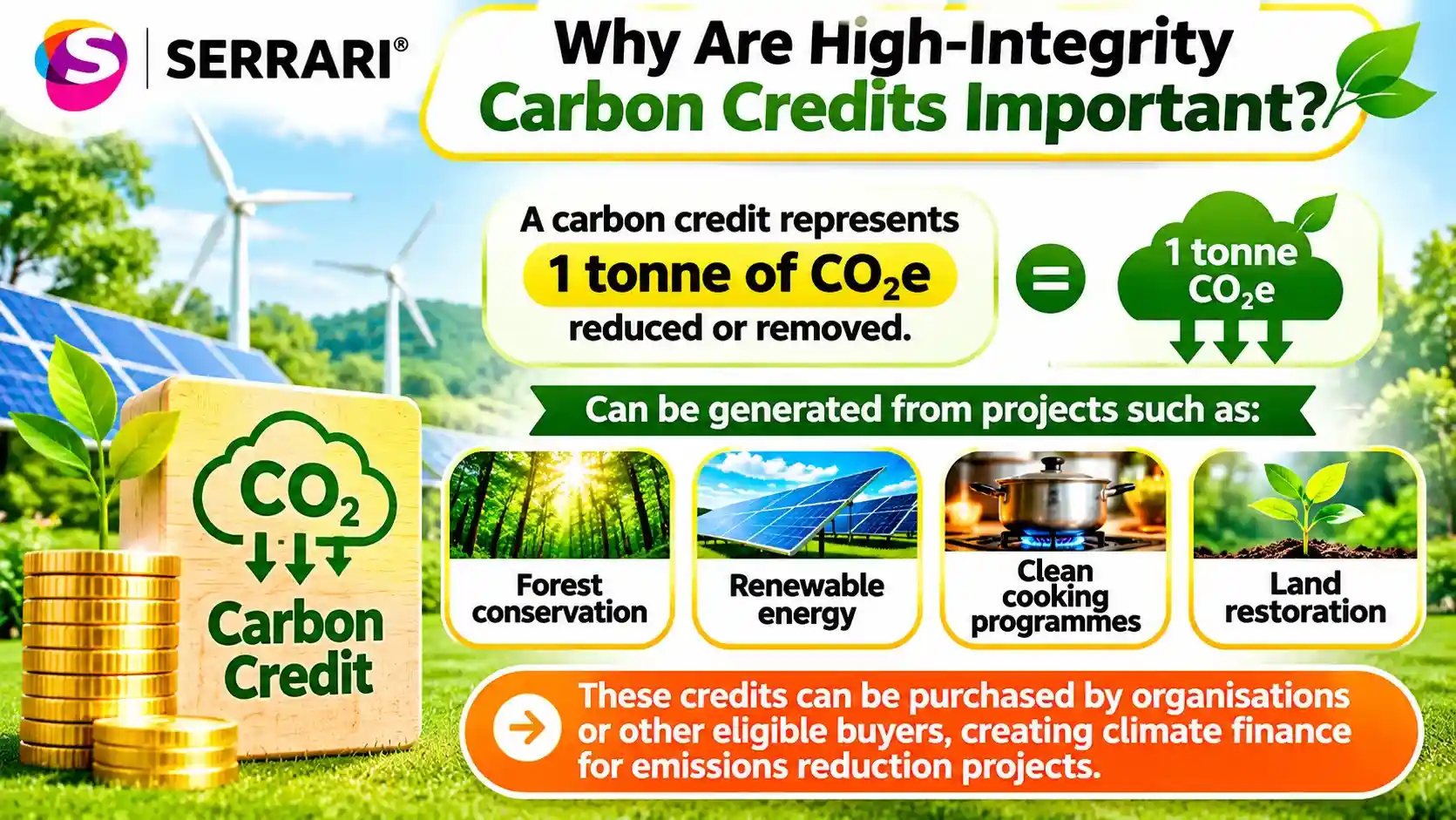
A carbon credit generally represents one tonne of carbon dioxide equivalent (CO₂e) reduced or removed. Credits can be generated by projects such as forest conservation, renewable energy development, clean cooking programmes and land restoration, provided that their emissions reductions or removals are properly measured and verified under applicable standards.
For example, a project that protects a forest from deforestation may generate carbon credits when it demonstrates that it has prevented emissions that would otherwise have occurred. A renewable energy project may also generate credits where its verified activities displace emissions from more carbon-intensive energy sources.
These credits can then be purchased by organisations or other eligible buyers, creating a potential source of revenue for projects that deliver climate benefits.
However, the credibility of the market depends on the quality of the credits being issued. Buyers need confidence that the claimed emissions reductions are real, measurable, independently verified and properly accounted for.
Weak standards, inadequate oversight and unreliable emissions accounting can undermine confidence in carbon credits and reduce the effectiveness of carbon markets as a climate financing tool.
This is why the new initiative places emphasis on improving governance systems and establishing stronger standards for high-integrity carbon credits.
It also calls for the responsible use of credits to create effective market demand. In practice, stronger demand and more credible supply could help channel funding towards eligible emissions reduction and removal projects.
How Could the Initiative Benefit Developing Countries?
One of the central themes of the initiative is stronger cooperation among developing economies.
Türkiye’s Deputy Minister of Environment, Urbanization and Climate Change, Fatma Varank, said the initiative would provide a platform for emerging economies to strengthen cooperation through South-South collaboration.
She highlighted the financial and technical difficulties that developing countries often encounter when establishing and operating carbon markets.
“When collaborations are established directly among developing countries facing these real-world hurdles, it becomes truly invaluable,” Varank said.
Developing countries may have opportunities to generate carbon credits through forestry, renewable energy, agriculture, clean cooking and other climate-related activities. However, establishing the necessary systems can require technical expertise, reliable emissions measurement, regulatory oversight, project development capacity and access to international buyers.
Cooperation could help countries exchange experience, improve the institutions responsible for carbon markets and develop more consistent approaches to credit quality.
For countries with limited financial and technical resources, these areas are particularly important. A functioning carbon market requires more than projects capable of reducing emissions. It also needs credible standards, transparent registries, clear ownership arrangements and systems for tracking credits throughout their lifecycle.
Ethiopia’s participation is particularly significant because the country is simultaneously developing its domestic carbon market framework and preparing to host COP32.
What Does the Initiative Mean for Ethiopia’s Carbon Market?
Ethiopia’s involvement comes at a time when it is establishing the legal and institutional arrangements needed to participate more actively in domestic and international carbon trading.
The country enacted Carbon Market Proclamation No. 1436/2026, published in the Federal Negarit Gazette on September 3, 2026. The legislation establishes rules governing carbon credit activities, market operators, ownership, registration and the transfer of mitigation outcomes.
One of its important provisions is the establishment of an Ethiopian National Carbon Registry. The registry is intended to record carbon credit ownership, issuance, transfers and retirement.
The legislation also designates the Environmental Protection Authority as the licensing authority for carbon market operators.
Another important feature is its approach to sharing the proceeds generated from carbon credit transactions. Under the legislation, proceeds are subject to benefit-sharing arrangements involving federal and regional governments, project developers, eligible intermediaries and local communities. The detailed distribution framework is expected to be implemented through subsequent regulations.
This is significant because carbon markets can involve communities and project developers whose land, resources or activities contribute to emissions reduction projects. Clear benefit-sharing arrangements can help establish how revenue is distributed among the parties involved.
The legislation follows Ethiopia’s National Carbon Market Strategy, developed in 2025. The strategy identifies forestry, renewable energy, agriculture and clean cooking as potential sources of carbon credits.
Together, the strategy and proclamation provide a foundation for developing the country’s carbon market institutions and attracting climate-related investment.
Context is everything. Stay ahead of shifting trends with today’s market updates, and uncover emerging opportunities using the Serrari Group Market Index and Marketplace. Then, take control of your own financial future by exploring our Money & Life Reset Transformation Blueprint ™ to build stronger habits, create better systems, and design a path toward lasting wealth.
How Does Article 6 of the Paris Agreement Fit into the Initiative?
Article 6 of the Paris Agreement provides a framework for countries to cooperate voluntarily in meeting their national emissions reduction targets, including through market-based mechanisms.
Under Article 6, countries can work together on emissions reduction activities and, subject to applicable rules, transfer internationally recognised mitigation outcomes.
One important part is Article 6.2, which allows countries to transfer internationally recognised mitigation outcomes through cooperative approaches. These transfers require authorisation, reporting and accounting procedures intended to prevent the same emissions reduction from being counted towards more than one country’s climate target.
For example, a country may support an emissions reduction project in another country and acquire authorised mitigation outcomes. The process requires the participating countries to follow the relevant rules and accounting requirements.
This distinction matters because the new China-Türkiye-Ethiopia initiative is not itself an Article 6 transfer mechanism.
Participation neither authorizes cross-border transfers under Article 6 nor commits members to linking markets, recognizing credits, or making financial contributions.
In other words, joining the initiative does not automatically mean that a country must accept credits issued by another participant or connect its national carbon registry to another country’s system.
The arrangement is voluntary and legally non-binding. It provides a platform for dialogue, information sharing, capacity-building and project cooperation rather than establishing a compulsory carbon trading system.
This also means that the initiative does not represent a carbon credit purchase agreement. No credit volume, transaction price, funding commitment or specific investment project was announced at the launch.
What Carbon Market Progress Has Ethiopia Made So Far?
Beyond its new legislation, Ethiopia has been developing technical systems to support the generation and verification of carbon credits.
The country has developed a Standardised Crediting Framework with technical support from the World Bank’s Carbon Initiative for Development. The framework is being tested through clean cooking and off-grid renewable energy programmes, allowing emissions reductions to be verified and linked to carbon financing.
Forestry is another potential area of carbon market activity.
Ethiopia’s first Biennial Transparency Report under the Paris Agreement recorded more than 100 million tonnes of carbon dioxide equivalent in reported emissions-reduction results associated with reducing emissions from deforestation and forest degradation between 2018 and 2022.
However, these reported results should not be confused with credits that are already available for international sale.
Those reported results do not automatically constitute tradable carbon credits. International transfers require separate authorisation and compliance with applicable carbon accounting rules.
An assessment of the report published by the Article 6 Network on November 3 indicated that Ethiopia had not yet authorised any international transfers under Article 6.
This highlights the difference between reporting emissions reduction results and having credits that are authorised and eligible for international transfer.
Ethiopia therefore still needs to develop and implement the relevant legal, technical and institutional arrangements before it can participate more extensively in international carbon trading.
The new initiative could provide a platform for cooperation as the country works through these requirements.
What Is the Role of COP32 in Ethiopia’s Plans?
The initiative also has significance for Ethiopia because the country is scheduled to host COP32 in Addis Ababa in November 2027.
By joining the initiative at COP31, Ethiopia is strengthening its international partnerships ahead of assuming the next climate conference presidency.
Selam Kidane Abebe, chief strategist for Ethiopia’s COP32 Presidency, welcomed the initiative and thanked the Chinese government for bringing the participating countries together. She described it as an important platform for strengthening international cooperation on climate solutions.
Ethiopia’s involvement also reflects its interest in mobilising climate finance and expanding opportunities for developing countries to participate in international carbon markets.
At COP31, China’s Vice-President Han Zheng, attending as President Xi Jinping’s special representative, also outlined China’s broader climate priorities at the Antalya Leaders’ Summit.
His proposals included implementing the UN Framework Convention on Climate Change and the Paris Agreement, accelerating the green transition, strengthening cooperation on climate mitigation and adaptation, and encouraging developed countries to fulfil their climate finance commitments.
These priorities provide wider context for the discussions taking place at COP31, including efforts to strengthen international cooperation on carbon markets.
What Could Happen Next?
The initiative creates an opportunity for China, Türkiye and Ethiopia to strengthen cooperation on carbon market governance, credit quality and information sharing. However, its actual impact will depend on what participating countries and market institutions do after the launch.
Several developments will be important to watch.
First, countries will need to translate the proposed cooperation into practical arrangements. This could involve technical exchanges, capacity-building programmes, policy dialogue and collaboration between carbon crediting mechanisms.
Second, the credibility of carbon credits will remain central. Stronger governance, transparent verification and reliable accounting systems will be necessary to build confidence among potential buyers and investors.
Third, Ethiopia’s implementation of its carbon market legislation will be important. The development of its national registry, licensing arrangements and benefit-sharing regulations will help determine how effectively the domestic market operates.
Finally, international transfers under Article 6 will require separate authorisations and compliance with the relevant rules. The new initiative does not remove these requirements.
The commercial significance of the agreement will therefore depend on subsequent cooperation, the development of eligible projects, recognition of crediting standards and the ability to secure buyers.
The Bigger Picture
The launch of the China-Türkiye-Ethiopia initiative reflects continuing efforts to strengthen international carbon markets and expand developing countries’ participation in climate finance.
For developing economies, carbon markets can potentially provide an additional source of funding for activities such as forest conservation, renewable energy, clean cooking and land restoration. However, these opportunities depend on the ability to generate credible credits and demonstrate measurable climate benefits.
The initiative’s emphasis on high-integrity credits is important because market growth alone does not guarantee effective climate action. Strong standards, transparent governance and reliable emissions accounting are necessary to ensure that credits represent genuine environmental benefits.
For Ethiopia, the agreement comes at a particularly important time as the country develops its domestic carbon market framework and prepares to host COP32.
Although the initiative does not immediately create new carbon trading arrangements or guarantee investment, it provides a platform through which countries can strengthen their technical and institutional capacity.
Why Does This Matter Now?
The development matters because countries are seeking ways to mobilise more climate finance while improving the credibility of carbon markets.
For developing countries, the ability to attract funding for emissions reduction and climate-related projects could support green economic development. However, this requires more than international agreements. Countries need functioning regulatory systems, reliable registries, credible verification procedures and clear rules for ownership and benefit-sharing.
The China-Türkiye-Ethiopia initiative provides a voluntary framework for advancing cooperation in these areas. Its success will ultimately be judged by whether it leads to stronger carbon market institutions, more credible credits and measurable emissions reductions.
Frequently Asked Questions
1. What is the China-Türkiye-Ethiopia carbon market initiative?
It is a voluntary international cooperation initiative launched at COP31 on November 11, 2026. It aims to improve carbon credit market governance, increase the supply of high-integrity credits, encourage information sharing and strengthen cooperation among governments and market participants.
2. Does the initiative allow countries to trade carbon credits across borders automatically?
No. The initiative does not automatically authorise international transfers under Article 6 of the Paris Agreement. Countries must still meet the relevant authorisation, reporting and carbon accounting requirements.
3. Why is Ethiopia participating in the initiative?
Ethiopia is developing its domestic carbon market through Carbon Market Proclamation No. 1436/2026, its National Carbon Market Strategy and the development of a national carbon registry. Participation also supports its efforts to strengthen international partnerships ahead of hosting COP32 in Addis Ababa in 2027.
4. Could the initiative attract climate investment into developing countries?
Potentially. Stronger cooperation, improved carbon credit standards and better market infrastructure could help developing countries attract financing for eligible projects. However, the initiative does not guarantee funding or investment. Actual opportunities will depend on project development, credit quality, applicable authorisations and demand from buyers.
Your financial future isn’t something you wait for—it’s something you build.
The real question is: when do you begin?
Move beyond simply staying informed.
Navigate the markets with clarity—track trends through the Serrari Group Market Index, uncover opportunities in the Serrari Marketplace, and build practical knowledge with our Curated Wealth Builder Platform.
Stay connected to what truly matters.
Get daily insights on macro trends and financial movements across Kenya, Africa, and global markets—delivered through the Serrari Newsletter.
Growth opens doors.
Advance your career through professional programs including ACCA, HESI A2, ATI TEAS 7 , HESI EXIT , NCLEX – RN and NCLEX – PN, Financial Literacy!🌟—designed to move you forward with confidence.
See where money is flowing—clearly and in real time.
Track Money Market Funds, Treasury Bills, Treasury Bonds, Green Bonds, and Fixed Deposits, alongside global and African indexes, key economic indicators, and the evolving Crypto and stablecoin landscape—all within Serrari’s Market Index.