




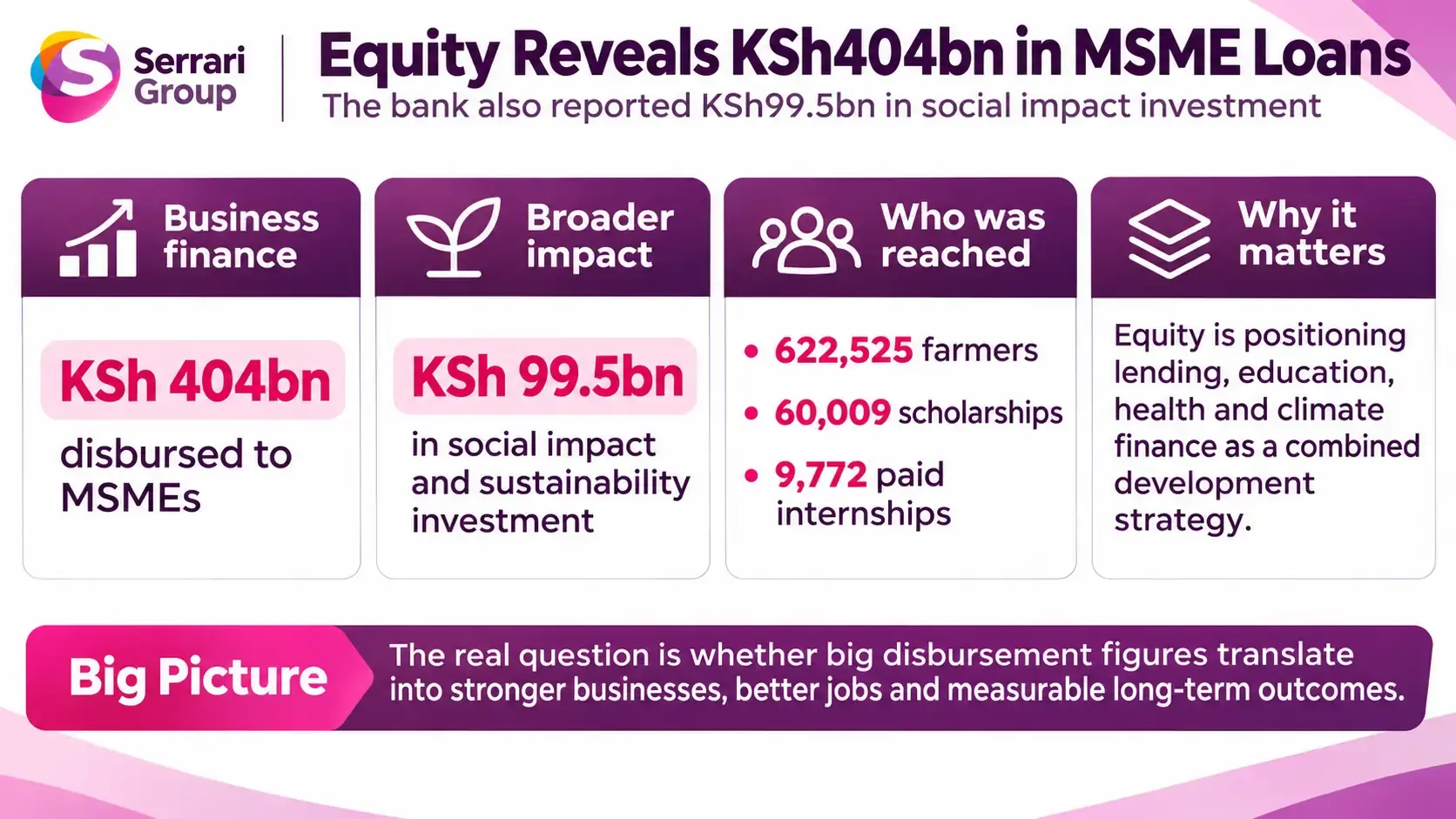
Equity Group Holdings has disclosed KSh404 billion in financing disbursed to micro, small and medium-sized enterprises (MSMEs) and KSh99.5 billion in reported social impact and sustainability investment, highlighting the growing role of commercial banks in financing development across East and Central Africa. The figures were announced on November 5, 2026, alongside the group’s 2025 Sustainability Report, which also detailed support for 622,525 farmers, 60,009 scholarships and an expanding primary healthcare network.
The announcement matters because Equity is making a strategic bet that lending, training and essential services can reinforce each other: better-supported businesses may become stronger borrowers, while more productive farms and skilled workers could support economic growth. But the headline amounts require careful interpretation. The KSh404 billion represents loan disbursements, not grants, and programme counts include cumulative achievements. The figures therefore cannot simply be added together or treated as a single year’s direct charitable expenditure.
Key Overview
- Business financing: Equity reported KSh404 billion disbursed to MSMEs under its enterprise development and financial inclusion programme.
- Impact investment: The group reported KSh99.5 billion in social impact and sustainability investment by 2025, covering a different measure from MSME loan disbursements.
- Agriculture: Programmes reached 622,525 small and medium-sized farmers through financing, training and value-chain support; a separate agricultural loan total was not disclosed in the announcement.
- Education and work: The group reported 60,009 scholarships and 9,772 facilitated paid internships, alongside 415 technology apprentices who secured employment.
- Healthcare and protection: Equity Afya operated 150 centres with more than 4.62 million cumulative patient visits; social protection programmes channelled KSh173.5 billion in cash transfers.
- Climate finance: More than KSh26 billion was deployed in sustainable and climate-aligned financing during 2025.
- 2030 ambition: Equity Bank Kenya targets a 65% MSME share of its loan book, alongside 30% for food and agriculture and 15% for manufacturing; these sector targets are not additive because classifications can overlap.
Why Equity Is Putting Business Lending at the Centre of Its Strategy
The 2025 sustainability announcement presents enterprise finance as part of a broader commercial and social strategy, rather than a standalone community programme. The economic logic is clear: small businesses need working capital to buy inventory, pay suppliers, purchase equipment and withstand uneven cash flow, but lenders must also manage the risk that borrowers cannot repay.
Equity’s response combines credit with entrepreneurship training and financial literacy. The group reported that its foundation had cumulatively trained 962,924 entrepreneurs and provided financial education to 2,490,471 women and young people. Those totals describe the scale of outreach, not the number trained for the first time in 2025. The distinction matters when evaluating annual progress.
Lending alone does not guarantee business expansion. A company can obtain credit and still struggle because of weak demand, delayed customer payments or rising operating costs. Training may help owners keep records and manage inventories, while better financial information may allow the bank to assess creditworthiness more accurately. If these interventions work together, they could improve loan quality while widening access for borrowers who have historically been underserved.
The KSh404 billion should also be understood as a flow of loans disbursed under the programme, not the size of the outstanding MSME loan book at year-end. Loans may be repaid and reissued during a period. As a result, the disbursement figure cannot establish how many unique businesses borrowed, how much financing remained outstanding or whether the resulting investment generated additional jobs.
What the Reported KSh99.5 Billion Actually Measures
The group’s reported KSh99.5 billion impact investment is a central headline, but readers should not equate it with KSh99.5 billion in donations. Equity describes a broad portfolio spanning enterprise development, sustainability, healthcare, education and social initiatives. Its separate KSh404 billion lending figure and KSh173.5 billion of cash transfers also describe different financial activities and should not be added to the impact figure as though all were comparable expenditure.
This is more than a technical accounting issue. Development reports routinely combine money committed, money disbursed, people reached and outcomes achieved. Each answers a different question. Spending describes resources deployed; loan disbursement describes credit delivered; scholarships awarded describe access; and outcomes would reveal whether incomes, learning, health or employment improved.
For investors and policymakers, the relevant test is whether Equity can demonstrate measurable benefits over time, including repayment performance, business survival and improved earnings. For communities, the question is whether the initiatives produce services and opportunities they would otherwise have struggled to access.
Equity also said local suppliers accounted for 90% of its 2025 procurement expenditure, equivalent to KSh47.59 billion. This offers a second channel through which a financial institution can support domestic enterprises: buying goods and services locally, in addition to providing loans. However, the extent of the wider economic benefit depends on what was purchased, how much value remained locally and whether suppliers gained sustainable new business.
Why Supporting 622,525 Farmers Matters for Food Security
Equity reported reaching 622,525 small and medium-sized farmers through climate-smart agricultural financing, training and agricultural value-chain initiatives. The announcement did not isolate the monetary amount lent specifically to these farmers, so the beneficiary count must not be described as a cash-disbursement total.
The focus on farming responds to connected economic problems. Agricultural households may need credit before a harvest generates revenue, while weather shocks can reduce output precisely when repayment obligations fall due. Small farmers may also lack reliable buyers, storage or equipment, making it difficult to invest in productivity.
The bank’s development impact framework describes an approach combining agricultural finance with mechanisation, partnerships and arrangements linking producers to markets. Better access to equipment and buyers could make farmers more productive and improve the bank’s ability to recover loans. Climate adaptation can additionally reduce exposure to losses caused by drought or changing weather patterns.
The public benefit could extend beyond individual farms. Higher and more reliable food production may improve availability for consumers and reduce pressure on prices. Yet the number of farmers reached is not itself proof of higher crop yields or lower retail food costs. Those claims require results showing changes in output, income, defaults and resilience compared with suitable baselines.
Scholarships and Internships Target the Education-to-Employment Gap
Education programmes account for another major component of Equity’s disclosures. The group reported 60,009 scholarships, including 29,515 university scholars, 4,039 technical and vocational education scholars and 1,115 global scholars. These categories do not exhaust the overall scholarship total, which encompasses other programmes.
The significance goes beyond paying school fees. Educational access can be undermined when graduates cannot move into stable employment, especially if their qualifications do not match the skills employers require. Equity’s 9,772 facilitated paid internships and technology apprenticeships aim to connect training with practical experience.
The group said 415 participants secured employment after a 12-month technology apprenticeship, while partnerships with digital training providers expanded access to industry-oriented skills. These figures offer a more concrete employment indicator than scholarship counts alone, although they do not establish the overall job-placement rate across every education initiative.
For young people and families, the intended benefit is a stronger pathway from school into income generation. For the bank, a wider pool of skilled workers and emerging entrepreneurs could expand the future customer base. Whether the programmes deliver lasting economic mobility will depend on completion rates, job quality, earnings and retention—not simply the total number of participants.
Context is everything. Stay ahead of shifting trends with today’s market updates, and uncover emerging opportunities using the Serrari Group Market Index and Marketplace. Then, take control of your own financial future by exploring our Money & Life Reset Transformation Blueprint ™ to build stronger habits, create better systems, and design a path toward lasting wealth.
Healthcare and Cash Transfers Show a Wider Development Role
Equity Afya expanded to 150 outpatient facilities across Kenya and the Democratic Republic of Congo and reported more than 4.62 million cumulative patient visits. The network reflects a strategy of broadening access to primary care, which can reduce the need for people to travel long distances or delay seeking treatment.
Here, too, the distinction between activity and outcomes is important. Patient visits are not necessarily unique patients, and a larger clinic network does not by itself establish affordability, clinical outcomes or equal access between rural and urban areas. Those measures will determine the depth of the healthcare impact.
In social protection, the group reported programmes reaching 5.94 million people, with KSh173.5 billion channelled through cash transfers. Such transfers can provide essential liquidity to vulnerable households, but the financial institution’s role in delivering payments is different from funding every shilling transferred from its own balance sheet.
Equity also disclosed KSh57.9 million in loans extended to 115 refugees, with 772 refugees receiving training. These interventions illustrate an attempt to move beyond payment distribution towards financial participation, although a small borrower group provides limited evidence about the scalability of the lending approach.
Why Climate Finance Is Becoming a Banking Issue
The group reported deploying more than KSh26 billion in sustainable and climate-aligned financing during 2025, alongside more than 47,000 climate-related transactions. It also distributed 75,855 clean-energy products and planted 9.1 million trees during the year, bringing cumulative planting to 44.6 million trees.
Climate-related lending is not separate from ordinary credit risk. Farmers exposed to drought, businesses facing energy disruptions and property owners vulnerable to flooding may have a harder time generating the cash needed to service loans. Funding resilience can therefore protect both borrowers and lenders.
The commercial question is whether projects are viable without relying indefinitely on concessional support. Cleaner equipment may reduce operating expenses, but upfront capital costs and repayment schedules remain barriers for many households and businesses. Partnerships and suitable financing terms can help bridge that gap.
Tree-planting totals and transaction counts are useful activity measures, but they should not be confused with verified emissions reductions, survival rates of planted trees or independently established environmental outcomes. Equity says it is expanding environmental and social screening, climate scenario analysis and its capacity for sustainability reporting, which should improve the ability to evaluate these questions.
Equity’s 2030 Lending Targets Put Its Strategy to the Test
Alongside its sustainability announcement, Equity Bank Kenya disclosed plans to raise the share of its loan book directed towards MSMEs to 65% by 2030, compared with 56.6% in 2025 and 50.1% in 2023. It also aims for food and agriculture to reach 30% of its portfolio and manufacturing 15%, while doubling the Equity Afya network to 300 clinics.
These are targets for the Kenyan banking subsidiary, not necessarily for every subsidiary across the group. And because a manufacturing business can also qualify as an MSME, the percentages should not be added together to imply an allocation exceeding the entire loan book.
The published impact disclosure approach ties sector targets to development priorities and a commitment to monitor both positive and negative consequences. Equity also reported that the share of lending directed to women rose from 18.0% in 2023 to 23.9% in 2025, indicating progress on an additional measure of financial inclusion.
The targets could reshape the bank’s risk profile. Greater exposure to small firms, agriculture and manufacturing may support employment and productivity, but these sectors are also vulnerable to economic slowdowns, weather shocks and working-capital pressures. Growth will need to be accompanied by sound underwriting, appropriate loan tenors and careful monitoring of defaults.
What Investors and the Public Should Watch Next
Equity’s disclosures show the scale of activity across lending, education, healthcare and climate programmes. Their long-term significance, however, depends on the quality of the resulting outcomes and the bank’s financial resilience.
The most informative future disclosures would connect disbursement volumes with outstanding loans, repayment performance, unique beneficiaries and measurable improvements in businesses’ revenue or household wellbeing. For education, employment outcomes and earnings would add more meaning to scholarship and internship totals. For agriculture, evidence of improved yields and resilience would strengthen the case for expanded financing.
There is also a governance dimension. As lenders increasingly present sustainability as a core business strategy, stakeholders need consistent definitions and clear reporting periods. Annual performance and cumulative achievements must remain distinguishable so that progress is not overstated through impressive but incomparable figures.
Equity’s larger argument is that a profitable bank can support development by directing commercial finance towards productive sectors while building services around its customers. That is plausible, but the benefits are not automatic. The evidence that matters most will be whether the institution can keep growing its loan book responsibly while demonstrating durable improvements in access, incomes, skills and resilience.
The central question is not how many billions Equity reports deploying, but whether that financing creates stronger businesses and communities without undermining the financial health of the bank itself. Its 2030 targets provide a concrete opportunity to test that proposition.
Sources: Equity Group Holdings / Equity Group Foundation / Citizen Digital / The Star / The Kenya Times
Your financial future isn’t something you wait for—it’s something you build.
The real question is: when do you begin?
Move beyond simply staying informed.
Navigate the markets with clarity—track trends through the Serrari Group Market Index, uncover opportunities in the Serrari Marketplace, and build practical knowledge with our Curated Wealth Builder Platform.
Stay connected to what truly matters.
Get daily insights on macro trends and financial movements across Kenya, Africa, and global markets—delivered through the Serrari Newsletter.
Growth opens doors.
Advance your career through professional programs including ACCA, HESI A2, ATI TEAS 7 , HESI EXIT , NCLEX – RN and NCLEX – PN, Financial Literacy!🌟—designed to move you forward with confidence.
See where money is flowing—clearly and in real time.
Track Money Market Funds, Treasury Bills, Treasury Bonds, Green Bonds, and Fixed Deposits, alongside global and African indexes, key economic indicators, and the evolving Crypto and stablecoin landscape—all within Serrari’s Market Index.