Zimbabwe is advancing a proposed $300 million hybrid renewable energy project in Mashonaland Central Province, combining 128 MW of wind power, 100 MW of solar capacity and a 50 MW/100 MWh battery storage system. Developed by Modaso Energy and Tatanga Energy, the 228 MW Guruve-Mazowe project is expected to generate around 550 GWh of electricity annually—equivalent to approximately 5% of Zimbabwe’s current annual generation.
The project responds to electricity supply constraints, drought-related hydropower vulnerability and the need to diversify the country’s generation mix. Its hybrid design aims to make renewable electricity more consistent by combining complementary sources and storing energy. Financial close is targeted for mid-2027, with construction expected to begin afterwards and commercial operations planned for 2029. Key power purchase agreements and remaining licences are still outstanding.
Key Takeaways
- The $300 million Guruve-Mazowe project will combine wind, solar and battery storage in northern Zimbabwe.
- Its expected annual output of 550 GWh would equal roughly 5% of current national electricity generation.
- The hybrid design is intended to improve supply consistency and reduce dependence on rainfall-sensitive hydropower.
- The project is expected to create around 1,000 construction jobs and fund road upgrades along the equipment transport route.
- Financial close is targeted for mid-2027, but power purchase agreements and licensing remain important milestones.
Why Zimbabwe Needs More Diverse Power Sources
Zimbabwe’s electricity system faces a persistent challenge: reliable domestic generation has not always kept pace with demand. The country’s power supply depends on hydropower, which is vulnerable to drought and changing water levels, while ageing equipment at thermal power stations can constrain output.
The project’s source materials estimate peak electricity demand at roughly 2,000MW to 2,200 MW, compared with reliable domestic generation capacity of around 1,200MW to 1,600 MW. That gap helps explain why adding generation capacity—and making it more dependable—matters.
“Zimbabwe still needs significant investment to ramp up electricity production to meet its energy targets and close the gap between supply and peak demand.”
The Guruve-Mazowe project is designed to address part of this challenge by adding electricity from sources that do not rely on rainfall or imported fuel. It will not resolve the country’s power constraints on its own, but its planned output would represent a meaningful addition to the national supply.
A Hybrid Design to Make Renewable Power More Consistent
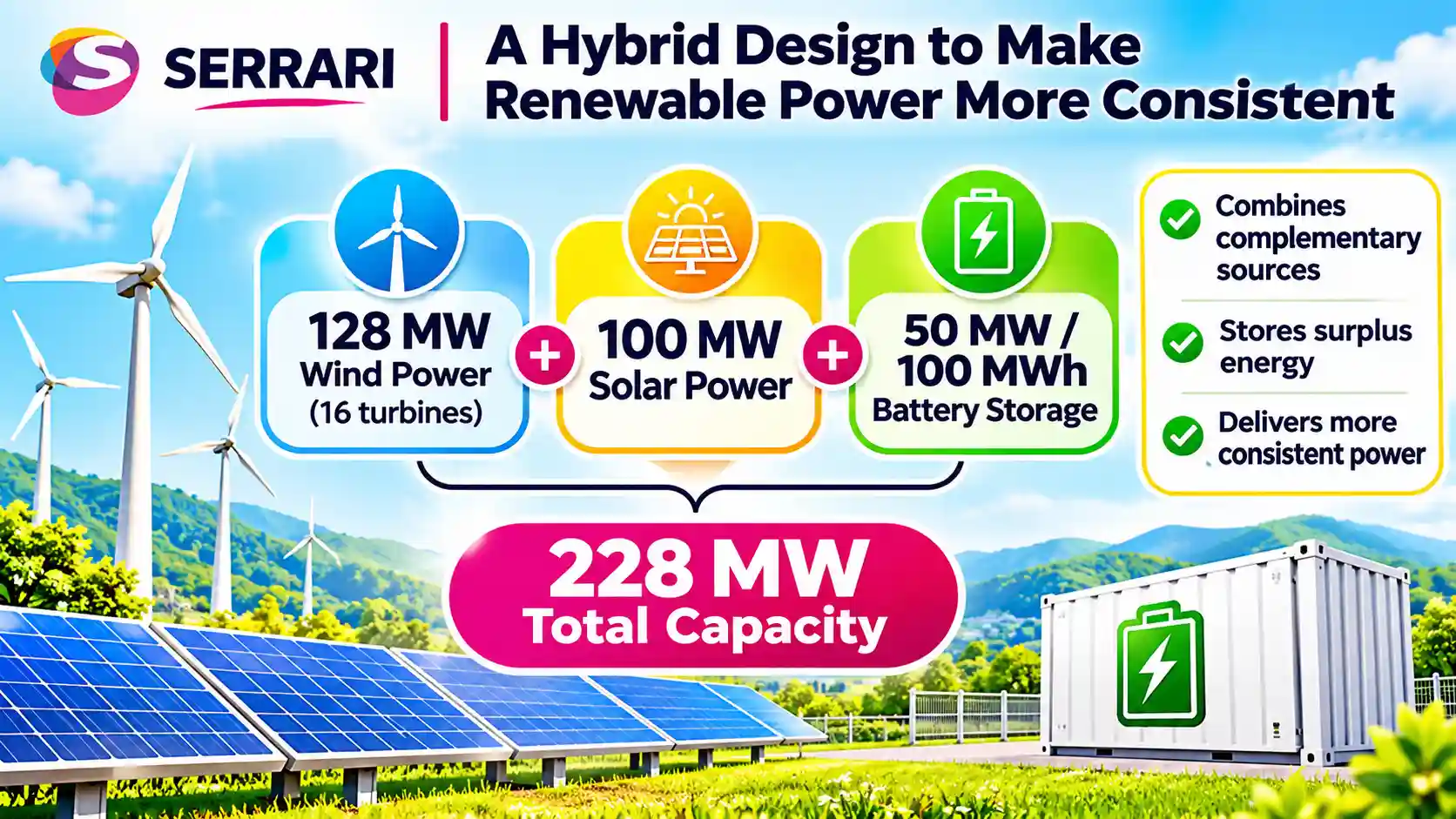
The project brings together three technologies:
- 128 MW of wind power, generated by 16 turbines
- 100 MWac of solar capacity
- 50-MW/100-MWh battery energy storage
The original development concept was a 100 MW wind farm. Following wind measurement campaigns that began in 2021, the project was redesigned to include solar generation and battery storage.
The reason for combining the technologies is practical: solar generation is concentrated during daylight hours, while wind output varies with weather conditions. Battery storage can retain surplus electricity and release it when generation falls or demand rises.
The developers expect the hybrid configuration to achieve an average capacity factor of more than 60%, delivering approximately 40% more energy through the same grid connection than a wind-only development. These are project estimates, and actual performance will depend on operating conditions and grid arrangements.
“The combination is designed to address one of the major challenges associated with renewable energy: the inconsistent availability of power.”
The plant is planned to connect to the national grid through a single 100-MW connection to the 132 kV Mutorashanga-Horseshoe transmission line. Its proposed 228 MW generation capacity therefore exceeds the grid connection rating, making the project’s operating and dispatch arrangements important to how its output is delivered.
What the Project Could Mean for Electricity Supply
The developers expect Guruve-Mazowe to generate approximately 550 GWh annually, equivalent to about 5% of Zimbabwe’s current yearly electricity production.
That output could help diversify the electricity mix and reduce some exposure to hydropower variability. Wind and solar generation would provide alternative sources of electricity, while storage could help manage fluctuations in renewable output.
The project’s value will depend not only on how much electricity it generates, but also on whether that electricity can be delivered when and where it is needed. Grid conditions, dispatch arrangements and the battery’s operating strategy will influence the contribution it makes to supply reliability.
The development also aligns with Zimbabwe’s broader renewable energy ambitions. Under its National Energy Compact, the country aims to increase renewable energy capacity from 1,282 MW in 2024 to 2,640 MW by 2030. The project could contribute to that expansion if it secures financing, completes approvals and enters operation as planned.
Financing and Power Purchase Agreements Remain Critical
Modaso Energy, a subsidiary of Geneva-based MISA Group, is developing the project with Zimbabwean renewable energy developer Tatanga Energy. Standard Bank has been appointed lead arranger for the project debt, and a debt term sheet is in place.
However, financial close has not yet been reached. The developers are targeting mid-2027, with construction expected to begin immediately afterwards.
Zimbabwe’s national utility ZESA is expected to be the primary buyer of the electricity. Africa GreenCo’s Zimbabwean subsidiary, ZimGreenCo, has also signed heads of terms to purchase part of the output under a long-term arrangement. Any uncontracted electricity could potentially be sold through the Southern African Power Pool.
“The developers and prospective buyers have yet to finalise the power purchase agreements, leaving an important commercial component of the project unresolved.”
These agreements matter because they establish how electricity will be purchased, priced and paid for. Their completion, alongside remaining licences and financing arrangements, will be central to moving the project from development into construction.
Context is everything. Stay ahead of shifting trends with today’s market updates, and uncover emerging opportunities using the Serrari Group Market Index and Marketplace. Then, take control of your own financial future by exploring our Money & Life Reset Transformation Blueprint ™ to build stronger habits, create better systems, and design a path toward lasting wealth.
Jobs, Local Infrastructure and Emissions
The developers expect construction to generate approximately 1,000 jobs, with local hiring preferences negotiated through community consultations.
The project is also expected to fund permanent road upgrades along the route used to transport turbines and other heavy equipment. Developers say the project will not require population displacement or land resettlement.
In addition, the facility is projected to displace around 500,000 tonnes of carbon dioxide emissions annually, depending on the conventional generation it replaces. This would add a climate benefit to the project’s primary role of supplying electricity.
“Construction will deliver clean energy, local infrastructure upgrades, and thousands of jobs.”
These local benefits are expected outcomes rather than completed results. Their scale will depend on the project reaching financial close and proceeding through construction.
The Bigger Picture: Hybrid Renewables and Energy Access
Guruve-Mazowe reflects a broader shift in renewable energy development: combining technologies to make electricity supply more predictable rather than relying on standalone wind or solar installations.
For Zimbabwe, this approach is especially relevant because the country’s generation system is exposed to both rainfall variability and thermal plant reliability issues. A diversified mix can reduce reliance on any single source, although it cannot replace the need for transmission upgrades, distribution investment and affordable access.
Zimbabwe also aims to achieve universal electricity access by 2030, compared with an estimated household electrification rate of 41% in 2024. New generation capacity is one part of that goal. Extending connections, improving grid infrastructure and ensuring electricity is affordable will also determine whether increased production translates into wider access.
Outlook
The Guruve-Mazowe project could become a significant addition to Zimbabwe’s renewable energy capacity and a regional example of utility-scale wind, solar and storage integration. Its expected output, employment and infrastructure benefits make it important beyond the energy sector.
But the project remains under development. The immediate milestones are finalising power purchase and grid-use agreements, securing remaining licences and reaching financial close, targeted for mid-2027. Construction is expected to follow, with commercial operations planned for 2029.
The central question is whether the developers can convert the project’s technical promise into a bankable, grid-connected asset. If they do, Guruve-Mazowe could help diversify Zimbabwe’s electricity supply while demonstrating how hybrid renewable projects can contribute to energy security and climate goals.
Frequently Asked Questions
What is the Guruve-Mazowe project?
It is a proposed 228 MW hybrid renewable energy facility in Mashonaland Central Province, Zimbabwe, combining wind, solar and battery storage.
How much electricity will it generate?
The project is expected to produce approximately 550 GWh annually, or about 5% of Zimbabwe’s current annual electricity generation.
Who is developing the project?
It is being developed by Modaso Energy, a subsidiary of MISA Group, in partnership with Zimbabwean developer Tatanga Energy.
When is the project expected to begin operating?
Financial close is targeted for mid-2027, construction is expected to begin afterwards, and commercial operations are planned for 2029.
What are the expected local benefits?
The project is expected to create around 1,000 construction jobs, fund road upgrades and avoid approximately 500,000 tonnes of carbon dioxide emissions annually, depending on the conventional electricity it displaces.
Your financial future isn’t something you wait for—it’s something you build.
The real question is: when do you begin?
Move beyond simply staying informed.
Navigate the markets with clarity—track trends through the Serrari Group Market Index, uncover opportunities in the Serrari Marketplace, and build practical knowledge with our Curated Wealth Builder Platform.
Stay connected to what truly matters.
Get daily insights on macro trends and financial movements across Kenya, Africa, and global markets—delivered through the Serrari Newsletter.
Growth opens doors.
Advance your career through professional programs including ACCA, HESI A2, ATI TEAS 7 , HESI EXIT , NCLEX – RN and NCLEX – PN, Financial Literacy!🌟—designed to move you forward with confidence.
See where money is flowing—clearly and in real time.
Track Money Market Funds, Treasury Bills, Treasury Bonds, Green Bonds, and Fixed Deposits, alongside global and African indexes, key economic indicators, and the evolving Crypto and stablecoin landscape—all within Serrari’s Market Index.