




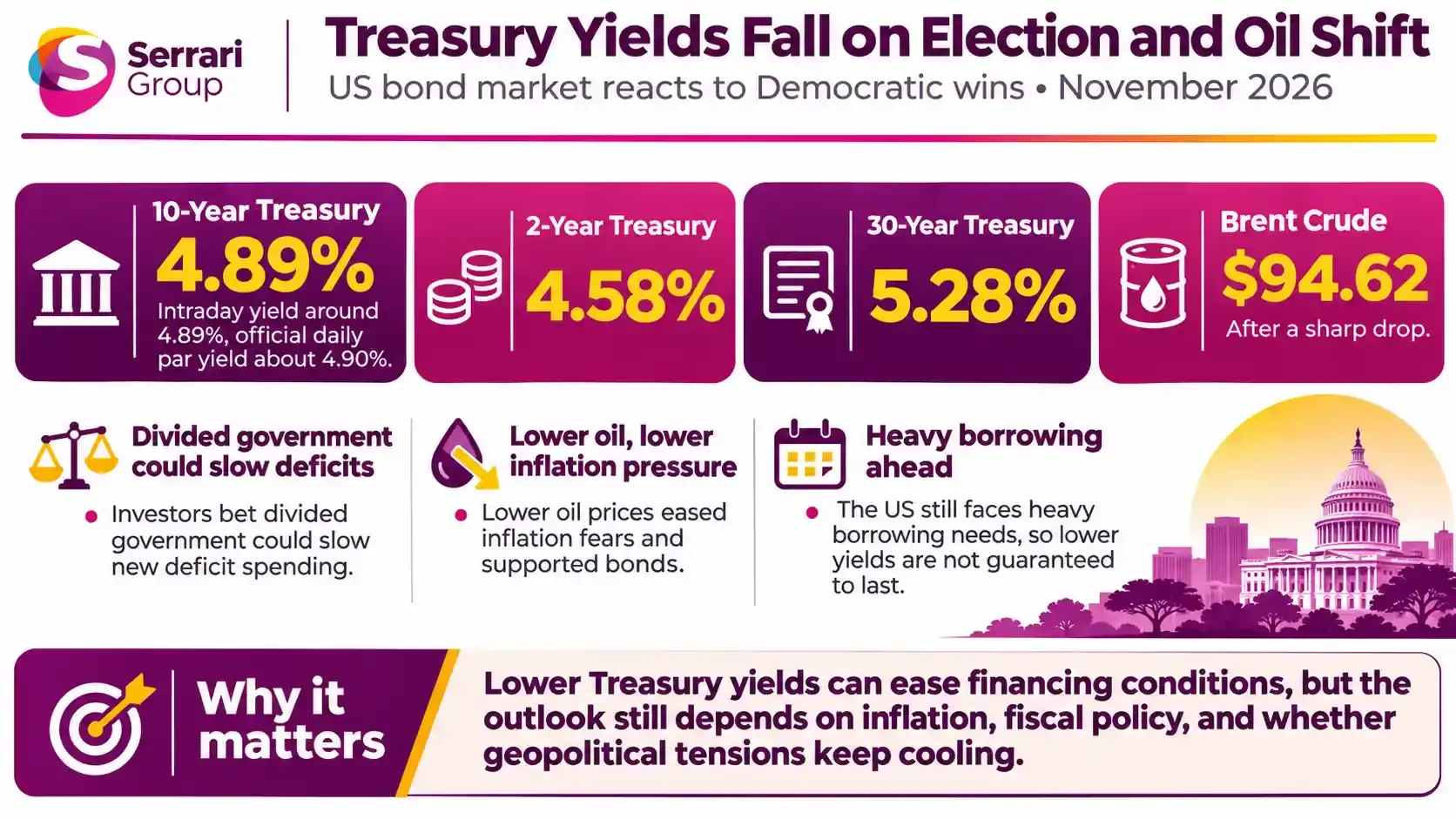
US Treasury yields fell on November 4, 2026, as investors weighed a sweeping Democratic victory in the midterm elections alongside a sharp oil-price decline. The benchmark 10-year yield traded around 4.89% late in the session, roughly six basis points lower, while the 2-year and 30-year yields also declined. The official Treasury yield curve for November 4 recorded the 10-year at 4.90%, the 2-year at 4.58% and the 30-year at 5.28%; these end-of-day par figures should not be confused with continuously changing market quotes.
The fall was driven by two connected reassessments. Democratic control of both chambers of Congress could make additional tax cuts and fiscal stimulus harder to enact, potentially restraining future borrowing. Meanwhile, oil prices plunged on speculation that the election setback would increase pressure on President Donald Trump to de-escalate the war with Iran. The bond rally matters because Treasury yields help set financing conditions across mortgages, corporate debt and international capital markets. Yet investors are betting on possible outcomes, not confirmed changes in fiscal policy or Middle East security.
Key Overview
- Bond yields declined: The 10-year Treasury traded around 4.89% on November 4, while the official daily par yield was 4.90%; the 2-year and 30-year par yields were 4.58% and 5.28%.
- Political trigger: Democrats secured majorities in the House and Senate, raising expectations of divided government and tighter constraints on new fiscal legislation.
- Energy shock: Brent crude dropped 8.7% to $94.62 a barrel, while US West Texas Intermediate fell 8.3% to $88.12.
- Inflation channel: Cheaper energy could reduce price pressures, potentially improving the outlook for bonds and interest-sensitive companies.
- Borrowing remains heavy: The Treasury announced $125 billion of refunding securities, with around $28 billion in new cash raised, underscoring ongoing financing needs.
- Market risk: Renewed war escalation, persistent inflation or fiscal deadlock could reverse some of the decline in yields.
Why the Election Sent Treasury Yields Lower
The Democratic victories changed the outlook for how easily the White House can advance new spending and tax legislation. With the opposition holding both congressional chambers, President Trump faces a more demanding legislative process, even though he retains substantial executive authority and veto power. The midterm results confirming Democratic majorities gave markets a clearer picture of the balance of power in Washington.
For Treasury investors, the relevant question is not whether one political party is inherently better for bonds. It is whether the result changes the expected amount of federal borrowing, economic stimulus and inflation over the coming years. Large deficit-financed packages can increase the supply of government debt and, depending on economic conditions, push up growth and inflation expectations. If investors conclude that Congress will block additional unfunded measures, they may demand less compensation for those risks.
That helps explain why bond prices rose as yields declined. Treasury securities make fixed payments, so their prices and market yields move in opposite directions. A six-basis-point decline means a reduction of 0.06 percentage point, not six percentage points. Even a modest yield change can matter greatly in a market that serves as a global benchmark for pricing risk and borrowing.
The reaction was not entirely smooth. Trading through Wednesday showed shifting expectations, with yields at times rising as investors absorbed economic data and Treasury financing announcements before the oil-price collapse strengthened demand for bonds. That uneven path is important: the market was responding to several forces, rather than delivering a simple verdict on the election.
Why Falling Oil Prices Strengthened the Bond Rally
The second major catalyst was energy. Brent crude settled at $94.62 and WTI at $88.12, declines of approximately 8.7% and 8.3%, respectively. Oil prices retreated as traders considered whether Republican electoral losses, and public discontent over the Iran conflict, would increase incentives for a negotiated outcome.
This matters to bonds because oil affects inflation expectations. Expensive energy raises fuel and transport costs, which can spread through supply chains into food, manufacturing and services. If sustained, cheaper crude can ease some of these pressures and make inflation less persistent. Bond investors may then anticipate less need for restrictive monetary policy, although the Federal Reserve responds to a broad range of economic indicators rather than one day’s commodity move.
Vice President JD Vance’s public comments linking the Republican defeat to the Iran war added to expectations of political pressure for de-escalation. But expectations are not outcomes. Diplomacy may advance, stall or fail, and renewed attacks or disruptions around the Strait of Hormuz could quickly restore a geopolitical premium to oil. A one-day fall in crude therefore cannot establish that future inflation will be lower.
The direction of causality is also more complicated than a simple oil-to-bond relationship. Falling crude can improve the economic outlook for fuel-importing businesses and consumers, but it can weigh on energy producers and investment in the sector. Investors must judge whether the fall reflects improving supply conditions or weaker demand. On Wednesday, the election-driven reassessment of war risk appeared especially important.
A Fiscal Reality Check: The US Still Needs to Borrow
Divided government may restrain new legislation, but it does not automatically reduce existing federal debt, interest costs or spending obligations. In fact, political confrontation can make budgets harder to pass and raise the risk of shutdowns without delivering a durable deficit agreement. The market’s immediate optimism must therefore be distinguished from an actual improvement in public finances.
On the same day as the bond rally, the Treasury announced a $125 billion quarterly refunding operation, comprising $58 billion of three-year notes, $42 billion of ten-year notes and $25 billion of thirty-year bonds. The operation was designed to refinance approximately $97 billion of maturing privately held securities while raising roughly $28 billion in new cash.
The department also said it anticipated maintaining nominal coupon and floating-rate note auction sizes for the coming several quarters, while retaining flexibility over bill issuance. This does not mean Washington has stopped borrowing or that markets no longer need to absorb substantial debt issuance. It shows why Treasury yields depend on both government financing supply and investor demand.
A lasting reduction in yields would require more than congressional gridlock. Investors would look for credible fiscal plans, contained inflation, sustained demand for Treasuries and a manageable debt-service outlook. If political negotiations instead produce disruptions without meaningful deficit improvement, the initial bond-market relief may fade.
Context is everything. Stay ahead of shifting trends with today’s market updates, and uncover emerging opportunities using the Serrari Group Market Index and Marketplace. Then, take control of your own financial future by exploring our Money & Life Reset Transformation Blueprint ™ to build stronger habits, create better systems, and design a path toward lasting wealth.
What the Yield Curve Reveals About Investor Expectations
The yield curve compares interest rates on government borrowing across different maturities. On November 4, the reported daily curve placed the 2-year at 4.58%, 10-year at 4.90% and 30-year at 5.28%. Longer-dated yields remained above shorter-dated rates, reflecting compensation for time, inflation uncertainty and other risks associated with holding debt for longer periods.
The 2-year yield is particularly sensitive to expectations for the Federal Reserve’s near-term policy path. The 10-year yield combines expectations for future short-term rates with a term premium, while the 30-year yield can be especially exposed to long-run fiscal and inflation concerns. All three maturities falling together suggests a broader repricing of economic and policy risks, although it does not reveal one precise motive shared by every investor.
The distinction between market quotes and daily published data is also important. A financial-news report may capture a 10-year yield of 4.884% at one point in the afternoon; a daily official par-yield series may show 4.90% for the same date. The latter is a standardized reference measure, not the final tick of every traded security. Mixing these numbers can create false discrepancies or misleading comparisons.
Why Lower Treasury Yields Matter to Households and Businesses
Treasury yields are foundational to how other borrowing costs are priced. Mortgage rates, investment-grade corporate bonds and many other financing instruments respond to government yields plus premiums for credit, liquidity and other risks. If the 10-year yield falls and remains lower, borrowing conditions can become easier for some households and companies, though the effect is neither immediate nor automatic.
For homeowners and prospective buyers, lower benchmark yields may help bring down mortgage quotes over time. The actual rate also depends on lenders’ funding costs, mortgage-backed security spreads, credit conditions and market competition. For firms considering factories, equipment or acquisitions, reduced long-term financing costs can improve project economics and valuations. Companies that must refinance debt soon may be especially sensitive to shifts in yields.
Bondholders experience the change differently depending on whether they already own securities. Existing fixed-rate bonds typically rise in price when comparable market yields fall. But investors buying newly issued bonds at lower yields generally lock in less income than they would have obtained before the rally, all else equal. Investors in longer-duration bonds also face greater price sensitivity if yields reverse direction.
For savers, one day’s change in government yields does not necessarily mean deposit rates will fall immediately. Banks set deposit rates according to funding needs, competition and policy conditions. The practical question is whether Wednesday’s reaction develops into a sustained easing in the wider interest-rate environment.
Why the US Bond Move Matters Beyond America
US Treasuries are used as reference assets throughout the global financial system. Their yields influence the relative appeal of dollar assets and can affect borrowing costs for governments and businesses abroad. When US yields decline, some investors may become more willing to hold emerging-market debt, particularly if global risk sentiment is stable and foreign-exchange volatility remains contained.
For African economies, the consequences are potentially significant but uneven. Lower US yields can improve conditions for international bond issuance and refinancing, while cheaper global oil can ease import costs for net oil-importing countries. For Kenya, sustained lower crude prices could help reduce pressure on the import bill, inflation and demand for foreign exchange. However, the shilling’s movement, domestic taxes, shipping costs and the local fuel-pricing framework determine how much relief reaches consumers.
There are limits to this positive transmission. A renewed geopolitical shock might simultaneously raise oil prices, increase risk aversion and push investors back toward dollar assets. Moreover, global borrowing spreads may remain elevated for countries perceived as fiscally vulnerable, even if the underlying Treasury yield declines. Lower US benchmark rates alone cannot resolve domestic creditworthiness challenges.
This is why international investors should examine both the US yield and the additional spread demanded on a particular country’s debt. A reduction in one component of borrowing cost may be offset by an increase in the other.
What Could Reverse the Bond Rally?
The strongest challenge to Wednesday’s bond-market move is that its main drivers remain uncertain. A durable diplomatic breakthrough in the Middle East could support lower energy prices, but escalation could restore inflation fears. Divided government could constrain further stimulus, but budget confrontations or unexpected fiscal measures might undermine confidence. Strong growth and persistent price pressures could also keep the Federal Reserve cautious.
Investors will therefore watch inflation and employment reports, central-bank communications, the results of Treasury debt auctions and the actual legislative agenda of the new Congress. Auction demand matters because the government must continue financing itself regardless of the election result. If buyers require higher returns to absorb supply, yields can rise even in an environment of heightened political gridlock.
The timing makes the market response particularly consequential. The United States is confronting large borrowing requirements while energy security and overseas military commitments remain politically contentious. Wednesday’s drop in yields shows how quickly expectations can shift when political and geopolitical developments intersect. It does not establish a permanent lower-rate regime.
The central takeaway is that bonds rallied because investors saw a possible reduction in two risks at once: additional deficit-financed policy and oil-driven inflation. Whether those risks actually diminish will determine if lower yields persist, influence household borrowing costs and provide relief across global capital markets. The election changed the probabilities; it has not yet delivered the outcomes.
Sources: Reuters / U.S. Department of the Treasury / Federal Reserve / ABC News / Treasury Rate Watch / CNBC
Your financial future isn’t something you wait for—it’s something you build.
The real question is: when do you begin?
Move beyond simply staying informed.
Navigate the markets with clarity—track trends through the Serrari Group Market Index, uncover opportunities in the Serrari Marketplace, and build practical knowledge with our Curated Wealth Builder Platform.
Stay connected to what truly matters.
Get daily insights on macro trends and financial movements across Kenya, Africa, and global markets—delivered through the Serrari Newsletter.
Growth opens doors.
Advance your career through professional programs including ACCA, HESI A2, ATI TEAS 7 , HESI EXIT , NCLEX – RN and NCLEX – PN, Financial Literacy!🌟—designed to move you forward with confidence.
See where money is flowing—clearly and in real time.
Track Money Market Funds, Treasury Bills, Treasury Bonds, Green Bonds, and Fixed Deposits, alongside global and African indexes, key economic indicators, and the evolving Crypto and stablecoin landscape—all within Serrari’s Market Index.