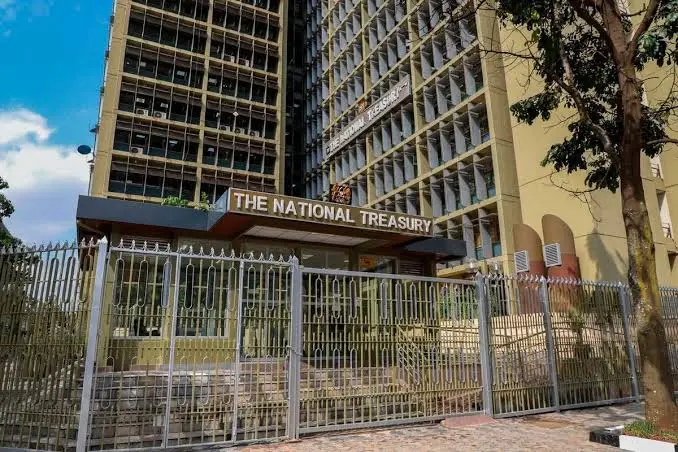
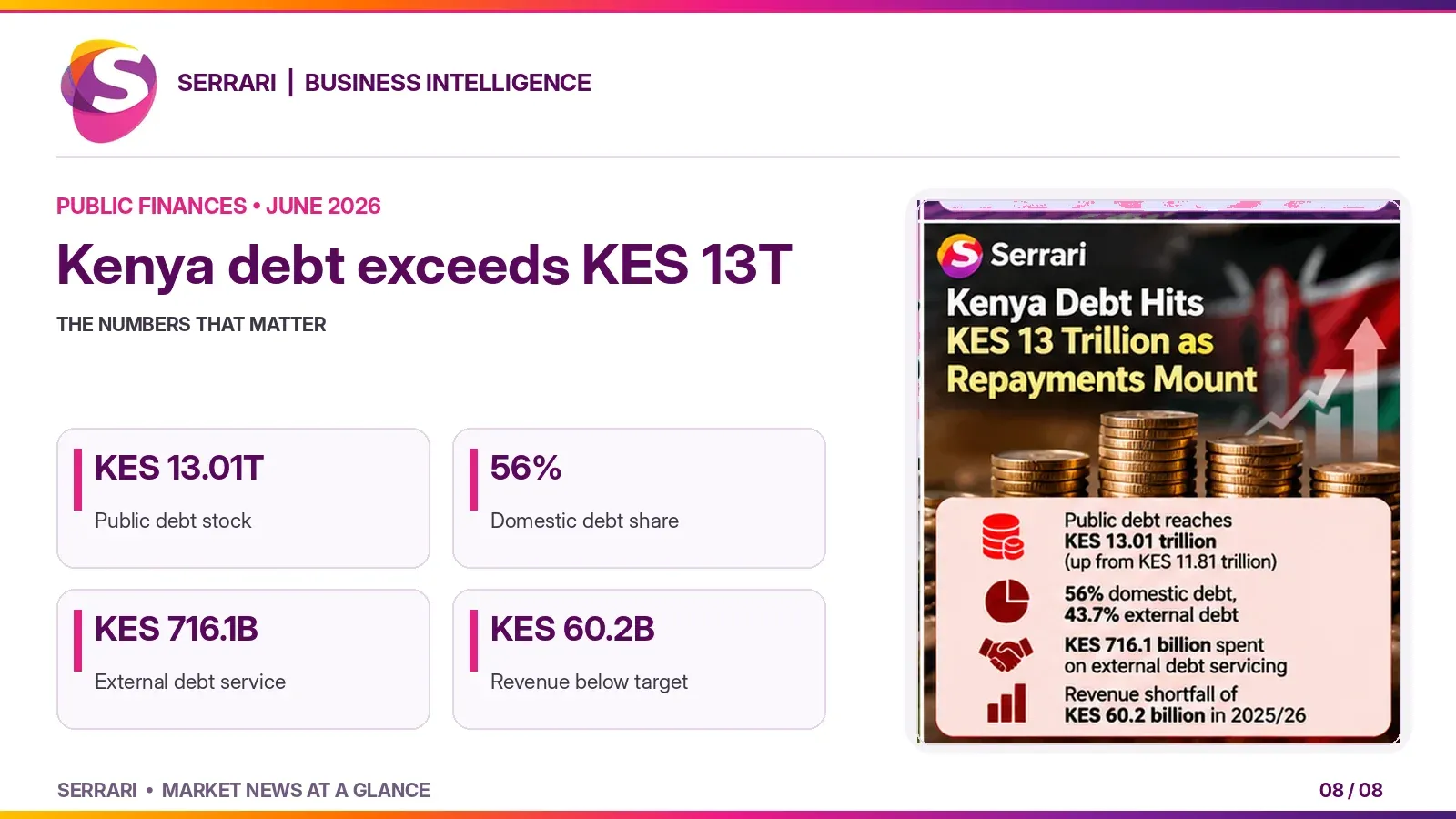
Kenya’s public and publicly guaranteed debt reached KES 13.01 trillion at the end of June 2026, up from KES 11.81 trillion a year earlier. National Treasury Principal Secretary Chris Kiptoo told lawmakers on October 27 that domestic borrowing now accounts for most of the debt stock, while KES 716.1 billion was spent servicing external debt during the 2025/26 financial year. The figures underscore the pressure debt obligations place on government finances as revenue falls short of targets.
Key Overview
- Public debt rose by about KES 1.20 trillion, or 10.2%, between June 2025 and June 2026.
- Domestic borrowing accounted for roughly 56% of total debt, compared with 43.7% from external sources.
- External debt service reached KES 716.1 billion, comprising KES 504.3 billion in principal and KES 211.8 billion in interest.
- Government revenue, including Appropriations-in-Aid, missed its annual target by approximately KES 60.2 billion.
- Lawmakers warned that heavier domestic borrowing could restrict private-sector access to credit.
Domestic Debt Takes a Larger Share
According to the October 27 parliamentary briefing, the debt stock increased from KES 11.81 trillion in June 2025 to KES 13.01 trillion a year later. The earlier figure is also consistent with the 2026 medium-term debt strategy, which recorded KES 6.33 trillion in domestic debt and KES 5.49 trillion in external debt at June 2025.
By June 2026, domestic debt represented approximately 56% of the outstanding balance. This shift matters because increased issuance of Treasury bills and bonds can draw savings toward government securities, potentially competing with businesses seeking bank finance. However, the extent of any crowding-out depends on banking liquidity, loan demand and market interest rates.
External Debt Service Reaches KES 716 Billion
Kiptoo reported that external debt-service obligations totalled KES 716.1 billion in the 2025/26 financial year. This comprised KES 504.3 billion in repayments of principal and KES 211.8 billion in interest. The distinction is important: KES 716.1 billion refers to external debt service, not Kenya’s entire domestic and external debt-servicing bill.
Principal repayments reduce outstanding liabilities, whereas interest is the cost of borrowing. Governments may nevertheless need to refinance maturing principal when available revenue is insufficient to repay it outright. Treasury’s financing plan included a KES 901 billion fiscal deficit and KES 646.3 billion for refinancing obligations, a combined amount of approximately KES 1.55 trillion.
Context is everything. Stay ahead of shifting trends with today’s market updates, and uncover emerging opportunities using the Serrari Group Market Index and Marketplace. Then, take control of your own financial future by exploring our Money & Life Reset Transformation Blueprint ™ to build stronger habits, create better systems, and design a path toward lasting wealth.
Revenue Shortfall Narrows Fiscal Space
National government revenue, including Appropriations-in-Aid, totalled KES 3.1988 trillion against a target of KES 3.259 trillion, resulting in a KES 60.2 billion shortfall. Lower-than-planned collections can complicate debt payments and spending commitments, particularly when refinancing needs remain substantial.
Kiptoo also reported a 93.3% overall budget absorption rate for the National Treasury, which spent KES 118.64 billion against its approved KES 127.14 billion budget. Recurrent expenditure absorption was 95.2%, compared with 88.8% for development spending. These departmental absorption rates should not be confused with government-wide expenditure performance.
Economic Growth Offers Some Support
Despite the debt pressure, Kenya’s economy expanded by 5.3% in the first quarter of 2026, compared with 4.9% in the same period of 2025. Stronger growth can improve revenue collection over time, but it does not automatically reduce the debt stock or the cost of refinancing.
Lawmakers urged caution over greater reliance on domestic debt, citing possible effects on lending to households and businesses. The fiscal challenge is to keep meeting debt obligations while funding infrastructure and public services without allowing borrowing costs to undermine the wider economy.
Sources: Kenyans.co.ke / National Treasury / Kenya National Bureau of Statistics
Your financial future isn’t something you wait for—it’s something you build.
The real question is: when do you begin?
Move beyond simply staying informed.
Navigate the markets with clarity—track trends through the Serrari Group Market Index, uncover opportunities in the Serrari Marketplace, and build practical knowledge with our Curated Wealth Builder Platform.
Stay connected to what truly matters.
Get daily insights on macro trends and financial movements across Kenya, Africa, and global markets—delivered through the Serrari Newsletter.
Growth opens doors.
Advance your career through professional programs including ACCA, HESI A2, ATI TEAS 7 , HESI EXIT , NCLEX – RN and NCLEX – PN, Financial Literacy!🌟—designed to move you forward with confidence.
See where money is flowing—clearly and in real time.
Track Money Market Funds, Treasury Bills, Treasury Bonds, Green Bonds, and Fixed Deposits, alongside global and African indexes, key economic indicators, and the evolving Crypto and stablecoin landscape—all within Serrari’s Market Index.