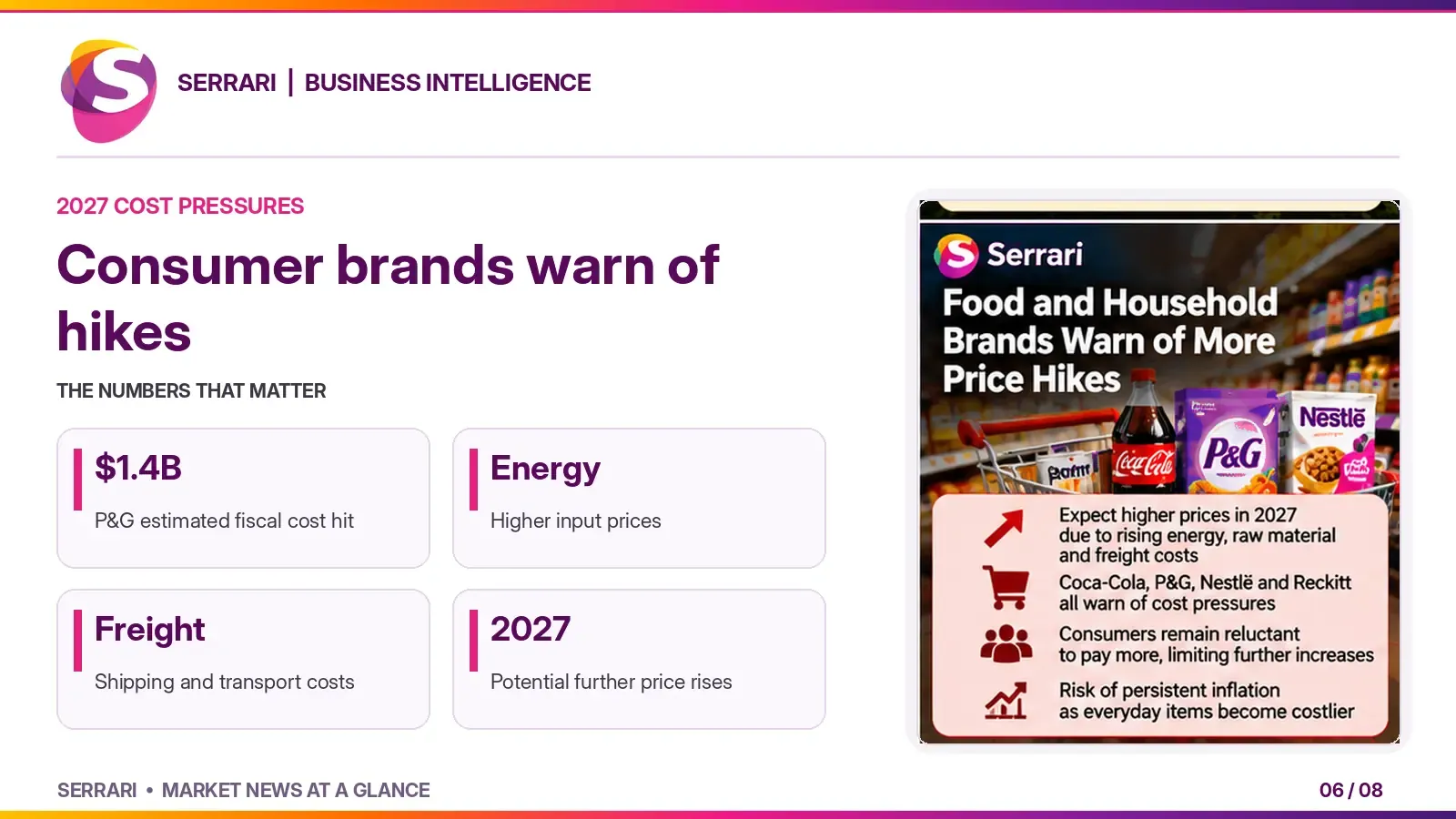
Major consumer goods companies, including Coca-Cola, Procter & Gamble, Nestlé and Reckitt, are warning that higher energy, transport and raw-material costs could force further price increases in 2027. The pressures, aggravated by the US war on Iran, are arriving as households in Europe and North America remain sensitive to grocery and household-product prices, leaving manufacturers to balance profit margins against the risk of losing sales.
Key Overview
- Companies face rising fuel, freight, packaging and commodity expenses linked in part to the conflict involving Iran.
- Procter & Gamble now forecasts a $1.4 billion after-tax commodity cost headwind in fiscal 2027, up from $1 billion.
- Coca-Cola raised its 2026 profit outlook but warned that consumer and logistics pressures could persist into 2027.
- Reckitt lowered its 2026 underlying revenue-growth forecast to 3.5%–4.5% amid operational and demand challenges.
- Nestlé reported stronger third-quarter real internal growth than pricing growth, illustrating why companies are cautious about further increases.
Energy and Freight Costs Put Pressure on Manufacturers
The industry-wide warnings reflect another wave of cost pressure for businesses selling food, drinks, detergents and personal-care products. Higher fuel prices affect shipping and distribution, while more expensive raw materials and packaging raise manufacturing expenses.
Procter & Gamble’s latest quarterly results put the expected after-tax hit from commodities, energy and transport at around $1.4 billion for its fiscal year ending in 2027. That is $400 million above its previous estimate. Despite these pressures, the company recorded a 4% increase in quarterly net sales to $23.3 billion.
The company maintained its fiscal 2027 core earnings-per-share outlook, suggesting it expects to manage some of the impact through its wider operations. Nevertheless, higher costs create pressure to raise prices if productivity savings and other offsets are insufficient.
Coca-Cola and Reckitt Weigh Price Increases
Coca-Cola’s third-quarter earnings announcement showed net revenue rising 7% to $13.4 billion, supported by stronger sales volumes. The beverage company also increased its full-year profit forecast, even as chief executive Henrique Braun warned that logistics and transport expenses remained elevated.
Reckitt faces a different combination of pressures. Its October trading update reported 3.3% like-for-like revenue growth in its core business, while management reduced expected full-year growth to 3.5%–4.5% from 4%–5%. The change partly reflects manufacturing constraints affecting Lysol in North America and weaker demand in China’s vitamins, minerals and supplements market.
Chief executive Kris Licht indicated that additional pricing could be necessary if commodity costs stay elevated. However, higher shelf prices can lead shoppers to switch brands, purchase smaller packs or wait for promotions.
Context is everything. Stay ahead of shifting trends with today’s market updates, and uncover emerging opportunities using the Serrari Group Market Index and Marketplace. Then, take control of your own financial future by exploring our Money & Life Reset Transformation Blueprint ™ to build stronger habits, create better systems, and design a path toward lasting wealth.
Nestlé’s Results Show Why Pricing Has Limits
Nestlé’s third-quarter sales figures showed organic growth of 4%, including real internal growth of 2.8% and pricing growth of 1.1%. Real internal growth measures sales growth after excluding pricing, illustrating that the company generated more growth from its underlying sales activity than from price increases during the quarter.
Chief financial officer Anna Manz cautioned that increases can temporarily reduce volumes as customers adjust. Nestlé is therefore seeking to recover costs without sacrificing its longer-term consumer base.
The consequences of aggressive pricing have also become visible elsewhere. Chocolate producer Lindt & Sprüngli acknowledged that it had misjudged consumers’ response to earlier increases, highlighting the risk of overestimating brand loyalty when household budgets are tight.
What Further Price Hikes Could Mean for Inflation
More expensive everyday products could keep consumer-price inflation elevated into 2027, particularly if energy and freight costs remain high. The effect will vary by market, product and the extent to which manufacturers absorb cost increases rather than passing them on.
For now, the warnings do not mean all brands have announced specific 2027 increases. Companies are weighing different responses, including selective price changes, promotions, smaller pack sizes and efficiency savings. Their challenge is to recover rising costs without driving increasingly price-conscious shoppers away.
Sources: Reuters / Procter & Gamble / Coca-Cola / Reckitt / Nestlé
Your financial future isn’t something you wait for—it’s something you build.
The real question is: when do you begin?
Move beyond simply staying informed.
Navigate the markets with clarity—track trends through the Serrari Group Market Index, uncover opportunities in the Serrari Marketplace, and build practical knowledge with our Curated Wealth Builder Platform.
Stay connected to what truly matters.
Get daily insights on macro trends and financial movements across Kenya, Africa, and global markets—delivered through the Serrari Newsletter.
Growth opens doors.
Advance your career through professional programs including ACCA, HESI A2, ATI TEAS 7 , HESI EXIT , NCLEX – RN and NCLEX – PN, Financial Literacy!🌟—designed to move you forward with confidence.
See where money is flowing—clearly and in real time.
Track Money Market Funds, Treasury Bills, Treasury Bonds, Green Bonds, and Fixed Deposits, alongside global and African indexes, key economic indicators, and the evolving Crypto and stablecoin landscape—all within Serrari’s Market Index.