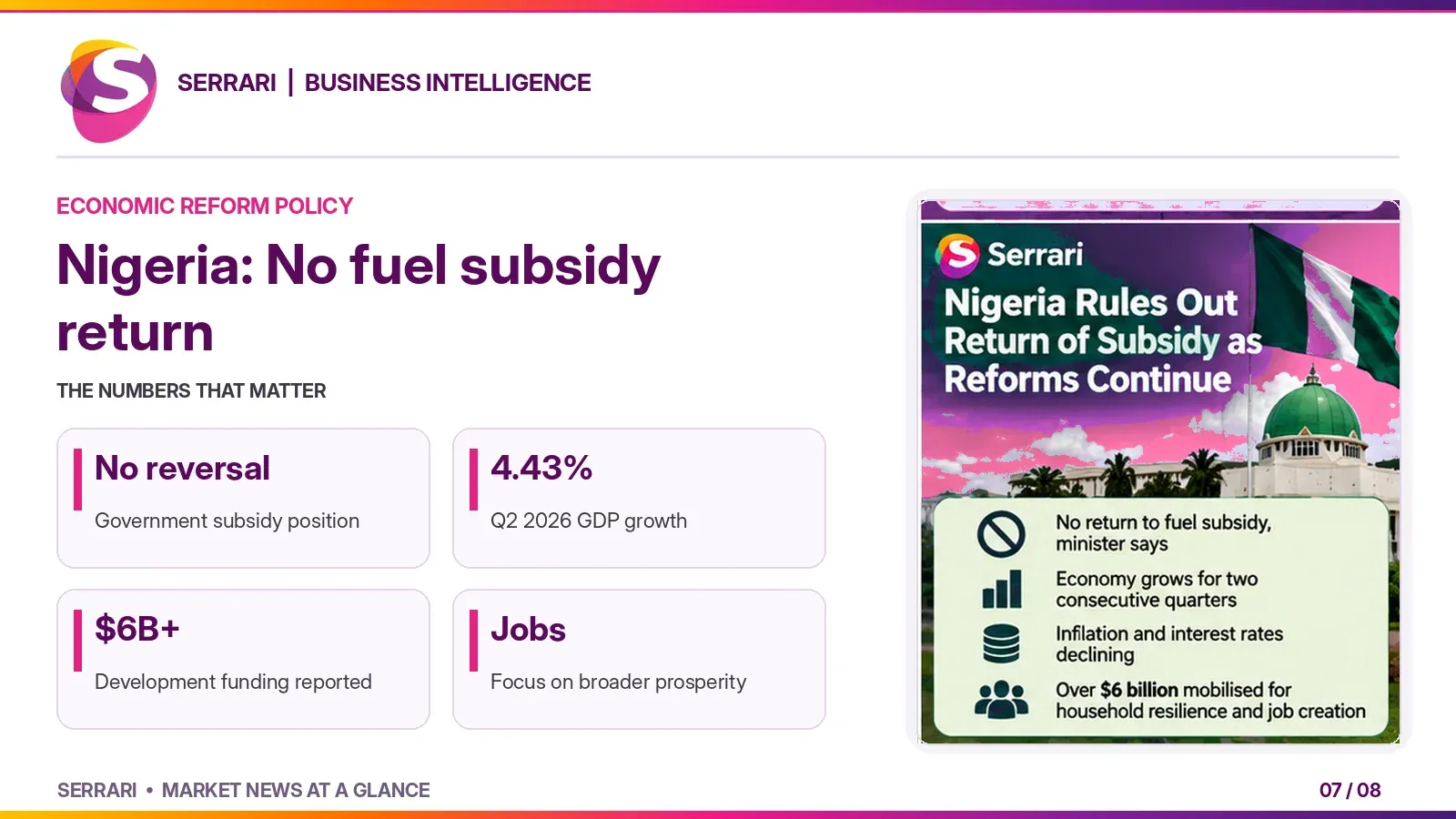
Nigeria’s federal government has ruled out restoring petrol subsidies, reaffirming its commitment to economic reforms despite continuing pressure on households and businesses. Budget and Economic Planning Minister Abubakar Atiku Bagudu made the declaration at the 32nd Nigerian Economic Summit in Abuja on October 26, saying the government would refine its policies while pursuing stronger domestic production, employment and infrastructure investment.
Key Overview
- The government says it will not reinstate petrol subsidies removed under President Bola Tinubu’s reform programme.
- Nigeria’s economy expanded by 4.43% year on year in the second quarter of 2026.
- Official data showed annual headline inflation at 15.39% in August, down from 15.43% in July.
- The central bank reset its monetary policy rate to 23% in September from 26.5%, describing the move as a recalibration rather than an easing of its underlying stance.
- Bagudu said more than $6 billion had been mobilised from development partners for household resilience and economic opportunities, although a project-level breakdown was not provided.
Government Rejects Reversal of Petrol Subsidy Policy
At the 32nd Nigerian Economic Summit, held on October 26–27 under the theme Growth That Works: Delivering Jobs, Productivity and Shared Prosperity, Bagudu said reversing fuel subsidy reforms would undermine efforts to stabilise the economy. He acknowledged that implementation must improve to cushion vulnerable households and help economic gains reach more Nigerians.
The minister’s remarks on subsidy policy followed renewed debate over the effect of higher fuel and living costs. The administration maintains that ending subsidies helps reduce fiscal distortions and redirects public resources, while critics argue households need more immediate relief from price pressures.
Bagudu said government priorities include investment in domestic agriculture, infrastructure, skills development and small businesses. He also emphasised cooperation among federal, state and local authorities to turn higher revenues into public services.
GDP Growth and Inflation Offer Mixed Signals
Nigeria recorded 4.43% real GDP growth in the second quarter of 2026, compared with 4.23% a year earlier. The expansion supports the government’s argument that economic activity is recovering, but GDP growth alone does not establish that living standards have improved across the population.
Official macroeconomic indicators placed annual headline inflation at 15.39% in August, versus 15.43% in July. Although the rate eased, it still means consumer prices were rising substantially compared with a year earlier. Food inflation remained elevated, adding pressure to household budgets.
At its September monetary policy meeting, the central bank reset its benchmark policy rate to 23% from 26.5%. The bank described the adjustment as a change in the operating framework intended to strengthen policy transmission, not a straightforward loosening of monetary conditions. Lower benchmark rates also do not automatically translate into cheaper borrowing for businesses.
Context is everything. Stay ahead of shifting trends with today’s market updates, and uncover emerging opportunities using the Serrari Group Market Index and Marketplace. Then, take control of your own financial future by exploring our Money & Life Reset Transformation Blueprint ™ to build stronger habits, create better systems, and design a path toward lasting wealth.
Development Funding and the $1 Trillion Ambition
Bagudu said over $6 billion had been mobilised from the World Bank and other development partners to strengthen household resilience and expand economic opportunities. The reported sum was not accompanied by a verified list of projects, disbursement dates or beneficiaries, so it should not be treated as money already delivered to households.
The government continues to pursue its ambition of building a $1 trillion economy, but reaching that level will depend on sustained investment, productivity gains and the value of the naira against the dollar. Bagudu also reported that revenue allocations to some states and local councils had risen more than fivefold, without identifying those jurisdictions or the precise comparison periods.
Reform Success Will Depend on Household Outcomes
The broader policy debate is shifting from whether Nigeria should maintain reforms to how those reforms can produce jobs and raise incomes. A proposed economic policy framework is also being discussed to make future government decisions more predictable, although it has not yet become law.
For households and investors, the practical tests will be whether inflation eases further, private investment expands and increased public revenues translate into better infrastructure and services. The government has ruled out a return to fuel subsidies, but implementation and targeted support remain central to whether the economic recovery becomes more widely felt.
Sources: Nigerian Tribune / Nigerian Economic Summit Group / Central Bank of Nigeria / Federal Ministry of Finance / Premium Times / The Guardian
Your financial future isn’t something you wait for—it’s something you build.
The real question is: when do you begin?
Move beyond simply staying informed.
Navigate the markets with clarity—track trends through the Serrari Group Market Index, uncover opportunities in the Serrari Marketplace, and build practical knowledge with our Curated Wealth Builder Platform.
Stay connected to what truly matters.
Get daily insights on macro trends and financial movements across Kenya, Africa, and global markets—delivered through the Serrari Newsletter.
Growth opens doors.
Advance your career through professional programs including ACCA, HESI A2, ATI TEAS 7 , HESI EXIT , NCLEX – RN and NCLEX – PN, Financial Literacy!🌟—designed to move you forward with confidence.
See where money is flowing—clearly and in real time.
Track Money Market Funds, Treasury Bills, Treasury Bonds, Green Bonds, and Fixed Deposits, alongside global and African indexes, key economic indicators, and the evolving Crypto and stablecoin landscape—all within Serrari’s Market Index.