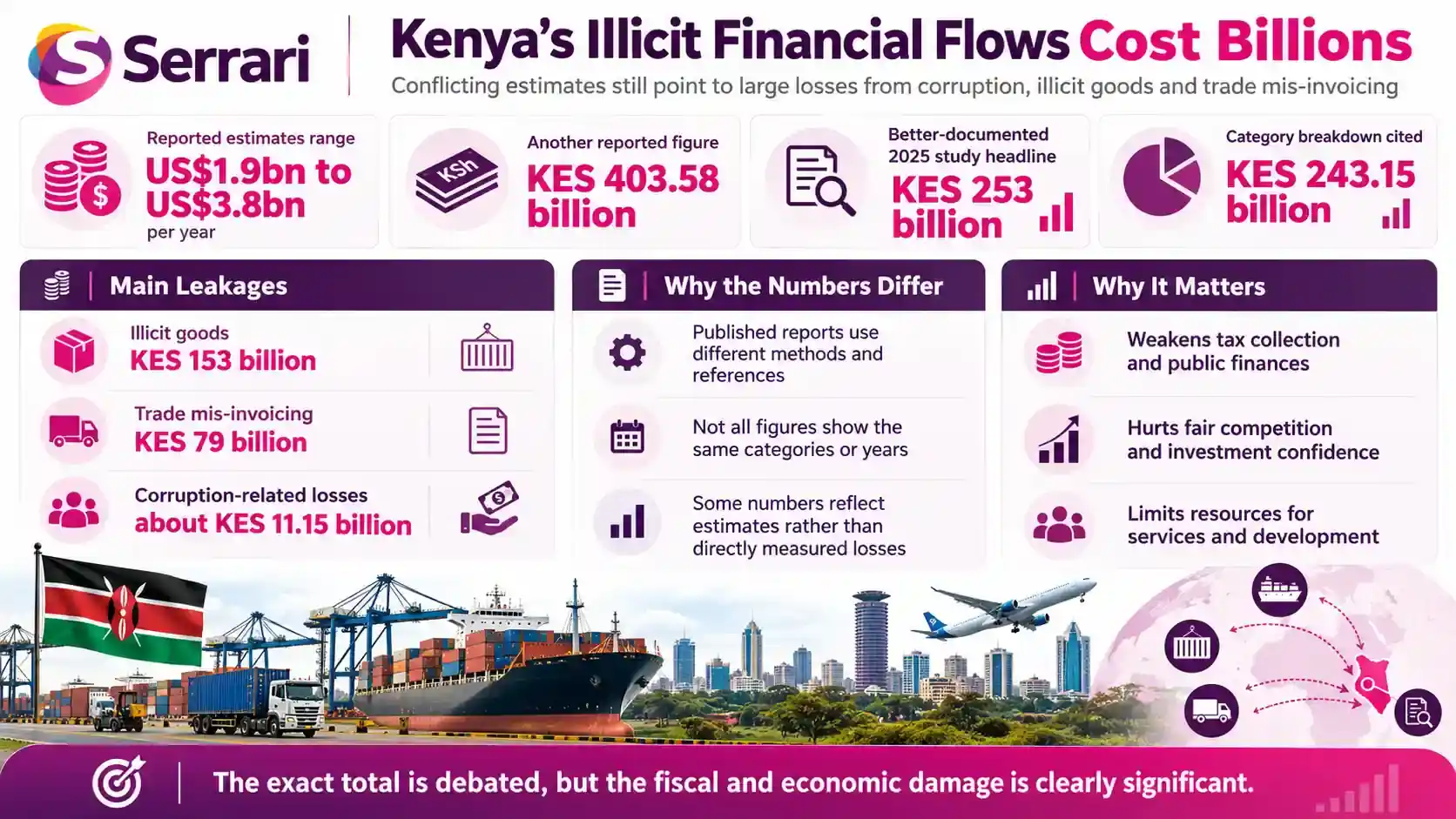
Kenya could be losing hundreds of billions of shillings each year through corruption, counterfeit goods and manipulated trade invoices, but recently published estimates do not agree on the scale of the problem. An October 2026 news report puts annual losses at KES 403.58 billion, while an earlier joint research assessment gives a headline estimate of approximately KES 253 billion.
A separate human-rights report released on October 19 connects weak accountability and pressure on public finances with public anger over taxes and living costs. The differing estimates underscore the need for clearer and more consistent measurement of illicit financial activity.
Key Overview
- Latest reported figure: KES 403.58 billion in estimated annual losses, but its calculation has not been established from the underlying study.
- Earlier headline estimate: Approximately KES 253 billion annually from a study released in September 2025.
- Alternative category total: KES 243.15 billion, including KES 153 billion linked to illicit goods, KES 79 billion to trade mis-invoicing and KES 11.15 billion to corruption.
- Other published estimate: US$3.8 billion cited in an October 2026 report; the difference from the original research remains unexplained.
- Economic implications: Weaker revenue collection, unfair competition, reduced confidence and pressure on public services.
- Priority response: Better trade-data matching, beneficial ownership transparency, enforcement and asset recovery.
Why Kenya’s Illicit Financial Flow Estimates Differ
The September 2025 research findings describe an estimated KES 253 billion in annual losses associated with corruption, illegal trade and related financial activity. Yet reporting on the category breakdown lists KES 243.15 billion: KES 153 billion in illicit goods, KES 79 billion in trade mis-invoicing and approximately KES 11.15 billion in corruption-related losses.
The difference between these two totals is approximately KES 9.85 billion. The October 2026 figure of KES 403.58 billion is substantially higher, while another report cites US$3.8 billion. The available published summaries do not reconcile these values through a common calculation or reporting period.
These figures should therefore be treated as estimates using potentially different methods, not audited amounts of money proven to have left Kenya in a single year. Some categories may also describe economic damage or forgone revenue rather than money transferred across borders.
How Trade Mis-Invoicing and Counterfeits Drain the Economy
Trade mis-invoicing happens when importers or exporters report incorrect shipment prices or quantities. Understating the declared value of imports can reduce customs duties, while overstating or understating trade values can also help disguise illicit transfers.
The 2025 assessment highlighted widening discrepancies in trade declarations, alongside losses associated with counterfeit goods. Such discrepancies warrant investigation, although not every difference between countries’ trade statistics proves fraud; timing, freight treatment and recording methods can also cause mismatches.
Counterfeit and smuggled products create another problem. They can bypass taxes, undercut legitimate businesses and expose consumers to poor-quality or unsafe goods. The study’s KES 153 billion estimate makes illicit goods the largest category in its published breakdown.
Context is everything. Stay ahead of shifting trends with today’s market updates, and uncover emerging opportunities using the Serrari Group Market Index and Marketplace. Then, take control of your own financial future by exploring our Money & Life Reset Transformation Blueprint ™ to build stronger habits, create better systems, and design a path toward lasting wealth.
Why the Losses Matter for Kenya’s Budget and Households
Illicit activity can weaken the tax base and increase pressure on compliant workers and businesses to carry the burden of financing public services. It can also distort competition, discourage investment and leave less fiscal room for healthcare, education or infrastructure.
A recent assessment of economic grievances describes how debt concerns, rising living costs, taxes and allegations of corruption contributed to protests between 2023 and 2025. However, estimated illicit financial flows cannot be treated as revenue the government could automatically recover in full. Different forms of loss require different recovery and enforcement approaches.
What Kenya Could Do to Reduce Illicit Flows
The research recommendations include stronger coordination among tax, customs and investigative agencies, improved data sharing, scrutiny of high-risk transactions and more effective identification of the people who ultimately own companies.
Trade-value comparisons, targeted inspections and consistent publication of recoveries could help distinguish suspected fraud from statistical discrepancies. Independent reporting that explains each estimate’s methodology would also make it easier to evaluate progress.
The immediate lesson is clear: Kenya faces a significant illicit-finance challenge, but the exact annual cost remains uncertain. Establishing a credible baseline is essential to judging whether reforms are working.
Sources: National Taxpayers Association / Oxfam Kenya / Amnesty International / The Standard / The Rio Times
Your financial future isn’t something you wait for—it’s something you build.
The real question is: when do you begin?
Move beyond simply staying informed.
Navigate the markets with clarity—track trends through the Serrari Group Market Index, uncover opportunities in the Serrari Marketplace, and build practical knowledge with our Curated Wealth Builder Platform.
Stay connected to what truly matters.
Get daily insights on macro trends and financial movements across Kenya, Africa, and global markets—delivered through the Serrari Newsletter.
Growth opens doors.
Advance your career through professional programs including ACCA, HESI A2, ATI TEAS 7 , HESI EXIT , NCLEX – RN and NCLEX – PN, Financial Literacy!🌟—designed to move you forward with confidence.
See where money is flowing—clearly and in real time.
Track Money Market Funds, Treasury Bills, Treasury Bonds, Green Bonds, and Fixed Deposits, alongside global and African indexes, key economic indicators, and the evolving Crypto and stablecoin landscape—all within Serrari’s Market Index.