BRAC Bank plans to issue a three-year, zero-coupon green bond worth Tk 1,000 crore to channel financing into eligible environmental projects. The instrument is designed to support renewable energy, greener buildings and industrial energy efficiency, while expanding Bangladesh’s sustainable finance market.
Key Overview
- Bond value: Tk 1,000 crore, equivalent to Tk 10 billion.
- Tenure: Three years.
- Structure: Senior, unsecured, non-convertible, fully redeemable and zero-coupon.
- Eligible projects: Renewable energy, green buildings and industrial energy-efficiency initiatives.
- Face value per bond: Tk 10 lakh.
- Target return: 7.5%, as reported at the launch announcement.
- Framework: Bangladesh Bank’s green bond financing policy and the International Capital Market Association’s Green Bond Principles.
A Major Step for Bangladesh’s Green Finance Market
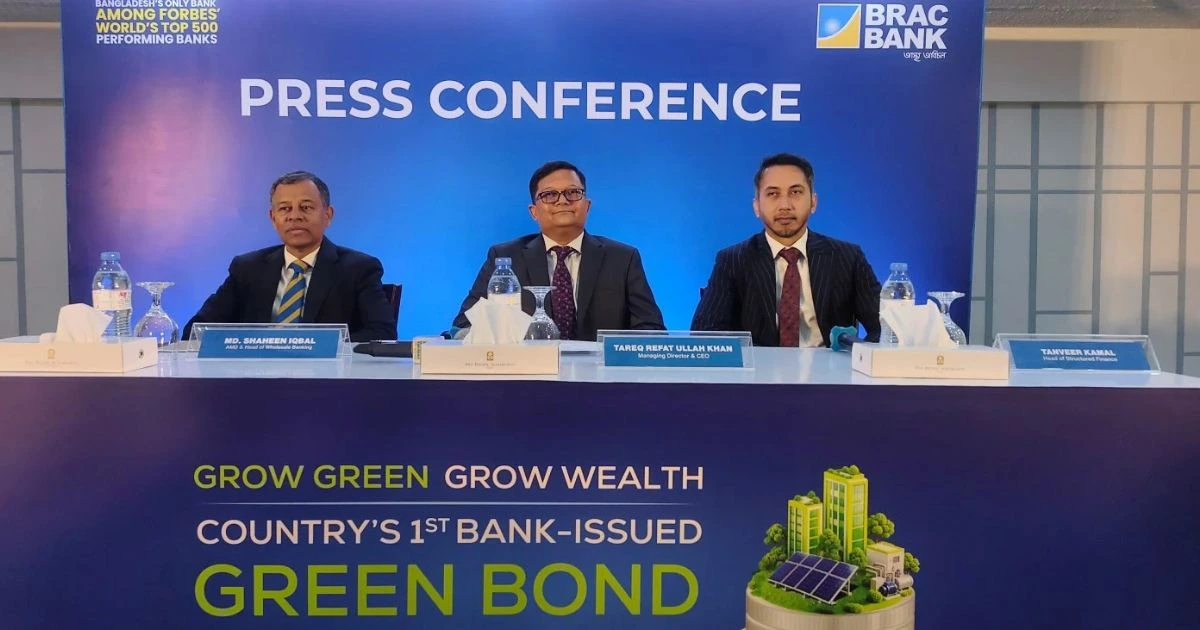
BRAC Bank is preparing to issue a Tk 1,000 crore green bond, a move intended to expand financing for environmentally sustainable projects in Bangladesh. The proposed instrument is notable because it is the first green bond by a Bangladeshi bank aligned with Bangladesh Bank’s policy on green bond financing for banks and financial institutions. The initiative aims to channel capital towards businesses investing in cleaner energy, environmentally responsible buildings and more efficient industrial operations.
The bond will have a three-year tenure and is structured as senior, unsecured, non-convertible, fully redeemable and zero-coupon debt. Its total face value is Tk 1,000 crore, or Tk 10 billion. The issuance comes as Bangladesh’s financial sector looks for ways to direct more capital towards sustainable investment while broadening the range of instruments available in the domestic capital market.
Unlike a conventional bond that pays interest periodically, a zero-coupon bond does not make regular interest payments. Instead, it is issued at a discount to its face value and redeemed at face value at maturity. The difference between the purchase price and the amount received at maturity represents the investor’s return, subject to the bond’s terms and applicable taxes.
Where the Bond Proceeds Will Go
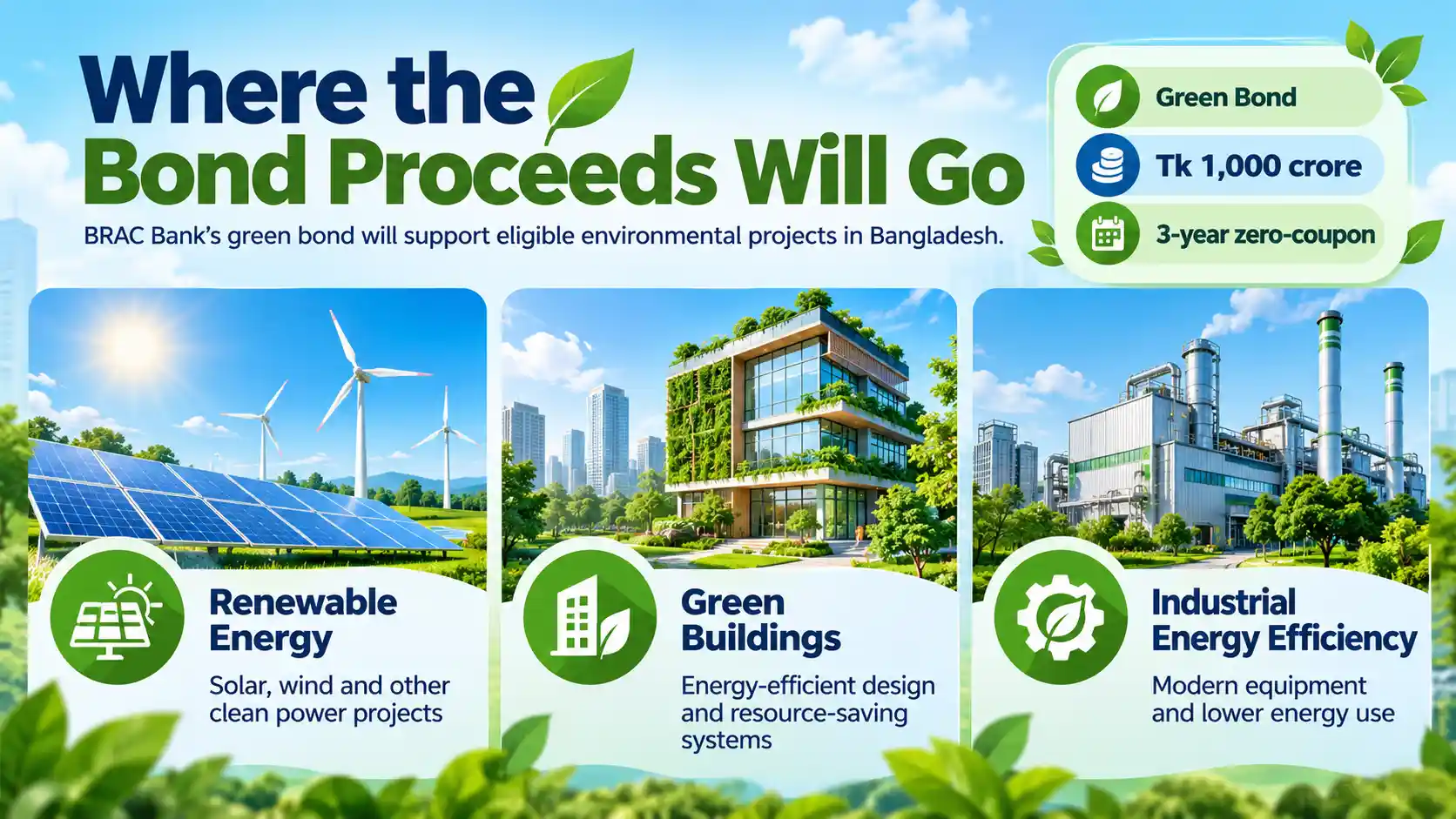
The proceeds are intended to finance projects that deliver measurable environmental benefits. The main eligible categories include renewable energy, green buildings and industrial energy-efficiency. By directing capital towards these areas, BRAC Bank aims to help businesses reduce their environmental footprint while improving the efficiency and sustainability of their operations.
Renewable energy projects can help companies reduce their dependence on fossil fuels and exposure to volatile fuel prices. Solar installations, wind power and other eligible clean-energy investments can also support businesses seeking more reliable and cost-effective energy supplies.
Green buildings represent another potential use of the funds. These projects can incorporate energy-efficient equipment, improved building design and resource-saving technologies to reduce energy consumption and environmental impacts. Meanwhile, industrial energy-efficiency investments can help factories modernise equipment, optimise production processes and reduce the amount of energy needed to manufacture goods.
The bank’s stated objective is to make financing more accessible to businesses pursuing these investments. Its green bond initiative is intended to mobilise capital specifically for eligible environmental projects rather than general corporate purposes.
Investment Terms and Expected Returns
The bond will have a face value of Tk 10 lakh per unit, with corporate institutions and individual investors among the intended participants. Eligible company provident and gratuity funds may also invest, subject to applicable regulations and investment requirements.
The reported target return is 7.50 percent, with the zero-coupon structure meaning investors will not receive periodic interest payments. Instead, the bond is expected to be issued below its face value and redeemed at the full face value at maturity. The final investment outcome will depend on the issue terms, applicable tax treatment and the investor’s holding period.
For illustration, a bond with a face value of Tk 10 lakh purchased at a discount would generate a return through the difference between its purchase price and the amount repaid at maturity. Investors should distinguish between an annualised yield and the total return over the full three-year term, as these are not interchangeable measures.
The instrument’s senior unsecured status is also important. Although senior debt ranks ahead of subordinated debt in the relevant repayment hierarchy, the bond is unsecured, meaning it does not have specific collateral backing it. Investors should therefore assess the issuer’s creditworthiness, the final offering documentation and the risks associated with holding the security.
Context is everything. Stay ahead of shifting trends with today’s market updates, and uncover emerging opportunities using the Serrari Group Market Index and Marketplace. Then, take control of your own financial future by exploring our Money & Life Reset Transformation Blueprint ™ to build stronger habits, create better systems, and design a path toward lasting wealth.
Sustainability Standards and Accountability
The bond framework is aligned with the International Capital Market Association’s Green Bond Principles. These principles provide a recognised framework for green bond issuance, covering areas such as the use of proceeds, project evaluation, management of funds and reporting.
The framework has also received a second-party opinion from S&P Global Ratings, providing an independent assessment of its green credentials. Such external review can help investors evaluate whether a bond’s stated environmental objectives are supported by a defined financing framework.
Transparency will be particularly important once the proceeds are allocated. Investors need to understand which projects receive financing, how eligibility is assessed and whether funds are being used for the intended environmental purposes. Clear reporting and ongoing monitoring can help strengthen confidence in the instrument and the wider green bond market.
The expected contribution to the United Nations Sustainable Development Goals includes SDG 7: Affordable and Clean Energy; SDG 9: Industry, Innovation and Infrastructure; SDG 11: Sustainable Cities and Communities; and SDG 13: Climate Action. These goals connect the financing initiative with broader priorities involving clean energy, industrial development, sustainable urban growth and climate action.
Implications for Bangladesh’s Capital Market
The proposed issuance comes as Bangladesh seeks to diversify its sources of long-term financing. Green bonds can provide an alternative channel for mobilising investment towards environmental projects while giving investors access to securities linked to defined sustainability objectives.
BRAC Bank has said that more than 60 percent of its loan portfolio is dedicated to sustainable finance. The bank has also reported recognition among Bangladesh Bank’s top sustainable banks for five consecutive years and a first-place ranking among Bangladeshi banks in Bloomberg’s ESG Rating.
The green bond builds on these activities by creating a dedicated instrument for eligible environmental investments. It could help businesses seeking financing for projects that may require substantial upfront capital but generate operational savings and environmental benefits over time.
However, the longer-term impact will depend on execution. The amount of capital raised, the quality of the projects financed, the transparency of reporting and the bond’s performance will all influence investor confidence. The development of a deeper corporate bond market will also require clear rules, credible disclosures and a wider range of investment opportunities.
Outlook
BRAC Bank’s Tk 1,000 crore green bond represents a significant development in Bangladesh’s sustainable finance market. By directing financing towards renewable energy, green buildings and industrial energy efficiency, the bank aims to connect capital-market investment with environmental objectives.
Its success will depend on investor participation, effective allocation of proceeds and credible oversight throughout the bond’s life. If the framework delivers on its commitments, the issuance could help demonstrate how banks can mobilise private capital for environmental projects while supporting the gradual development of Bangladesh’s corporate bond market.
FAQs
1. How much is BRAC Bank’s green bond worth?
The planned issuance has a face value of Tk 1,000 crore, equivalent to Tk 10 billion.
2. What projects will the green bond finance?
The proceeds are intended for eligible renewable energy projects, green buildings and industrial energy-efficiency initiatives.
3. How long is the bond’s tenure?
The bond has a three-year tenure and is structured as a zero-coupon instrument, meaning it does not pay periodic interest.
4. Who can invest in the green bond?
Corporate institutions and individual investors are among the intended participants. Eligible company provident and gratuity funds may also invest, subject to applicable regulations and investment requirements.
Your financial future isn’t something you wait for—it’s something you build.
The real question is: when do you begin?
Move beyond simply staying informed.
Navigate the markets with clarity—track trends through the Serrari Group Market Index, uncover opportunities in the Serrari Marketplace, and build practical knowledge with our Curated Wealth Builder Platform.
Stay connected to what truly matters.
Get daily insights on macro trends and financial movements across Kenya, Africa, and global markets—delivered through the Serrari Newsletter.
Growth opens doors.
Advance your career through professional programs including ACCA, HESI A2, ATI TEAS 7 , HESI EXIT , NCLEX – RN and NCLEX – PN, Financial Literacy!🌟—designed to move you forward with confidence.
See where money is flowing—clearly and in real time.
Track Money Market Funds, Treasury Bills, Treasury Bonds, Green Bonds, and Fixed Deposits, alongside global and African indexes, key economic indicators, and the evolving Crypto and stablecoin landscape—all within Serrari’s Market Index.