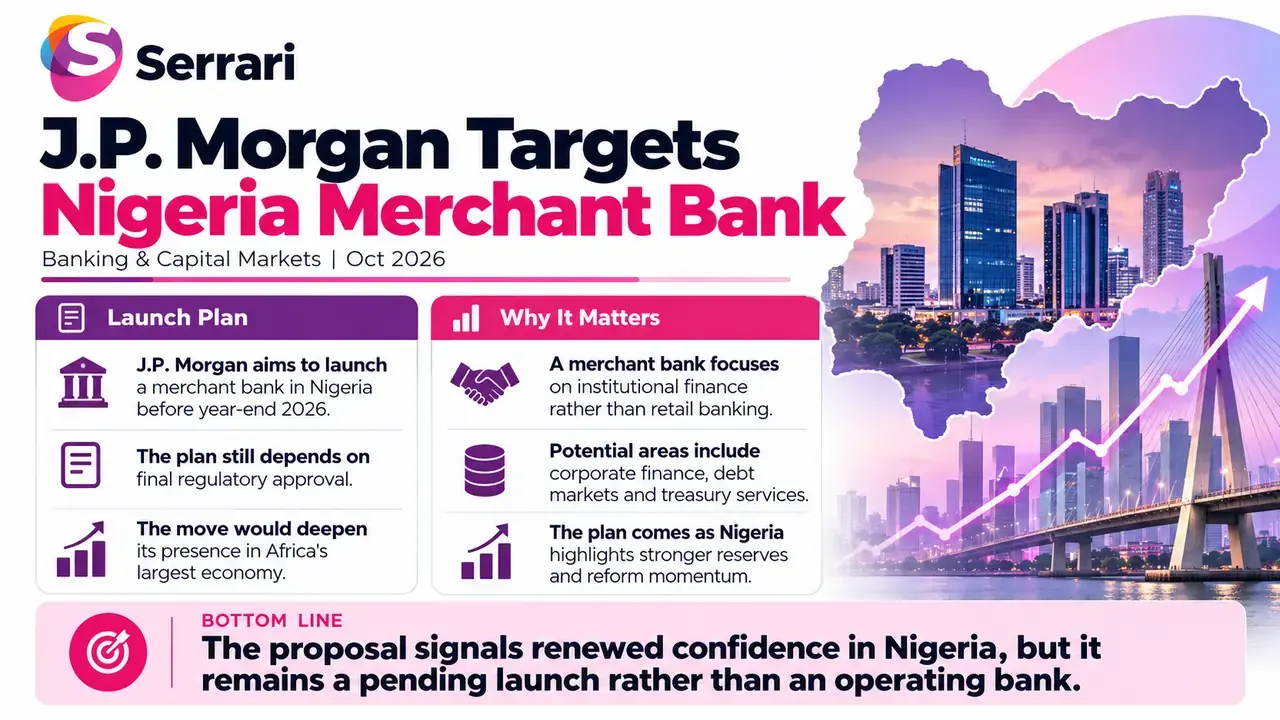
J.P. Morgan plans to establish a merchant bank in Nigeria before the end of 2026, expanding its local presence as the country seeks stronger international investment and more developed capital markets. Dapo Olagunji, the bank’s managing director for West Africa, outlined the proposed launch at a Singapore financial dialogue on October 8. The opening is a target, not a completed transaction: operations remain subject to approval from Nigerian regulators.
Key Overview
- J.P. Morgan aims to open a Nigerian merchant bank by the end of 2026, subject to regulatory approval.
- The proposed institution would deepen the group’s existing Nigerian operations rather than mark its first entry into the market.
- Corporate financing, capital-market transactions and cross-border investment are potential areas of opportunity, but a detailed product rollout has not been confirmed.
- Nigeria’s central-bank governor reported gross foreign reserves of $55.07 billion as of October 8, alongside approximately $46 billion in net reserves.
- The announcement coincides with efforts to connect Nigerian financial institutions and investors with Asian markets.
What J.P. Morgan’s Planned Expansion Involves
Olagunji disclosed the year-end launch ambition at the Nigeria–Asia Financial Connectivity Dialogue, organised by the Central Bank of Nigeria (CBN) with J.P. Morgan, Nigerian Exchange Group and FMDQ Group. The gathering brought together policymakers, financiers and businesses to discuss capital formation and investment links.
The American banking group is not new to Nigeria. Its existing Lagos operations serve clients through asset and wealth management and commercial and investment banking. A locally licensed merchant bank would represent a more substantial operating presence, subject to the precise authorisation granted.
The company has not publicly confirmed a final opening date, initial lending commitments or a complete list of products for the proposed subsidiary. Those details should not be treated as settled while its regulatory application remains outstanding.
How Merchant Banking Differs From Retail Banking
Merchant banks primarily serve companies, institutions and large transactions rather than building extensive consumer savings-account and branch networks. Depending on the permissions granted, a Nigerian operation could support corporate finance, debt issuance, structured financing, treasury services and investment-related activities.
For local businesses, that could mean more options when raising capital for acquisitions, infrastructure and expansion. For international investors, deeper local participation by a global institution could improve access to transaction expertise and counterparties. Neither outcome is automatic: financing volumes, borrowing costs and actual services will depend on commercial decisions and market conditions.
Nigeria’s banking recapitalisation framework has also increased minimum capital requirements and regulatory scrutiny. Licensing therefore involves more than a launch announcement, including assessment of capital, governance, risk management and compliance arrangements.
Context is everything. Stay ahead of shifting trends with today’s market updates, and uncover emerging opportunities using the Serrari Group Market Index and Marketplace. Then, take control of your own financial future by exploring our Money & Life Reset Transformation Blueprint ™ to build stronger habits, create better systems, and design a path toward lasting wealth.
Foreign Reserves and Market Reforms Shape the Backdrop
At the Singapore meetings, CBN Governor Olayemi Cardoso said Nigeria’s gross foreign reserves had reached $55.07 billion on October 8, while net reserves stood at about $46 billion. Net reserves account for relevant foreign-currency liabilities, so the two figures measure different aspects of the country’s external position.
Cardoso presented stronger foreign-exchange buffers and reforms to currency-market operations as factors supporting investor confidence. However, the reserve figures do not establish that J.P. Morgan’s planned investment caused the improvement, or that foreign-exchange volatility has disappeared.
The wider Singapore engagement programme also included talks with Singapore’s monetary authority and a financial-innovation cooperation agreement with the Global Finance & Technology Network. The objective was to improve financial-market links, technology exchange and sustained investment relationships.
Potential Impact on Nigeria’s Capital Markets
A functioning merchant bank could widen choices for major Nigerian issuers seeking financing and create additional links to global pools of capital. The expansion also follows renewed international attention to Nigerian debt markets, including the country’s inclusion in a newly introduced J.P. Morgan emerging-market bond index in September.
Still, the immediate development is a plan subject to regulatory consent, not proof that fresh capital has entered Nigeria or that transaction costs have fallen. The next milestones are a confirmed licence, an operational start date and disclosure of the services the new bank will actually offer.
Sources: TheCable / THISDAY / J.P. Morgan / Central Bank of Nigeria
Your financial future isn’t something you wait for—it’s something you build.
The real question is: when do you begin?
Move beyond simply staying informed.
Navigate the markets with clarity—track trends through the Serrari Group Market Index, uncover opportunities in the Serrari Marketplace, and build practical knowledge with our Curated Wealth Builder Platform.
Stay connected to what truly matters.
Get daily insights on macro trends and financial movements across Kenya, Africa, and global markets—delivered through the Serrari Newsletter.
Growth opens doors.
Advance your career through professional programs including ACCA, HESI A2, ATI TEAS 7 , HESI EXIT , NCLEX – RN and NCLEX – PN, Financial Literacy!🌟—designed to move you forward with confidence.
See where money is flowing—clearly and in real time.
Track Money Market Funds, Treasury Bills, Treasury Bonds, Green Bonds, and Fixed Deposits, alongside global and African indexes, key economic indicators, and the evolving Crypto and stablecoin landscape—all within Serrari’s Market Index.