






France’s rising debt has prompted a warning that a prolonged loss of access to financial markets could require an extraordinary €1.8 trillion European rescue. However, the figure comes from a hypothetical financing exercise, not an announced bailout requirement. Current official statistics show serious fiscal pressure, but France continues to borrow in the bond market, and European authorities have not announced a rescue programme.
Key Overview
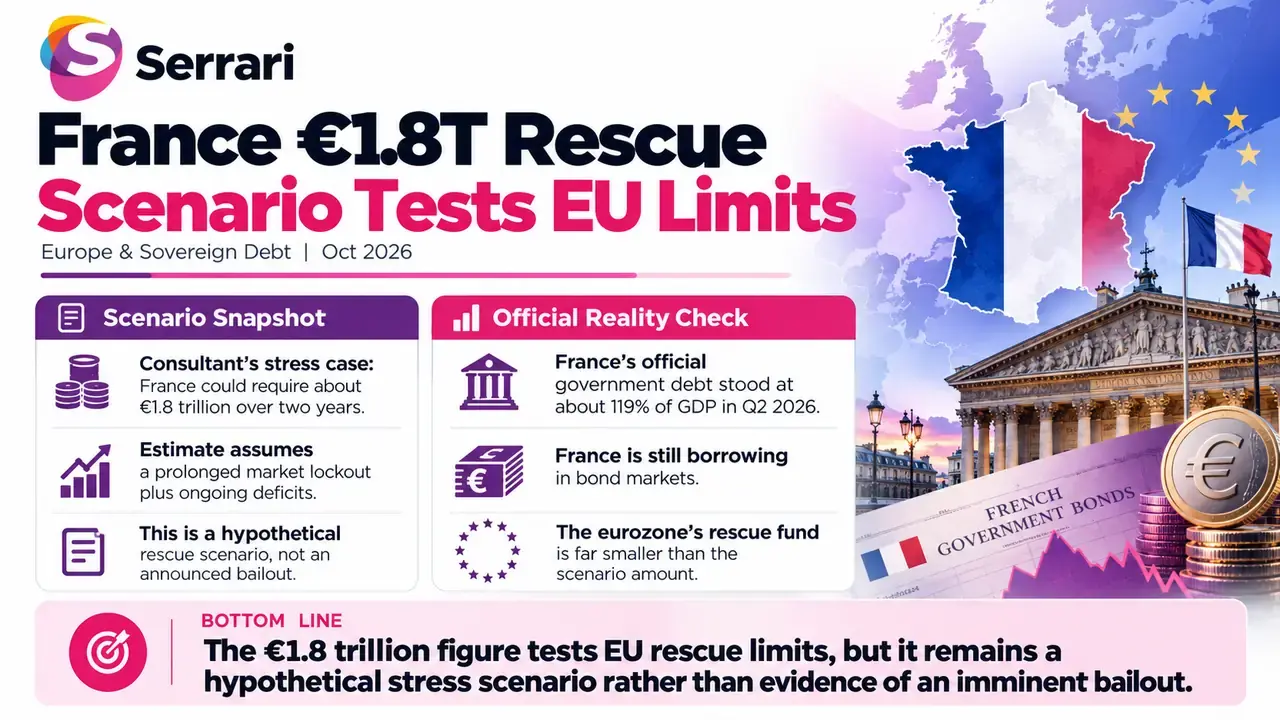
- Consultant Bob Lyddon estimates that a two-year market shutdown could create nearly €1.8 trillion in French public-sector financing needs.
- France’s official government debt reached €3.60 trillion, or 119.0% of GDP, at the end of June 2026.
- The eurozone’s permanent rescue fund has €433 billion in available lending capacity, far below the consultant’s scenario.
- An EU-funded bond-purchase programme is Lyddon’s proposal, not an agreed or automatically available intervention.
How the €1.8 Trillion Rescue Estimate Was Calculated
In an analysis published on October 7, tax consultant Bob Lyddon argues that France could require exceptional support if its public-sector borrowers were excluded from capital markets for two years.
His calculation assumes €4.917 trillion in liabilities are refinanced over an average seven-year period, producing roughly €702 billion in annual refinancing needs. He then adds a projected €185 billion annual deficit, equivalent to 5% of an assumed €3.7 trillion GDP. That produces approximately €887 billion a year, or €1.77 trillion across two years, rounded to €1.8 trillion.
Lyddon also estimates broader public-sector debts and contingent liabilities at 169% of GDP, using a methodology based on year-end 2021 data. That is not France’s current official government debt ratio. Contingent obligations also do not necessarily become cash payments or mature like conventional bonds, making the calculation a stress scenario rather than an established funding forecast.
Context is everything. Stay ahead of shifting trends with today’s market updates, and uncover emerging opportunities using the Serrari Group Market Index and Marketplace. Then, take control of your own financial future by exploring our Money & Life Reset Transformation Blueprint ™ to build stronger habits, create better systems, and design a path toward lasting wealth.
What France’s Latest Debt Figures Show
According to the September 29 official debt release, France’s Maastricht-defined government debt stood at €3.5955 trillion at the end of the second quarter of 2026, equivalent to 119.0% of GDP. This was up from 117.5% in the previous quarter.
The government has also projected a 2026 deficit of 5.4% of GDP, with debt potentially climbing to 121.7% of GDP in 2027. Persistent deficits, rising borrowing costs and political disagreements over spending cuts complicate the task of stabilising the debt burden.
Nevertheless, difficulty financing deficits is not the same as losing market access. France’s published funding figures show that 85% of its 2026 state financing programme had been completed by September, with demand for medium- and long-term securities exceeding supply. Its 2027 plan envisages €340 billion in new medium- and long-term issuance. On October 7, the Bank of France governor said the country did not currently need intervention from the European Central Bank.
Why Europe’s Existing Safeguards Face Limits
The European Stability Mechanism, the eurozone’s permanent crisis-lending institution, has a maximum lending capacity of €500 billion. Its reported remaining capacity is €433 billion, meaning it could not independently cover the full amount in Lyddon’s hypothetical two-year scenario.
The European Central Bank has a separate Transmission Protection Instrument, designed to counter unwarranted disruptions in the transmission of monetary policy. Purchases have no preset numerical cap, but activation depends on eligibility assessments, including fiscal sustainability and compliance with relevant EU policy requirements. It is not an unconditional sovereign bailout facility.
Could the EU Borrow €2 Trillion for France?
Lyddon proposes that the European Union itself raise roughly €2 trillion and purchase French public-sector bonds over two to three years. He points to the pandemic-era NextGenerationEU programme as a possible model for collective borrowing.
The existing EU borrowing framework uses the EU budget and its financial headroom to support repayment obligations. But a new rescue programme of this scale would require political and legal decisions; the pandemic programme does not automatically authorise €2 trillion of French bond purchases.
For now, the central concern is whether France can contain borrowing costs and put its public finances on a sustainable path. The €1.8 trillion figure illustrates the potential scale of a severe market-access shock, not evidence that such a bailout is imminent.
Sources: Lyddon Consulting / INSEE / Reuters / Agence France Trésor / European Stability Mechanism / European Central Bank / European Commission
Your financial future isn’t something you wait for—it’s something you build.
The real question is: when do you begin?
Move beyond simply staying informed.
Navigate the markets with clarity—track trends through the Serrari Group Market Index, uncover opportunities in the Serrari Marketplace, and build practical knowledge with our Curated Wealth Builder Platform.
Stay connected to what truly matters.
Get daily insights on macro trends and financial movements across Kenya, Africa, and global markets—delivered through the Serrari Newsletter.
Growth opens doors.
Advance your career through professional programs including ACCA, HESI A2, ATI TEAS 7 , HESI EXIT , NCLEX – RN and NCLEX – PN, Financial Literacy!🌟—designed to move you forward with confidence.
See where money is flowing—clearly and in real time.
Track Money Market Funds, Treasury Bills, Treasury Bonds, Green Bonds, and Fixed Deposits, alongside global and African indexes, key economic indicators, and the evolving Crypto and stablecoin landscape—all within Serrari’s Market Index.