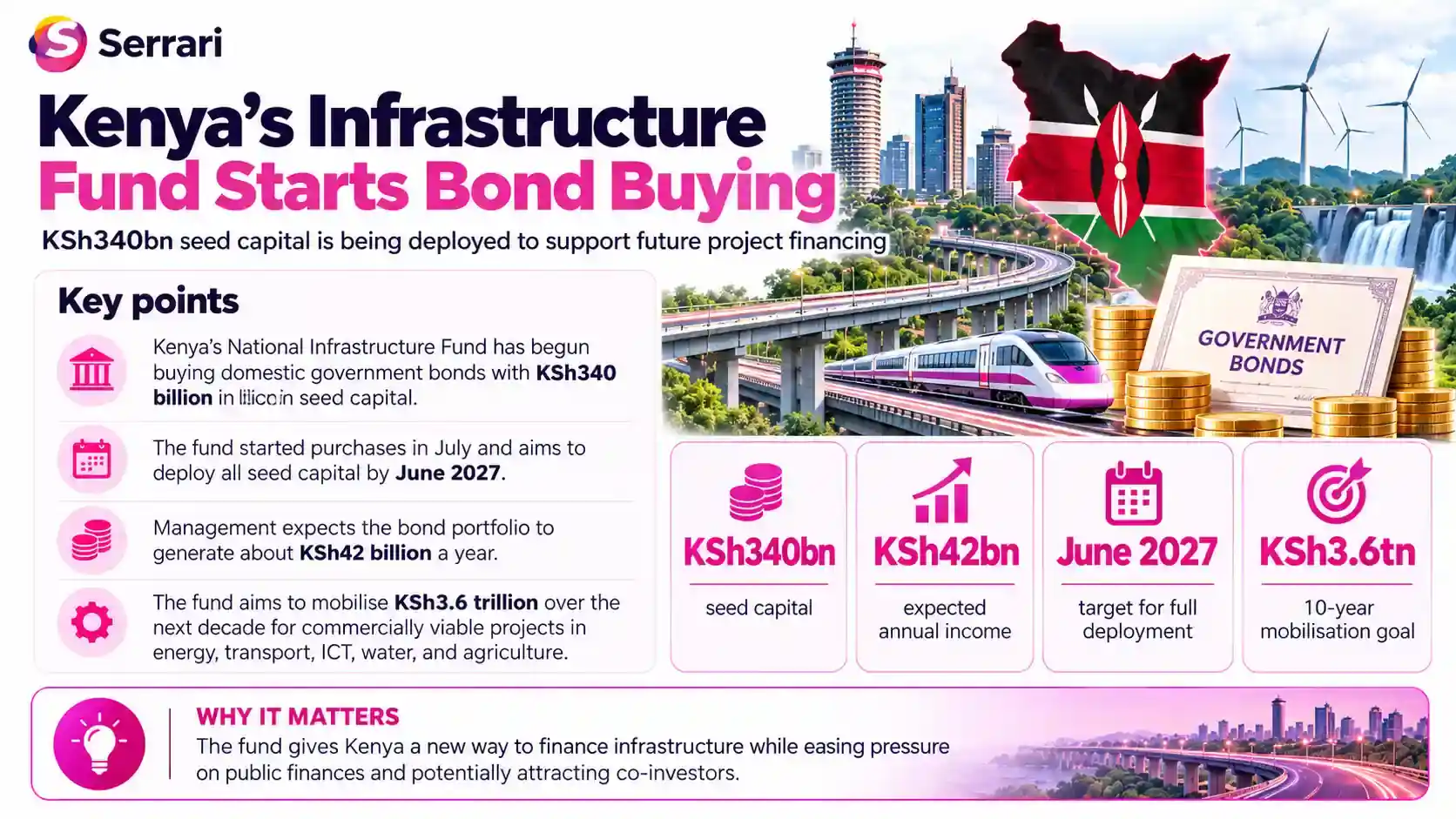
Kenya’s National Infrastructure Fund (NIF) has begun investing its KSh340 billion ($2.62 billion) seed capital in domestic government bonds, marking the first significant deployment of funds under the country’s new infrastructure financing framework.
According to the October 8, 2026 disclosure, the fund started purchasing government securities in July 2026 and expects to deploy its entire seed capital by June 2027.
The investment strategy is designed to generate approximately KSh42 billion annually in investment income while supporting liquidity in Kenya’s financial markets.
The fund ultimately aims to mobilise KSh3.6 trillion over the next decade through investment returns, co-investment arrangements and debt financing, targeting commercially viable projects in energy, transport, telecommunications, agriculture and water infrastructure.
Key Overview
- KSh340 billion seed capital: Kenya’s National Infrastructure Fund has begun deploying its initial capital through domestic government bond investments.
- KSh42 billion annual income: The bond portfolio is expected to generate approximately KSh42 billion per year once fully deployed.
- June 2027 deployment target: Management expects to invest the full seed capital before the end of the current financial year.
- KSh3.6 trillion financing ambition: The fund aims to mobilise additional public and private investment over the next decade.
- Privatisation proceeds: Initial capital comes from the partial divestiture of Kenya Pipeline Company and government share sales in Safaricom.
- Priority investments: Planned investments include energy, transport, logistics, ICT, water and agricultural infrastructure.
- Lamu refinery: The fund is considering an equity investment in a planned refinery associated with Nigerian industrialist Aliko Dangote.
Why Kenya’s Infrastructure Fund Is Buying Treasury Bonds
The National Infrastructure Fund is adopting an income-generating investment strategy before committing significant resources directly to infrastructure projects.
Chief Executive Officer James Mworia confirmed that government bond purchases began in July, although the precise value of securities acquired has not been disclosed.
The strategy involves investing seed capital in domestic government securities to earn interest income while preserving financial resources for future investments.
Based on the projected annual income of KSh42 billion and seed capital of KSh340 billion, the portfolio implies an annual yield of approximately 12.35%.
These earnings could provide a recurring source of financing for infrastructure development without requiring the government to fund every project directly through annual budget allocations.
However, actual returns will depend on bond yields, purchase prices, portfolio duration and reinvestment conditions.
The strategy also exposes the fund to interest-rate risk, sovereign credit risk and potential losses if securities must be sold before maturity.
Bond Purchases Could Increase Commercial Bank Liquidity
One of the fund’s objectives is to release liquidity held in government securities into Kenya’s banking system.
Commercial banks are among the largest holders of Kenyan Treasury bonds and bills, partly because government securities provide relatively predictable income compared with riskier private-sector lending.
According to the fund’s financing strategy, purchasing bonds from banks and other investors could provide additional cash that financial institutions may redirect toward loans for businesses and households.
In principle, greater banking-system liquidity could support credit availability and private-sector investment.
Nevertheless, increased liquidity does not automatically translate into higher lending. Banks must also assess borrower creditworthiness, prevailing interest rates, economic conditions and regulatory capital requirements.
Furthermore, buying existing government bonds in the secondary market differs from purchasing newly issued securities directly from the Treasury. Secondary-market transactions primarily transfer ownership and liquidity between investors.
The fund’s planned KSh340 billion investment is equivalent to approximately one-third of Kenya’s domestic borrowing target for the financial year ending June 2027, according to its management.
Safaricom and Kenya Pipeline Sales Provide Seed Capital
The National Infrastructure Fund has been capitalised using proceeds from government asset disposals rather than relying exclusively on additional taxation or conventional public borrowing.
Its initial capital structure includes approximately KSh106.3 billion generated through the partial privatisation of Kenya Pipeline Company and KSh204 billion from the sale of a 15% government stake in Safaricom to South Africa’s Vodacom Group.
These transactions provide an alternative mechanism for converting government ownership interests into investable financial resources.
By directing proceeds into an investment fund, the government aims to create a pool of capital capable of generating income and attracting additional investors.
The approach reflects broader efforts to reduce pressure on Kenya’s public finances, where debt-servicing obligations consume approximately 40% of government revenue.
However, exchanging public equity holdings for bond investments also involves trade-offs, including the loss of future dividends from shares sold and exposure to different investment risks.
Context is everything. Stay ahead of shifting trends with today’s market updates, and uncover emerging opportunities using the Serrari Group Market Index and Marketplace. Then, take control of your own financial future by exploring our Money & Life Reset Transformation Blueprint ™ to build stronger habits, create better systems, and design a path toward lasting wealth.
KSh3.6 Trillion Infrastructure Financing Target
Beyond government bond investments, the National Infrastructure Fund intends to finance commercially viable infrastructure projects capable of attracting institutional and private capital.
The ten-year mobilisation strategy targets approximately KSh3.6 trillion through a combination of investment income, co-investments and debt financing.
Priority sectors include energy generation and distribution, transportation networks, logistics infrastructure, information and communications technology, water systems and agriculture.
Rather than relying entirely on government expenditure, the fund intends to participate in projects alongside Kenyan and international investors.
Such arrangements could involve equity investments, project financing structures and partnerships with private infrastructure developers.
For the model to succeed, projects will need credible revenue streams, appropriate risk-sharing arrangements and strong governance.
Importantly, mobilising KSh3.6 trillion is a long-term target rather than confirmed financing already available for deployment.
Fund Considers Investment in Dangote’s Lamu Refinery
One of the projects under consideration is a planned petroleum refinery in Lamu County associated with Nigerian billionaire Aliko Dangote.
According to the reported investment plans, the fund intends to take an equity stake in the development, although its proposed investment amount and ownership percentage have not been disclosed.
The refinery forms part of broader efforts to develop Lamu as an industrial and logistics hub.
Proponents argue that the project could strengthen regional energy infrastructure, create employment and support industrial activity.
However, the development also faces environmental and community concerns, particularly regarding coastal ecosystems and potential effects on tourism and local livelihoods.
Any eventual investment will therefore require careful assessment of financial viability, environmental compliance and long-term commercial risks.
What the Fund Means for Kenya’s Economy
The National Infrastructure Fund represents a shift toward financing infrastructure through investment returns and partnerships rather than depending entirely on government borrowing.
Its bond portfolio could establish a recurring income stream, while co-investment arrangements may help attract domestic and international institutional capital.
For Kenya’s government securities market, the fund could become a significant investor, potentially influencing demand, liquidity and bond yields.
However, its wider economic benefits will depend on whether anticipated returns materialise and whether capital is ultimately allocated to productive infrastructure projects.
The most important measures of success will include realised investment income, private capital mobilised, completed infrastructure projects, governance standards and sustainable returns.
If effectively implemented, the fund could provide Kenya with an additional mechanism for financing long-term development while managing pressure on the national budget.
Sources
Reuters / Business Daily Africa / Capital FM Kenya / Kenyans.co.ke / The Wall Street Journal / Kenya Engineer
Your financial future isn’t something you wait for—it’s something you build.
The real question is: when do you begin?
Move beyond simply staying informed.
Navigate the markets with clarity—track trends through the Serrari Group Market Index, uncover opportunities in the Serrari Marketplace, and build practical knowledge with our Curated Wealth Builder Platform.
Stay connected to what truly matters.
Get daily insights on macro trends and financial movements across Kenya, Africa, and global markets—delivered through the Serrari Newsletter.
Growth opens doors.
Advance your career through professional programs including ACCA, HESI A2, ATI TEAS 7 , HESI EXIT , NCLEX – RN and NCLEX – PN, Financial Literacy!🌟—designed to move you forward with confidence.
See where money is flowing—clearly and in real time.
Track Money Market Funds, Treasury Bills, Treasury Bonds, Green Bonds, and Fixed Deposits, alongside global and African indexes, key economic indicators, and the evolving Crypto and stablecoin landscape—all within Serrari’s Market Index.