The Bank of Russia has registered its first four cryptocurrency exchange operators and five digital custodians under a new regulatory framework that took effect on 1 September 2026. The initial list includes VTB Bank in both categories and Sberbank as a custodian. The move establishes a formal structure for supervised crypto trading and custody, while restrictions on domestic cryptocurrency payments remain in place.
Key Overview
- Registered participants: Four crypto exchange operators and five digital custodians.
- Regulator: Bank of Russia.
- Key banks: VTB Bank and Sberbank.
- Framework effective date: 1 September 2026.
- Retail investor limit: ₽300,000 annually for non-qualified investors buying most liquid cryptocurrencies, subject to testing.
- Full compliance deadline: 1 September 2027.
- Domestic crypto payments: Still prohibited for ordinary goods and services.
Russia Registers Its First Crypto Exchanges and Custodians
Russia has taken a significant step towards formalising its cryptocurrency market after the Bank of Russia added the first group of digital asset businesses to its official registers on 6 October. The registrations follow the implementation of legislation governing digital currencies and digital rights, moving the country from establishing the legal framework towards authorising specific market participants.
The central bank registered four cryptocurrency exchange operators and five digital custodians. The framework permits these businesses to carry out defined activities under regulatory supervision, including cryptocurrency trading outside organised exchanges and the recording and transfer of digital assets.
The first registrations represent an early stage in Russia’s effort to establish regulated infrastructure for cryptocurrency transactions. They also provide a formal pathway for banks and specialist firms to participate in the domestic market, subject to the requirements imposed by the regulator.
The law took effect on 1 September 2026, and the central bank’s announcement confirms that the registered organisations must comply with transaction execution and accounting rules from the date they enter the registers.
Which Companies Have Been Registered?
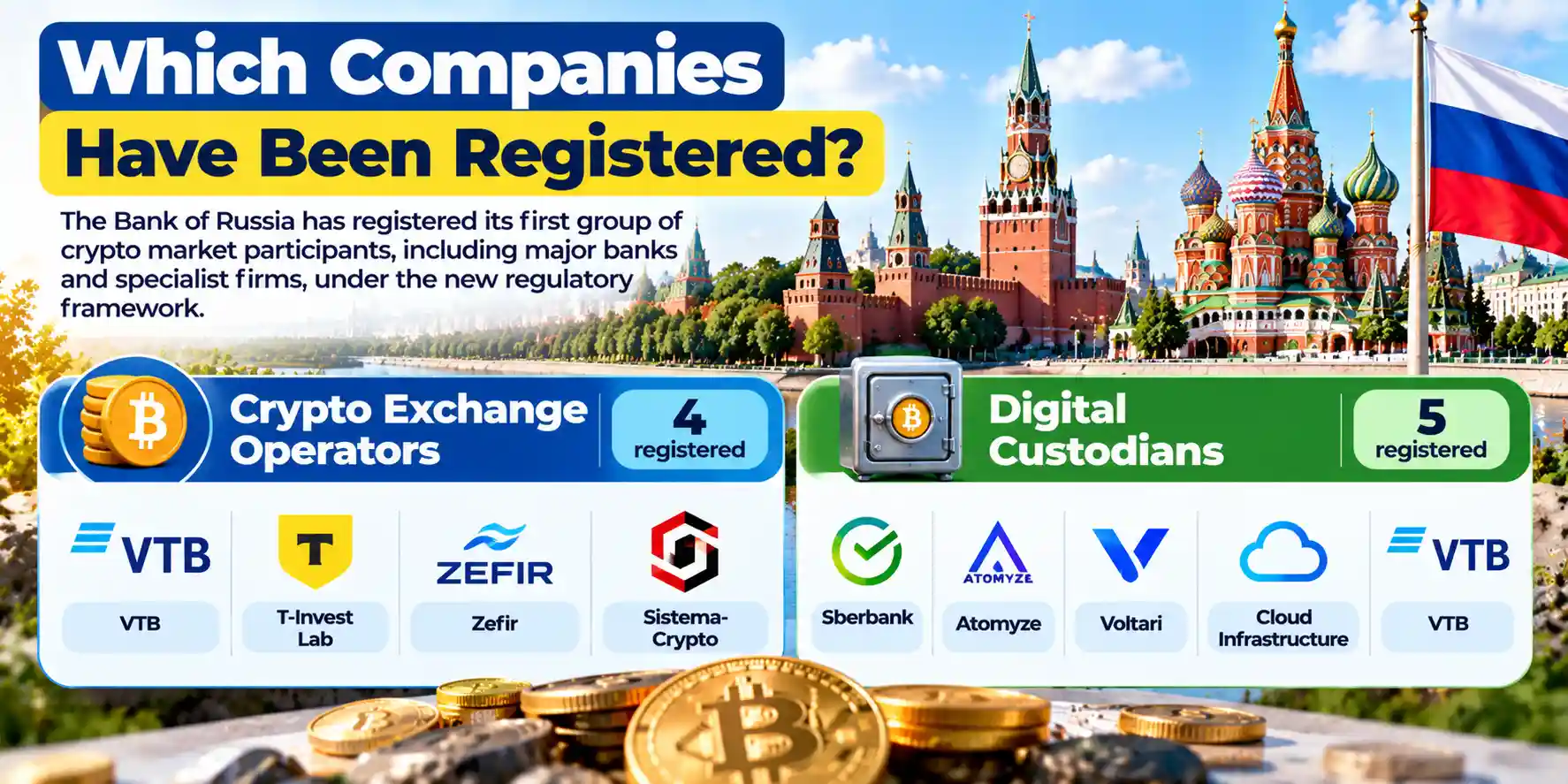
The exchange operator register includes VTB, T-Invest Lab, Zefir and Sistema-Crypto. The digital custodian register includes Sberbank, Atomyze, Voltari, Cloud Infrastructure, and VTB Bank.
VTB Bank is the only organisation included in both categories, giving it a role in both cryptocurrency exchange activity and digital asset custody. Sberbank, one of Russia’s largest banks, has been registered as a digital custodian as it prepares to expand its digital asset services.
The inclusion of banks alongside specialist businesses shows that the new framework is not limited to traditional financial institutions. It creates separate routes for different types of providers, depending on the activities they intend to conduct.
The first 5 digital custodians and 4 crypto exchanges will operate under distinct responsibilities. Their inclusion in the registers does not mean that every participant can offer all cryptocurrency services or that every digital asset is automatically permitted for every investor.
How the New Regulatory Framework Works
The framework distinguishes between cryptocurrency exchange operators and digital custodians.
Exchange operators may buy and sell digital currencies on their own behalf and for their own account outside organised trading. This model allows them to transact directly with customers rather than necessarily operating a conventional exchange with a public order book.
Digital custodians perform a different function. They can record and facilitate the transfer of digital currencies and digital rights, while providing clients with access to the address identifiers where assets are recorded. These services are intended to support the administration and tracking of digital holdings.
The distinction matters because trading and custody create different operational responsibilities. Exchange operators must manage transaction execution, while custodians focus on recording ownership and transfers. Both activities fall within the central bank’s broader effort to bring cryptocurrency services into a supervised financial structure.
The development has been described as a shift towards bank-supervised crypto operations, with established lenders and specialist firms entering the formal market.
Context is everything. Stay ahead of shifting trends with today’s market updates, and uncover emerging opportunities using the Serrari Group Market Index and Marketplace. Then, take control of your own financial future by exploring our Money & Life Reset Transformation Blueprint ™ to build stronger habits, create better systems, and design a path toward lasting wealth.
Sberbank Prepares to Introduce Crypto Products
Sberbank’s registration as a digital custodian comes as the bank prepares to introduce cryptocurrency products through its existing platforms. It has announced plans for an initial launch on 1 December, with Bitcoin (BTC), Ether (ETH), and Tether (USDT) expected to be supported.
The planned services are intended to be accessible through SberBank Online, SberInvestments and SberBusiness. These are future product plans, however, and should not be interpreted as confirmation that the products are already available to customers.
VTB Bank is also represented in the exchange operator and custodian registers. Its dual registration highlights how established financial institutions may participate in multiple parts of the digital asset infrastructure, provided they meet the applicable requirements.
The registrations are therefore relevant not only to specialist cryptocurrency businesses but also to banks exploring how digital assets can fit within existing financial services.
Investor Limits and Payment Restrictions Remain
Russia’s new framework does not grant unrestricted access to cryptocurrency. Non-qualified investors may purchase most liquid cryptocurrencies up to ₽300,000 per year through a single intermediary, after passing a required test. Qualified investors must also pass a test but are not subject to the same purchase limit under the rules described by the central bank.
The framework also maintains the prohibition on using cryptocurrency to pay for ordinary goods and services within Russia. Regulated trading and custody services are therefore being introduced without recognising digital currencies as a general domestic payment method.
These restrictions shape how the new market can develop. While the registers establish approved channels for specified activities, investor eligibility and permitted uses will influence the level and type of demand that authorised businesses can serve.
The transition period is also important. The Bank of Russia says registered organisations must bring their activities into compliance with the applicable legislation by September 1, 2027. This provides time for operational adjustments, but registration does not remove the need to meet the remaining legal requirements.
Outlook
Russia’s first registrations of crypto exchange operators and digital custodians establish a foundation for a more formally supervised digital asset market. The participation of VTB Bank and Sberbank demonstrates how established financial institutions are entering this environment alongside specialist providers.
The next phase will depend on whether registered firms can build reliable trading, custody, recordkeeping and compliance systems while meeting the central bank’s requirements. Their ability to serve customers within the permitted activities will help determine how much of Russia’s cryptocurrency activity moves into regulated channels.
However, the framework remains limited by investor eligibility rules and the prohibition on domestic cryptocurrency payments. These restrictions mean the registrations should be viewed as a structured opening for specific digital asset services rather than a wholesale liberalisation of cryptocurrency use.
For the market, the key test will be implementation: whether the new infrastructure attracts users, operates reliably and provides sufficient confidence for individuals and businesses to use authorised intermediaries. The registrations mark the beginning of that process, with the full compliance deadline in September 2027 serving as an important milestone.
FAQs
1. How many crypto businesses has Russia registered?
The Bank of Russia has registered nine organisations: four cryptocurrency exchange operators and five digital custodians.
2. Which banks are included in the registers?
VTB Bank appears in both registers, while Sberbank is included in the digital custodian register.
3. What is the difference between a crypto exchange operator and a digital custodian?
Exchange operators may buy and sell digital currencies on their own behalf and for their own account. Digital custodians record and facilitate the transfer of digital currencies and digital rights.
4. Does the new framework allow cryptocurrency payments in Russia?
No. The framework regulates specified trading and custody activities, but cryptocurrency remains prohibited as a means of paying for ordinary domestic goods and services.
Sources: The Paypers | KuCoin | FinanceFeeds | Yahoo Finance | CryptaCount
Your financial future isn’t something you wait for—it’s something you build.
The real question is: when do you begin?
Move beyond simply staying informed.
Navigate the markets with clarity—track trends through the Serrari Group Market Index, uncover opportunities in the Serrari Marketplace, and build practical knowledge with our Curated Wealth Builder Platform.
Stay connected to what truly matters.
Get daily insights on macro trends and financial movements across Kenya, Africa, and global markets—delivered through the Serrari Newsletter.
Growth opens doors.
Advance your career through professional programs including ACCA, HESI A2, ATI TEAS 7 , HESI EXIT , NCLEX – RN and NCLEX – PN, Financial Literacy!🌟—designed to move you forward with confidence.
See where money is flowing—clearly and in real time.
Track Money Market Funds, Treasury Bills, Treasury Bonds, Green Bonds, and Fixed Deposits, alongside global and African indexes, key economic indicators, and the evolving Crypto and stablecoin landscape—all within Serrari’s Market Index.