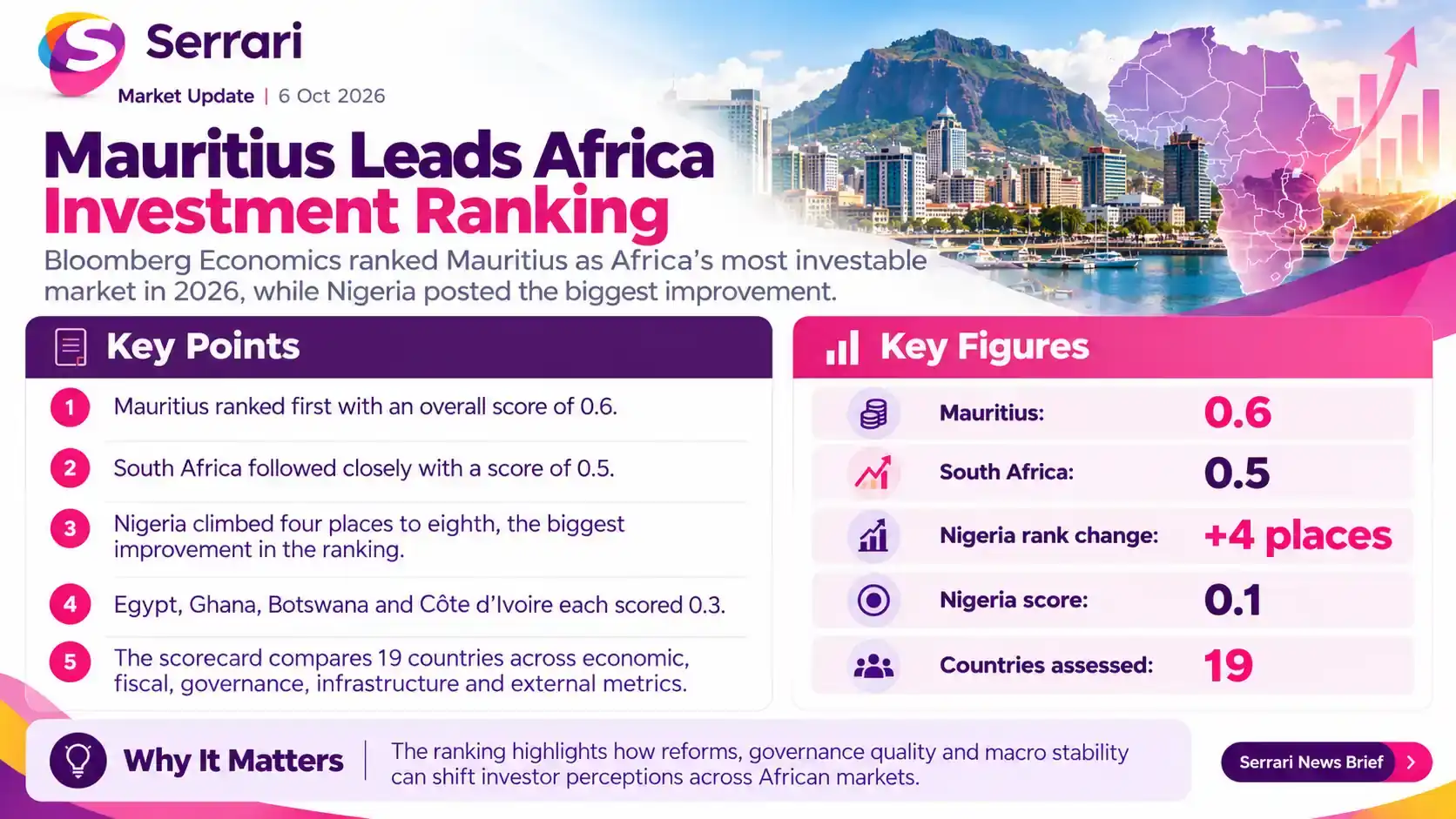
Mauritius has overtaken South Africa to lead Bloomberg Economics’ 2026 Africa Investment Risk-O-Meter, while Nigeria recorded the largest improvement among the 19 African markets assessed.
Mauritius posted an overall score of 0.6, ahead of South Africa at 0.5. Egypt, Ghana, Botswana and Côte d’Ivoire followed at 0.3, while Morocco scored 0.2 and Nigeria 0.1. The ranking compares countries on a relative basis using economic strength, fiscal strength, institutions and governance, infrastructure and external vulnerability.
Nigeria’s four-place rise to eighth highlights improving macroeconomic conditions, but the scorecard also shows that governance and infrastructure remain important constraints. The results should not be read as a ranking of every African economy, as only 19 countries were included.
Key Overview
- Mauritius ranks first with a score of 0.6, ahead of South Africa at 0.5.
- Nigeria climbed four places to eighth, the largest improvement in the 2026 ranking.
- Egypt, Ghana, Botswana and Côte d’Ivoire each recorded an overall score of 0.3.
- Kenya, Rwanda and Tanzania were all assessed at 0.0.
- The scorecard measures relative investment risk across five economic and institutional categories.
- The figures are standardized scores, not percentages or direct measures of how much safer one country is than another.
Mauritius Moves Ahead of South Africa
Mauritius reached the top of the 2026 ranking on the strength of its institutional and governance profile, recording a 1.7 component score in that category. It also scored 0.7 for infrastructure, while its fiscal-strength reading was 0.0 and external vulnerability stood at -0.1.
The broader Africa Investment Risk-O-Meter methodology converts indicators such as economic growth, debt, political risk and foreign reserves into standardized Z-scores before weighting them into an overall measure. A score above zero therefore indicates stronger relative performance within the group rather than a percentage advantage over another country.
South Africa slipped to second with a score of 0.5, with a moderately weaker growth outlook weighing on its position. The country continues to benefit from deeper financial markets and improving electricity availability, but weak growth, elevated public debt, unemployment and logistics constraints remain material challenges.
Mauritius’s position also coincides with its selection to host the October 7 launch of the Africa Credit Rating Agency. The new institution is intended to provide independent assessments of sovereign, corporate and institutional creditworthiness using African data and expertise while complementing existing international rating agencies.
Context is everything. Stay ahead of shifting trends with today’s market updates, and uncover emerging opportunities using the Serrari Group Market Index and Marketplace. Then, take control of your own financial future by exploring our Money & Life Reset Transformation Blueprint ™ to build stronger habits, create better systems, and design a path toward lasting wealth.
Nigeria Records the Biggest Improvement
Nigeria climbed from 12th to eighth place, overtaking Rwanda, Tanzania, Kenya and Namibia. Its improvement came from stronger readings for economic strength, fiscal strength and external vulnerability.
The shift follows several years of major policy changes, including fuel-subsidy reform and a move toward a more market-reflective foreign-exchange system. Recent macroeconomic reforms have strengthened revenues and reserves, while greater exchange-rate flexibility has improved macroeconomic stability and policy credibility.
Nigeria’s external position has also improved. Gross foreign reserves reached $51.9 billion at the end of July 2026, while the current-account surplus rose to $5.0 billion in the first quarter of the year.
However, the ranking does not suggest that Nigeria’s structural challenges have disappeared. Infrastructure gaps, institutional weaknesses, high living costs and pressure on household incomes remain significant. This means improved country-level indicators may not immediately translate into stronger investment across every sector.
Botswana Slips as Diamond Weakness Hits Finances
Botswana moved two places lower despite maintaining relatively strong institutional and infrastructure scores. Weaker economic and fiscal conditions have become more significant as the prolonged downturn in the diamond market reduces government income and erodes fiscal buffers.
On September 25, Moody’s downgraded Botswana to Baa2 from Baa1, citing weaker diamond-sector revenue, lower-than-expected customs-union receipts and disappointing proceeds from new tax measures.
The downgrade illustrates why strong institutions alone may not fully shield a commodity-dependent economy from deteriorating external and fiscal conditions.
Lower Rankings Do Not Mean Investment Has Stopped
At the lower end of the scorecard, Namibia recorded -0.1, while Ethiopia, Zambia, Angola and Uganda scored -0.2. Senegal stood at -0.3, the Democratic Republic of Congo at -0.5 and Mozambique at -0.8.
These positions measure relative risk across the five categories and do not imply that investment opportunities are absent. Major strategic projects continue across several lower-ranked markets, particularly in minerals, energy and transport infrastructure.
The assessment also covers only 19 countries, or roughly one-third of Africa’s states. Two-thirds of those included are among the continent’s larger economies, with additional markets selected because of characteristics such as commodity resources, financial-centre status or business tourism.
For investors, the ranking is therefore most useful as a comparative risk framework rather than a definitive list of where capital should or should not go. Mauritius’s rise and Nigeria’s improvement show how institutional quality and macroeconomic reform can shift relative positioning, while the weaker readings elsewhere underline the importance of fiscal resilience, infrastructure and governance in sustaining investment appeal.
Sources used: Bloomberg / bne IntelliNews / World Bank / African Union / Reuters
Your financial future isn’t something you wait for—it’s something you build.
The real question is: when do you begin?
Move beyond simply staying informed.
Navigate the markets with clarity—track trends through the Serrari Group Market Index, uncover opportunities in the Serrari Marketplace, and build practical knowledge with our Curated Wealth Builder Platform.
Stay connected to what truly matters.
Get daily insights on macro trends and financial movements across Kenya, Africa, and global markets—delivered through the Serrari Newsletter.
Growth opens doors.
Advance your career through professional programs including ACCA, HESI A2, ATI TEAS 7 , HESI EXIT , NCLEX – RN and NCLEX – PN, Financial Literacy!🌟—designed to move you forward with confidence.
See where money is flowing—clearly and in real time.
Track Money Market Funds, Treasury Bills, Treasury Bonds, Green Bonds, and Fixed Deposits, alongside global and African indexes, key economic indicators, and the evolving Crypto and stablecoin landscape—all within Serrari’s Market Index.