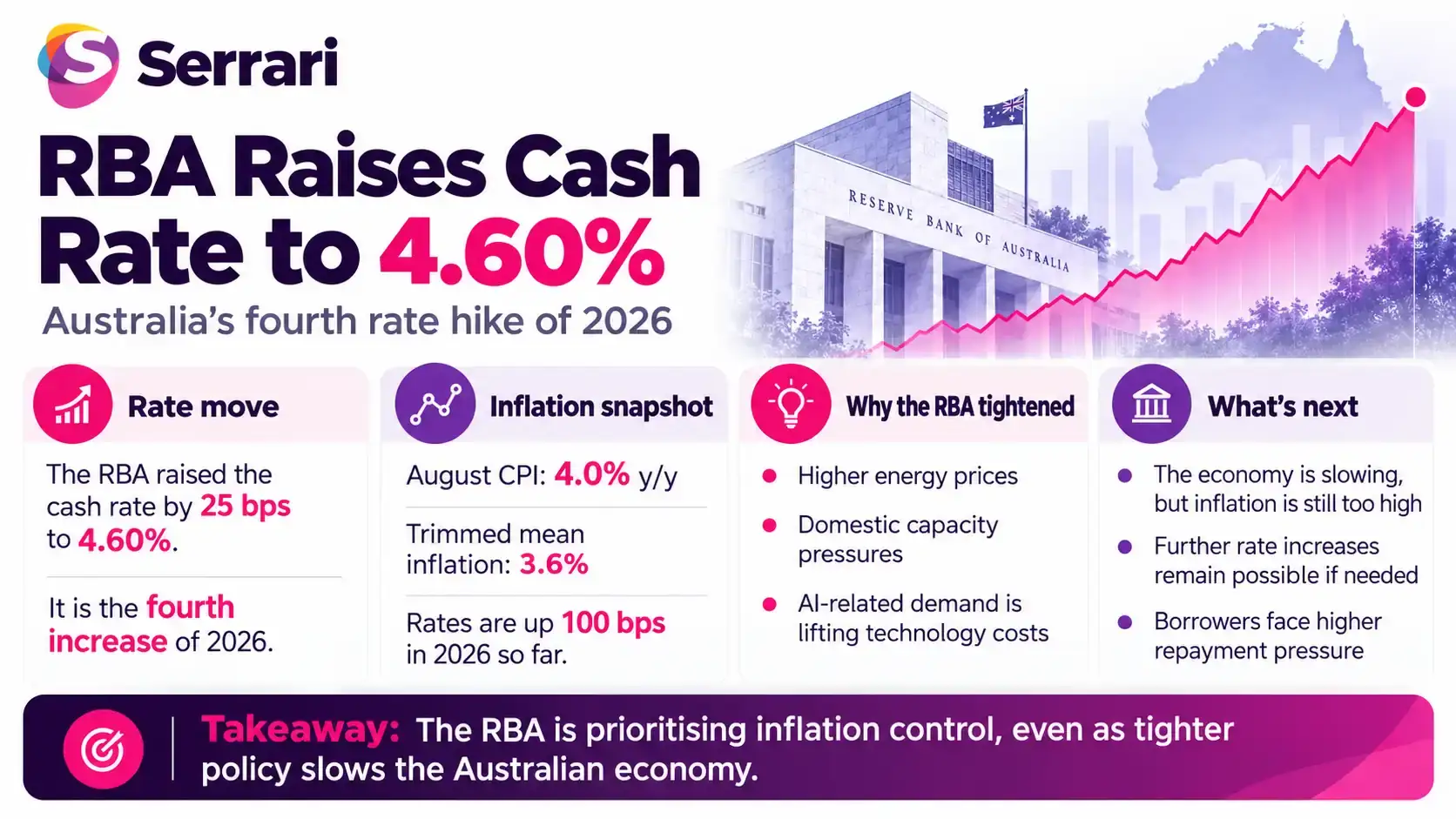
The Reserve Bank of Australia has raised its cash rate target by 25 basis points to 4.60%, delivering its fourth increase of 2026 and pushing borrowing costs to their highest level in roughly 15 years.
The unanimous decision reflects renewed concern that inflation is proving more persistent than expected. Higher global energy prices, domestic capacity constraints, stronger-than-expected inflation data and rising technology-related costs linked to artificial-intelligence demand are all complicating the RBA’s effort to return inflation sustainably to target.
Key Overview
- The RBA raised the cash rate target by 25 basis points to 4.60%.
- The September move is the fourth rate increase of 2026.
- Rates have risen by a cumulative 100 basis points since the start of the year.
- Australia’s annual CPI inflation accelerated to 4.0% in August from 3.5% in July.
- Trimmed mean inflation remained at 3.6% year over year.
- Higher energy costs, domestic capacity pressures and technology prices are contributing to inflation risks.
- The RBA said further rate increases remain possible if inflation does not ease sufficiently.
Why the RBA Raised Rates Again
The Monetary Policy Board voted unanimously to increase the cash rate to 4.60%, up from 4.35%.
The central bank said several upside inflation risks identified at its previous meeting were now materialising. Global energy prices have risen as disruptions to oil supply intensified, while higher fuel costs are beginning to flow into prices for other goods and services.
The RBA also highlighted strong global demand linked to artificial intelligence, saying AI-related investment was contributing to rapid increases in prices for technology-related goods.
Domestic pressures remain important as well. Businesses continue to report higher costs, and some firms are raising prices or considering doing so. Short-term measures of inflation expectations also remain elevated.
The Board concluded that financial conditions needed to tighten further to prevent high inflation from becoming embedded.
Inflation Accelerates to 4.0%
Fresh inflation data released immediately after the rate decision reinforced the RBA’s concerns.
Australia’s August Consumer Price Index rose 4.0% over the year, accelerating from 3.5% in July.
Monthly prices increased 0.4% on an original basis and 0.7% after seasonal adjustment, while trimmed mean inflation remained at 3.6%.
Housing costs rose 5.7% annually, including a 13.2% increase in electricity prices and a 5.4% rise in prices for new dwellings.
Transport prices also increased sharply, rising 5.6% over the year and 4.2% in August alone.
Those figures underline the challenge facing the central bank. Inflation is not being driven by a single category, with pressures appearing across energy, housing, transport and broader business costs.
Context is everything. Stay ahead of shifting trends with today’s market updates, and uncover emerging opportunities using the Serrari Group Market Index and Marketplace. Then, take control of your own financial future by exploring our Money & Life Reset Transformation Blueprint ™ to build stronger habits, create better systems, and design a path toward lasting wealth.
The Economy Is Slowing, but Not Fast Enough
The RBA acknowledged that its earlier rate increases are already restraining economic activity.
Consumer spending growth is easing, housing prices have fallen across most capital cities and new housing lending has declined noticeably. Labour-market conditions have also softened broadly in line with expectations.
At the same time, business investment and corporate borrowing remain strong, while economic output in the June quarter was slightly stronger than expected.
The RBA said weak productivity growth continues to limit how quickly the economy can expand without generating additional inflation.
That creates a difficult balancing act. Raising rates too aggressively risks weakening employment and household spending, but keeping policy too loose could allow inflation to remain above target for longer.
Borrowers Face Another Increase in Repayments
The higher cash rate will place additional pressure on households with variable-rate mortgages and businesses reliant on floating-rate debt.
Major lenders typically adjust variable borrowing rates after RBA decisions, meaning many borrowers are likely to face another increase in monthly interest costs.
The September move takes the cash rate to its highest level since 2011, substantially increasing debt-servicing costs compared with the low-rate environment that prevailed earlier in the decade.
The cumulative effect is becoming increasingly important. Four rate increases during 2026 mean monetary policy has tightened by a full percentage point this year alone.
Could Australian Rates Rise Again?
The RBA has deliberately kept the possibility of another increase open.
In its latest monetary policy decision, the Board said it would continue doing what it considered necessary to bring inflation sustainably back to target, including increasing the cash rate further if required.
Future decisions will depend heavily on incoming inflation, employment, spending and economic-growth data.
For now, the central bank’s message is that slowing economic activity has not yet been enough to offset persistent inflation pressure.
The combination of 4.0% headline inflation, higher energy costs and continued domestic capacity constraints means the RBA is not yet signalling the end of the tightening cycle.
Australia therefore enters the final months of 2026 with monetary policy at its tightest setting in roughly 15 years and the possibility that rates could still move higher before inflation convincingly returns toward target.
Sources: Reserve Bank of Australia / Australian Bureau of Statistics / Commonwealth Bank of Australia / ABC News
Your financial future isn’t something you wait for—it’s something you build.
The real question is: when do you begin?
Move beyond simply staying informed.
Navigate the markets with clarity—track trends through the Serrari Group Market Index, uncover opportunities in the Serrari Marketplace, and build practical knowledge with our Curated Wealth Builder Platform.
Stay connected to what truly matters.
Get daily insights on macro trends and financial movements across Kenya, Africa, and global markets—delivered through the Serrari Newsletter.
Growth opens doors.
Advance your career through professional programs including ACCA, HESI A2, ATI TEAS 7 , HESI EXIT , NCLEX – RN and NCLEX – PN, Financial Literacy!🌟—designed to move you forward with confidence.
See where money is flowing—clearly and in real time.
Track Money Market Funds, Treasury Bills, Treasury Bonds, Green Bonds, and Fixed Deposits, alongside global and African indexes, key economic indicators, and the evolving Crypto and stablecoin landscape—all within Serrari’s Market Index.