Seychelles has secured a $34 million loan to support the third and final phase of its Economic Resilience and Green Recovery Support Programme, extending a reform agenda focused on stronger public finances, private-sector growth, digital government and climate resilience.
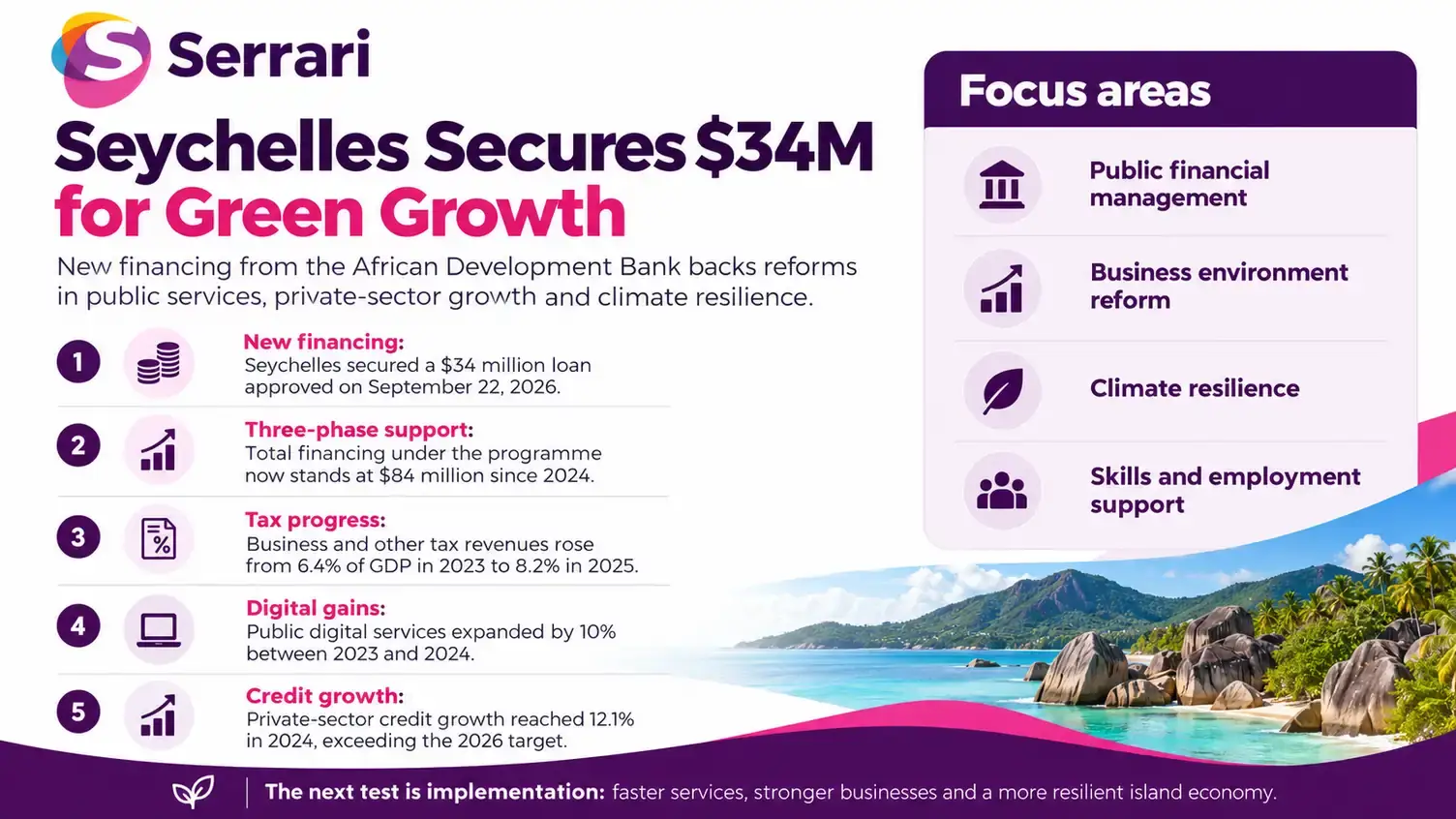
The financing was approved on September 22, 2026 and brings total support across the programme’s three phases to $84 million. Earlier reforms have already improved tax revenue collection, expanded digital public services and strengthened private-sector credit growth.
Key Overview
- Seychelles has secured a $34 million loan under the third and final phase of its economic reform programme.
- The financing was approved on September 22, 2026.
- Total financing across all three programme phases now stands at $84 million.
- Business and other tax revenue increased from 6.4% of GDP in 2023 to 8.2% in 2025.
- Digital public services expanded by 10% between 2023 and 2024.
- Private-sector credit growth reached 12.1% in 2024, exceeding the programme’s 2026 target.
- Planned reforms include electronic invoicing, national e-procurement and a one-stop investment portal.
- Climate measures will cover electricity planning, marine spatial planning, hazardous chemicals and agricultural reforms.
- Employment reforms will include skills development and the phased introduction of a national living-wage framework.
Third Phase Pushes Reform Programme Forward
The latest financing is part of the third phase of the Economic Resilience and Green Recovery Support Programme, which has supported Seychelles’ fiscal and structural reforms since 2024.
The new $34 million financing package focuses on three interconnected areas: economic governance and public financial management, the business environment and climate resilience.
The first two phases each received $25 million, one in 2024 and another in 2025. With the latest phase, total financing under the programme rises to $84 million.
The broader objective is to strengthen Seychelles’ economic institutions while ensuring that reforms translate into improved public services, stronger businesses and more sustainable long-term growth.
Tax and Credit Reforms Show Early Results
Previous phases of the programme have already produced measurable outcomes.
Business and other tax revenues increased from 6.4% of GDP in 2023 to 8.2% in 2025, reflecting improvements in revenue mobilisation and economic management.
Earlier programme documents also showed that business and other tax revenues had already risen to 7.5% of GDP in 2024, indicating continued progress into 2025.
Private-sector credit growth reached 12.1% in 2024, exceeding the programme’s target for 2026. Stronger credit expansion can support investment and business activity, particularly when accompanied by reforms that reduce administrative barriers.
Digital government services also increased by 10% between 2023 and 2024, reinforcing the government’s strategy of using technology to improve efficiency and service delivery.
Digitalisation Targets Faster Public Services
Digital reform is central to the next phase.
Seychelles plans to introduce electronic invoicing for tax compliance, while a national e-procurement platform will modernise public purchasing and improve transparency.
The programme will also support a one-stop investment portal and Government Business Service Centre. These initiatives are designed to make approvals, registrations and other administrative processes easier for businesses and investors to navigate.
The measures align with the wider goal of strengthening public-service delivery and private-sector productivity, particularly in an economy where efficient government services can have an outsized impact on smaller businesses and investors.
Context is everything. Stay ahead of shifting trends with today’s market updates, and uncover emerging opportunities using the Serrari Group Market Index and Marketplace. Then, take control of your own financial future by exploring our Money & Life Reset Transformation Blueprint ™ to build stronger habits, create better systems, and design a path toward lasting wealth.
Climate Resilience Remains a Core Priority
As a small island economy, Seychelles remains particularly exposed to climate and environmental risks.
The programme will support long-term electricity-sector planning, marine spatial planning and stronger regulation of hazardous chemicals. Institutional reforms in agriculture are also included.
Energy reform is especially important because Seychelles continues working toward a more sustainable power system. Earlier programme planning identified renewable energy expansion as a key investment priority, with the country seeking to reduce dependence on imported fossil fuels.
Marine planning is equally significant given Seychelles’ reliance on fisheries, tourism and ocean-based economic activity.
Employment and Skills Become Part of Reform Agenda
The latest phase also places greater emphasis on labour-market outcomes.
Planned reforms include measures to improve employment opportunities, strengthen skills development and support the phased introduction of a national living wage framework.
This expands the programme beyond fiscal management and administrative reforms by linking economic policy more directly to household welfare and labour-market outcomes.
For Seychelles, this is particularly important because long-term resilience depends not only on stronger government finances but also on ensuring that economic growth translates into better employment opportunities and incomes.
What the $34 Million Programme Could Achieve
The new loan is ultimately intended to protect recent economic gains while pushing Seychelles toward a more efficient, investment-friendly and climate-resilient economy.
Its success will depend on implementation. Faster digital services, stronger tax administration, improved procurement systems and simpler investment procedures could reduce the cost of doing business and improve government effectiveness.
At the same time, energy planning, marine management and employment reforms could strengthen Seychelles’ ability to withstand both economic and environmental shocks.
The third phase therefore marks the transition from supporting post-pandemic recovery toward embedding longer-term reforms that could make the country’s economy more productive, inclusive and resilient.
Sources: African Development Bank
Your financial future isn’t something you wait for—it’s something you build.
The real question is: when do you begin?
Move beyond simply staying informed.
Navigate the markets with clarity—track trends through the Serrari Group Market Index, uncover opportunities in the Serrari Marketplace, and build practical knowledge with our Curated Wealth Builder Platform.
Stay connected to what truly matters.
Get daily insights on macro trends and financial movements across Kenya, Africa, and global markets—delivered through the Serrari Newsletter.
Growth opens doors.
Advance your career through professional programs including ACCA, HESI A2, ATI TEAS 7 , HESI EXIT , NCLEX – RN and NCLEX – PN, Financial Literacy!🌟—designed to move you forward with confidence.
See where money is flowing—clearly and in real time.
Track Money Market Funds, Treasury Bills, Treasury Bonds, Green Bonds, and Fixed Deposits, alongside global and African indexes, key economic indicators, and the evolving Crypto and stablecoin landscape—all within Serrari’s Market Index.