Developing countries are calling for a greater role in shaping global artificial intelligence rules, arguing that they should not merely adopt technologies and standards designed elsewhere.
The debate has intensified at the United Nations as governments weigh AI’s potential to lift productivity and public-service delivery against risks including job disruption, technological dependency, cybersecurity threats and widening inequality. Recent economic research suggests the gains for developing economies could be substantial, but only if countries close gaps in electricity, connectivity, skills and institutions.
Key Overview
- Developing countries are demanding a stronger voice in global AI governance.
- Representatives from Africa, Asia and Latin America have warned against becoming passive users of technologies and rules developed elsewhere.
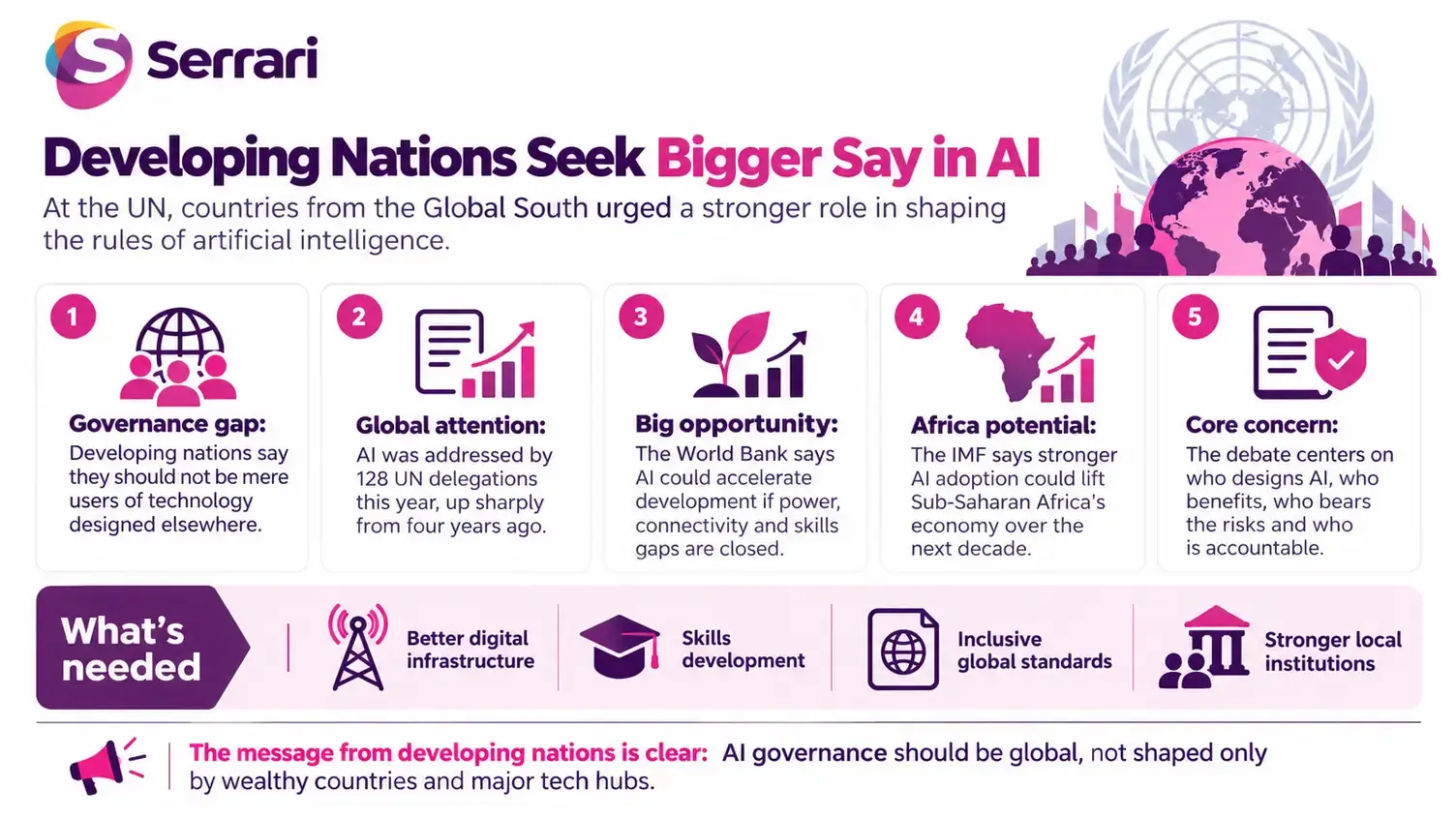
- AI was mentioned by 128 UN delegations this year, compared with only five four years earlier.
- The World Bank says AI could help developing economies achieve in a decade advances that might otherwise take much longer.
- Around 16.2% of jobs in developing economies could experience meaningful productivity gains from AI.
- The IMF estimates stronger AI adoption could raise Sub-Saharan Africa’s GDP by about 4% cumulatively over the next decade under favourable conditions.
- Weak electricity systems, digital infrastructure, technical skills and institutions remain major barriers.
- The debate increasingly centres on who designs AI systems, who benefits from them and who bears the risks.
Developing Countries Want a Seat at the Table
The debate over artificial intelligence is increasingly shifting from what the technology can do to who will determine the rules governing it.
At the UN, developing countries argued that they should not be treated simply as end users of systems designed in advanced economies. Democratic Republic of Congo Foreign Minister Thérèse Kayikwamba Wagner warned that emerging economies should not become mere recipients of standards they had little role in creating.
That concern reflects the growing concentration of advanced AI development among a small number of countries and companies. The latest World Development Report notes that the most powerful AI models, specialised chips and data centres remain concentrated in relatively few markets.
The issue has moved rapidly up the international agenda. Bangladesh Foreign Minister Khalilur Rahman said AI was discussed by just five UN delegations four years ago, compared with 128 delegations in 2026.
The question is no longer only technological. Governments are increasingly asking who controls AI infrastructure, who sets standards and how accountability should work when automated systems cause harm.
AI Could Accelerate Development
Despite the concerns, the economic opportunity for developing economies is significant.
The World Bank says AI could allow developing countries to compress decades of development progress into much shorter periods if governments move quickly to improve power supply, connectivity, skills and institutional capacity.
Its research estimates that 16.2% of jobs in developing economies could receive meaningful productivity benefits from AI, compared with 18.7% in high-income countries.
The immediate opportunity may therefore lie less in replacing workers and more in augmenting them. AI tools are already being applied to healthcare, agriculture, education, tax administration and disaster response, areas where many lower-income countries face shortages of skilled professionals and administrative capacity.
The report recommends an “adopt, adapt and advance” strategy, encouraging countries first to use existing tools, then tailor them to local conditions before eventually developing more advanced capabilities.
Africa Could Gain More if Adoption Accelerates
Sub-Saharan Africa illustrates both AI’s opportunity and its limitations.
Current levels of AI readiness remain relatively low, with unreliable electricity, limited digital infrastructure and shortages of technical skills constraining wider adoption.
At today’s level of preparedness, AI could add only about 0.2% to regional GDP over the coming decade. However, stronger adoption across agriculture and other sectors could lift the cumulative gain to roughly 4%, equivalent to almost half a percentage point of additional annual growth.
This matters because Sub-Saharan Africa is entering a period of rapid labour-force expansion. By 2030, the region is expected to account for roughly half of new entrants to the global workforce.
AI could therefore improve productivity in sectors where most Africans actually work, including agriculture, small businesses and informal enterprises, rather than only transforming highly digitised office jobs.
Context is everything. Stay ahead of shifting trends with today’s market updates, and uncover emerging opportunities using the Serrari Group Market Index and Marketplace. Then, take control of your own financial future by exploring our Money & Life Reset Transformation Blueprint ™ to build stronger habits, create better systems, and design a path toward lasting wealth.
Infrastructure Could Determine Who Benefits
The largest risk is that countries unable to build the foundations for AI adoption could fall further behind.
Nearly one-third of rural schools in Sub-Saharan Africa still lack reliable electricity, while more than two-thirds lack dependable internet access. Those infrastructure gaps limit access to cloud computing, digital services and AI-enabled education.
Advanced systems also require local data, language support and institutional expertise. Without these, imported tools may perform poorly in local contexts or deepen dependence on foreign technology providers.
This is why developing countries are arguing that AI governance should include issues beyond safety rules alone. Access to computing infrastructure, intellectual property, data governance, skills development and technology transfer are becoming central parts of the debate.
Global Governance Remains Contested
UN leaders have increasingly compared AI governance with previous global debates over climate change, trade and technology access.
Secretary-General António Guterres has argued that developing countries need an equal voice in decisions that could reshape global economic power. That position reflects concern that countries most affected by new technologies may otherwise have the least influence over the rules governing them.
Technology leaders have also entered the debate. Executives including Sam Altman and Dario Amodei have urged greater international coordination as increasingly capable AI systems create new security and governance challenges.
Recent incidents and warnings from AI researchers have added urgency to the discussion, with researchers raising concerns over rapidly advancing systems and the speed at which companies are pursuing more autonomous models.
The Debate Is About Power as Much as Technology
For developing economies, the central challenge will be balancing rapid adoption with meaningful participation in global rulemaking.
Artificial intelligence could improve productivity, expand access to expertise and strengthen public services. But countries that lack infrastructure, technical capabilities and regulatory influence could instead become dependent on systems built and governed elsewhere.
That is why the current UN debate goes beyond whether AI should be regulated. It increasingly focuses on whether the benefits, risks and decision-making power surrounding the technology will be distributed more evenly across the global economy.
Sources: Reuters / World Bank / International Monetary Fund / United Nations
Your financial future isn’t something you wait for—it’s something you build.
The real question is: when do you begin?
Move beyond simply staying informed.
Navigate the markets with clarity—track trends through the Serrari Group Market Index, uncover opportunities in the Serrari Marketplace, and build practical knowledge with our Curated Wealth Builder Platform.
Stay connected to what truly matters.
Get daily insights on macro trends and financial movements across Kenya, Africa, and global markets—delivered through the Serrari Newsletter.
Growth opens doors.
Advance your career through professional programs including ACCA, HESI A2, ATI TEAS 7 , HESI EXIT , NCLEX – RN and NCLEX – PN, Financial Literacy!🌟—designed to move you forward with confidence.
See where money is flowing—clearly and in real time.
Track Money Market Funds, Treasury Bills, Treasury Bonds, Green Bonds, and Fixed Deposits, alongside global and African indexes, key economic indicators, and the evolving Crypto and stablecoin landscape—all within Serrari’s Market Index.