
The 30-year US mortgage rate has risen to its highest level in nearly a year, according to Freddie Mac, increasing home financing costs for prospective buyers. Higher Treasury yields, persistent inflation concerns and expectations surrounding the Federal Reserve continue to shape the outlook for the US housing market.
Key Overview
- 30-year mortgage rate rises to 6.58%.
- Highest level in nearly 12 months.
- Freddie Mac reports higher borrowing costs.
- Treasury yields continue climbing.
- Inflation concerns pressure mortgage rates.
- Home sales remain historically subdued.
- Federal Reserve policy remains in focus.
- Housing market recovery faces headwinds.
30-Year US Mortgage Rate Climbs to Highest Level in Nearly a Year
The 30-year US mortgage rate increased to its highest level in almost twelve months, adding further pressure to home financing costs as prospective buyers continue navigating elevated borrowing expenses. According to Freddie Mac, the average rate on a 30-year fixed mortgage rose to 6.58%, up from 6.55% the previous week.
Although mortgage rates remain slightly below the 6.74% recorded a year ago, the latest increase reflects growing concerns about inflation, rising Treasury yields and uncertainty surrounding future Federal Reserve policy. The higher mortgage borrowing costs come at a time when the US housing market is already experiencing subdued sales activity and slower home price growth.
Freddie Mac Reports Highest Mortgage Rate Since August
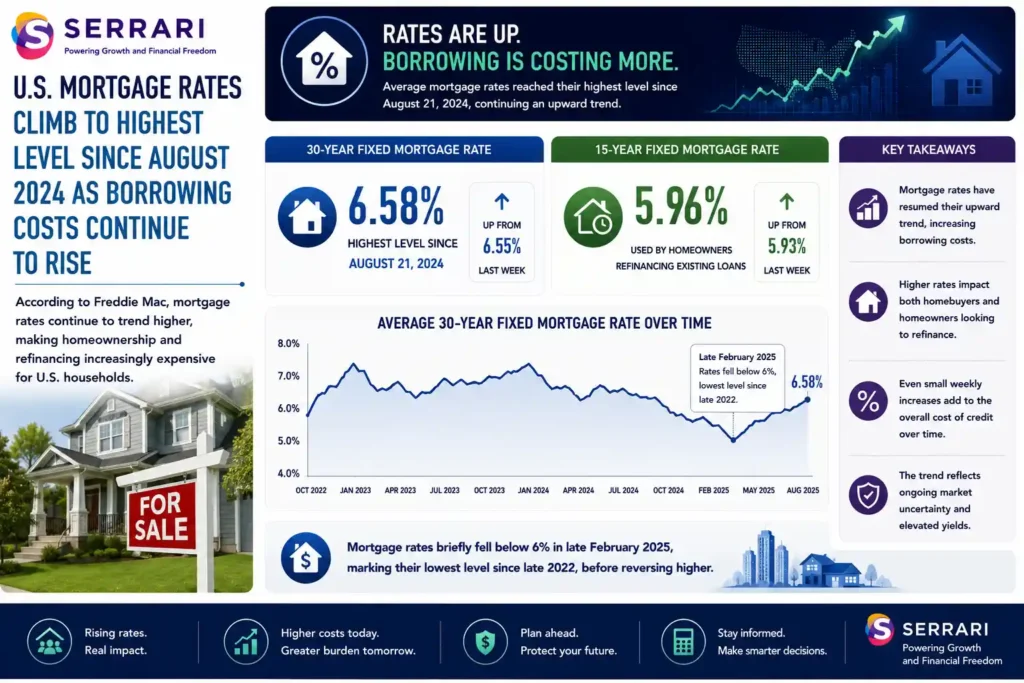
According to Freddie Mac, the average 30-year US mortgage rate reached 6.58%, matching its highest level since August 21 of the previous year.
The average rate on a 15-year fixed mortgage, commonly used by homeowners refinancing existing loans, also increased to 5.96%, compared with 5.93% the previous week.
While the weekly increases appear modest, they extend an upward trend that has gradually increased borrowing costs for households seeking to purchase or refinance residential property.
Mortgage rates had briefly fallen below 6% in late February, marking their lowest level since late 2022, before reversing higher.
Context is everything. Stay ahead of shifting trends with today’s market updates and uncover emerging opportunities using the Serrari Group Market Index and Marketplace. Then, take control of your own financial future by exploring our Money & Life Reset Transformation Blueprint ™ to build stronger habits, create better systems, and design a path toward lasting wealth.
Treasury Yields Continue Driving Mortgage Rates
Mortgage rates are influenced by several economic factors, but one of the most important benchmarks remains the 10-year US Treasury yield.
Mortgage lenders typically use Treasury yields as a reference when pricing long-term home loans.
During the week, the 10-year Treasury yield climbed to approximately 4.70%, compared with 4.57% a week earlier and 3.97% in late February.
As Treasury yields rise, investors demand higher returns for lending money over longer periods, increasing financing costs throughout the broader economy, including residential mortgages.
The recent increase in bond yields has therefore contributed directly to higher mortgage rates.
Inflation Concerns Weigh on Home Financing
Rising oil prices and renewed geopolitical tensions have added fresh inflation concerns to financial markets.
Higher energy prices increase transportation and production costs, potentially slowing progress in reducing overall inflation.
If inflation remains elevated for longer than expected, financial markets may anticipate that the Federal Reserve will maintain higher interest rates or delay future monetary easing.
Although the Federal Reserve does not directly determine mortgage rates, its policy decisions strongly influence bond markets, which in turn affect long-term borrowing costs across the economy.
These expectations continue shaping the outlook for home financing in the United States.
Homebuyers Face Higher Borrowing Costs
The increase in the 30-year US mortgage rate has made purchasing a home more expensive for many prospective homebuyers.
Higher mortgage rates translate into larger monthly loan repayments, reducing affordability even when home prices remain relatively stable.
For many households, increased financing costs have become one of the largest obstacles to entering the housing market, particularly for first-time buyers who typically require larger mortgage loans relative to their incomes.
As borrowing costs rise, some buyers delay purchases while others reduce the size or value of homes they are willing to purchase.
Housing Market Activity Remains Weak
Elevated mortgage rates continue affecting activity across the real estate market.
Seasonally adjusted sales of previously owned homes increased by approximately 0.7% during the first half of the year compared with the same period last year.
However, annual existing home sales remain close to 4 million properties, significantly below the long-term historical average of approximately 5.2 million homes.
The market slowdown extends a broader housing correction that began during 2022 after mortgage rates rose sharply from the exceptionally low levels experienced during the pandemic.
Existing home sales remained near thirty-year lows throughout the previous year, illustrating the lasting impact of higher borrowing costs.
Slower Home Price Growth Expected
The softer housing environment is also influencing home prices.
According to Realtor.com’s updated mid-year forecast, average U.S. home price growth is expected to slow to approximately 1.2% during 2026.
That pace is below the current rate of inflation, suggesting that real house price growth may remain relatively subdued despite limited housing supply in many markets.
Slower price appreciation may improve affordability over time, although elevated mortgage rates continue offsetting much of that benefit for buyers.
Federal Reserve Remains Key Market Focus
Financial markets continue closely monitoring future Federal Reserve decisions.
While the central bank does not establish mortgage rates directly, changes to short-term interest rates influence investor expectations regarding inflation, economic growth and future monetary policy.
Those expectations affect Treasury yields, which subsequently influence mortgage pricing by commercial lenders.
As long as inflation risks remain elevated, mortgage rates are likely to remain sensitive to incoming economic data and developments within financial markets.
Outlook for the 30-Year US Mortgage Rate
The latest increase in the 30-year US mortgage rate highlights the continuing challenges facing the US housing market. According to Freddie Mac, mortgage rates remain well above historical averages despite being slightly lower than a year ago, keeping home financing expensive for many households.
Future movements will largely depend on inflation trends, Treasury yields and the direction of Federal Reserve policy. Until borrowing costs ease meaningfully, higher mortgage borrowing costs are likely to continue weighing on homebuyers, housing demand and broader activity across the real estate market.
FAQs
What is the current 30-year US mortgage rate?
According to Freddie Mac, the average 30-year US mortgage rate increased to 6.58%, its highest level in nearly one year.
Why are mortgage rates increasing?
Mortgage rates generally rise when 10-year Treasury yields increase and when investors expect inflation to remain elevated. Expectations regarding Federal Reserve policy also influence long-term borrowing costs.
Does the Federal Reserve set mortgage rates?
No. The Federal Reserve sets short-term interest rates, not mortgage rates directly. However, its policy decisions influence bond markets, which affect mortgage rates offered by lenders.
How are higher mortgage rates affecting the housing market?
Higher mortgage borrowing costs reduce affordability for homebuyers, contributing to slower home sales and weaker activity across the US housing market, even as home price growth moderates.
Sources: Yahoo Finance, Abc News, Ap News, Wtop News
Your financial future isn’t something you wait for—it’s something you build.
The real question is: when do you begin?
Move beyond simply staying informed.
Navigate the markets with clarity—track trends through the Serrari Group Market Index, uncover opportunities in the Serrari Marketplace, and build practical knowledge with our Curated Wealth Builder Platform.
Stay connected to what truly matters.
Get daily insights on macro trends and financial movements across Kenya, Africa, and global markets—delivered through the Serrari Newsletter.
Growth opens doors.
Advance your career through professional programs including ACCA, HESI A2, ATI TEAS 7 , HESI EXIT , NCLEX – RN and NCLEX – PN, Financial Literacy!🌟—designed to move you forward with confidence.
See where money is flowing—clearly and in real time.
Track Money Market Funds, Treasury Bills, Treasury Bonds, Green Bonds, and Fixed Deposits, alongside global and African indexes, key economic indicators, and the evolving Crypto and stablecoin landscape—all within Serrari’s Market Index.