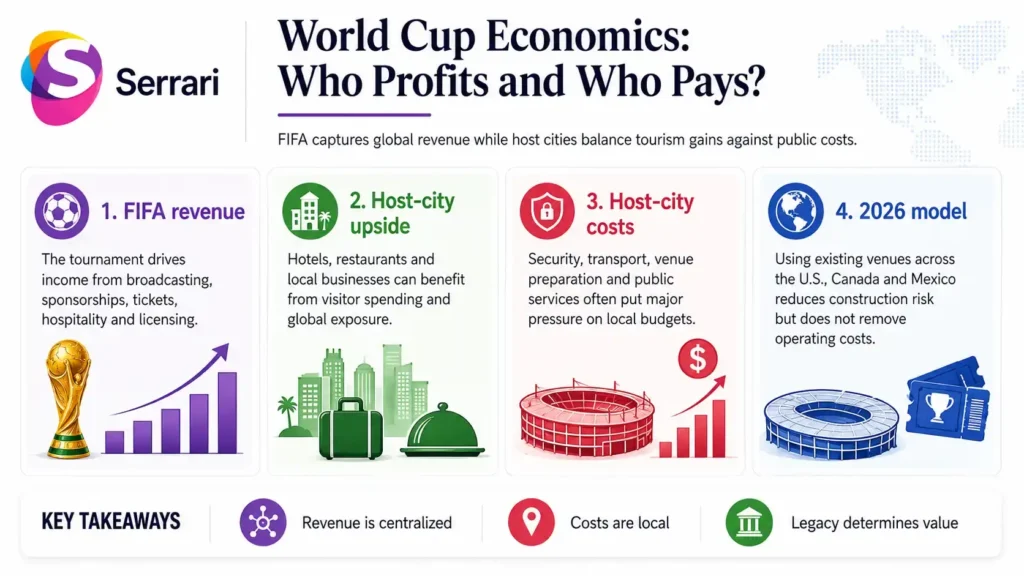
The FIFA World Cup is both a global sporting spectacle and a temporary economic system. FIFA earns centrally from broadcasting, sponsorship, licensing, ticketing and hospitality, while host cities confront a more complicated equation involving tourism, security, transport, venue preparation and public services.
The 2026 tournament, spread across the United States, Canada and Mexico, offers a different model from construction-heavy events such as Brazil 2014. Most venues already existed, reducing the risk of expensive new stadiums, but hosting costs remain substantial and the economic gains are unevenly distributed.
Key Overview
FIFA’s commercial model gives the governing body access to global revenue streams, while host governments and local organising bodies absorb many location-specific costs. FIFA recorded $7.57 billion in revenue during the 2019–22 cycle and has projected record revenue of $13 billion for the 2023–26 cycle.
For cities, the calculation is less predictable. Visitors can boost hotels, restaurants and local spending, but displacement of ordinary tourism, security bills and infrastructure costs can reduce the net benefit. The World Cup can create lasting value, but hosting the tournament does not automatically guarantee a financial windfall.
FIFA’s Centralised Revenue Machine
FIFA’s financial advantage comes from selling the same global event through several channels. These include media rights, sponsorship and marketing rights, licensing, ticket sales and hospitality.
The organisation generated a record $7.568 billion during the 2019–22 cycle, which culminated in the Qatar World Cup. Television broadcasting rights formed the largest revenue category.
The scale is increasing. FIFA’s revised 2023–26 budget projects $13 billion in revenue, supported by an expanded 48-team World Cup and a broader portfolio of competitions and commercial partnerships.
Some of this money is redistributed through development programmes. FIFA Forward 3.0 provides funding to member associations for football infrastructure, competitions and operational development.
However, FIFA’s commercial history has also attracted scrutiny. In 2015, the U.S. Department of Justice unsealed a 47-count indictment against nine FIFA officials and five corporate executives, alleging racketeering, wire fraud and money laundering conspiracies linked to a long-running corruption scheme.
Host Cities Face a Different Economic Equation
The financial experience of a host city differs sharply from FIFA’s.
Hotels, restaurants and other businesses can benefit from increased visitor spending, while cities receive global exposure and may accelerate infrastructure improvements. Yet local governments also face costs for policing, emergency services, transit, sanitation, traffic management and venue preparation.
The 2026 World Cup has reduced one traditional risk by relying mainly on existing major stadiums rather than constructing an entirely new network of venues. Even so, the facilities require modifications to meet tournament requirements, while cities must manage large crowds and security operations.
In the United States, federal authorities allocated $625 million for host-city security support, helping ease some local pressure. Yet a recent assessment of the tournament’s economics found that host cities were seeing only modest economic gains, with visitor spending not necessarily translating into the large net benefits sometimes forecast before mega-events.
This reflects the “substitution effect”: World Cup visitors may replace ordinary tourists or other economic activity rather than creating entirely additional spending.
Canada Shows How Hosting Costs Can Escalate
Canada illustrates how quickly the public cost of hosting can rise even without building new stadiums.
A parliamentary budget assessment estimated that Canadian governments would spend more than C$1 billion hosting 13 World Cup matches in Toronto and Vancouver. The estimate included contributions from federal, provincial and municipal governments.
Toronto alone budgeted C$380 million in direct hosting costs, comprising C$226.35 million in operating expenses and C$153.65 million in capital costs.
Those expenses can still produce longer-term benefits through upgraded facilities, tourism exposure and greater international visibility. But such benefits are difficult to measure and may not accrue directly to the government entities paying the bills.
Context is everything. Stay ahead of shifting trends with today’s market updates, and uncover emerging opportunities using the Serrari Group Market Index and Marketplace. Then, take control of your own financial future by exploring our Money & Life Reset Transformation Blueprint ™ to build stronger habits, create better systems, and design a path toward lasting wealth.
Ticket Pricing Highlights the Commercial Tension
Ticket affordability has become another part of the 2026 World Cup’s economic debate.
FIFA says it uses variable pricing, meaning prices can be adjusted between sales phases according to demand and availability, although it explicitly says this is not an automated dynamic pricing model.
After criticism over affordability, FIFA introduced a $60 Supporter Entry Tier for a limited allocation of tickets available through participating national associations across all 104 matches.
The pricing debate demonstrates a fundamental tension: maximising the commercial value of extraordinary demand while preserving the World Cup’s accessibility to ordinary supporters.
Why Past World Cups Offer a Warning
Previous tournaments show that spectacle and economic success are not necessarily the same thing.
The 1994 U.S. World Cup benefited from existing stadium infrastructure and helped build momentum for the launch of Major League Soccer. Yet academic research later challenged optimistic pre-tournament projections of local economic gains.
Brazil’s 2014 World Cup presented a different problem. Large public expenditures on stadiums and infrastructure generated intense debate over priorities, displacement and the long-term usefulness of certain venues.
The lesson is not that hosting a World Cup inevitably produces losses. Rather, economic outcomes depend heavily on existing infrastructure, financing arrangements, realistic tourism assumptions and whether investments continue to serve residents after the tournament ends.
The Final Whistle Does Not Close the Books
The 2026 World Cup demonstrates a more distributed hosting model, spreading 104 matches across three countries while making extensive use of existing venues.
That lowers some infrastructure risk but does not eliminate the fundamental imbalance in World Cup economics. FIFA centralises valuable global revenues, while individual cities and governments manage many of the costs and operational risks.
For host communities, the real measure of success will therefore extend beyond packed stadiums and visitor numbers. The lasting economic verdict will depend on whether public spending, infrastructure improvements and global exposure continue producing value long after the trophy is lifted.
Sources: FIFA / U.S. Department of Justice / Reuters / City of Toronto
Your financial future isn’t something you wait for—it’s something you build.
The real question is: when do you begin?
Move beyond simply staying informed.
Navigate the markets with clarity—track trends through the Serrari Group Market Index, uncover opportunities in the Serrari Marketplace, and build practical knowledge with our Curated Wealth Builder Platform.
Stay connected to what truly matters.
Get daily insights on macro trends and financial movements across Kenya, Africa, and global markets—delivered through the Serrari Newsletter.
Growth opens doors.
Advance your career through professional programs including ACCA, HESI A2, ATI TEAS 7 , HESI EXIT , NCLEX – RN and NCLEX – PN, Financial Literacy!🌟—designed to move you forward with confidence.
See where money is flowing—clearly and in real time.
Track Money Market Funds, Treasury Bills, Treasury Bonds, Green Bonds, and Fixed Deposits, alongside global and African indexes, key economic indicators, and the evolving Crypto and stablecoin landscape—all within Serrari’s Market Index.