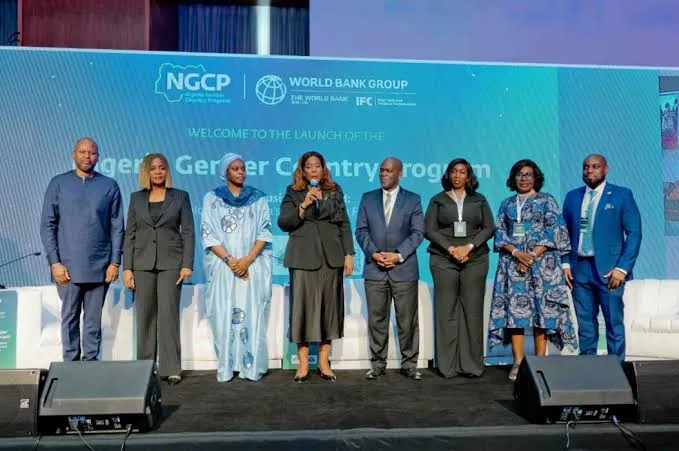
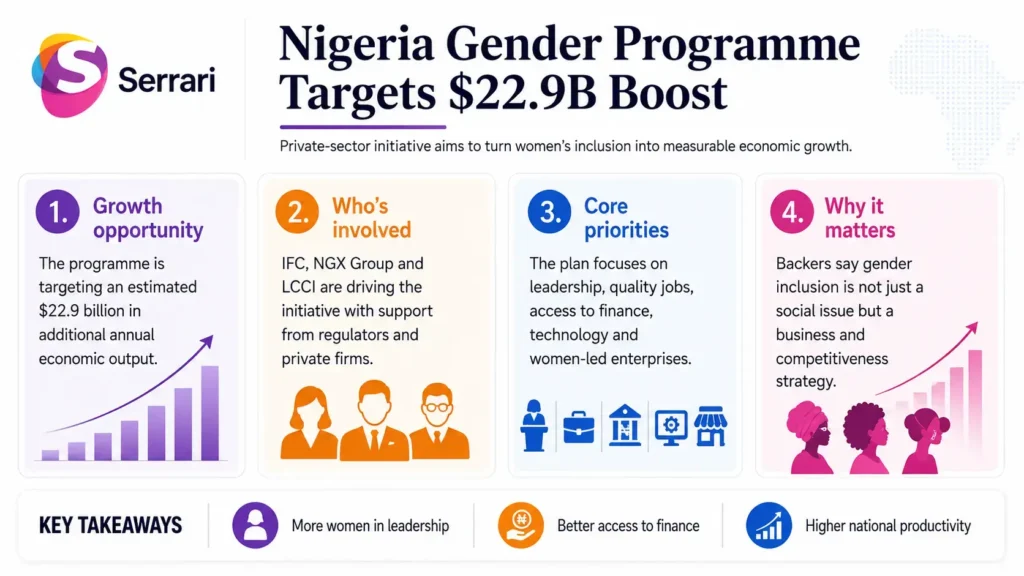
Nigeria’s private sector has launched a new gender inclusion programme aimed at expanding women’s participation in employment, entrepreneurship and corporate leadership, with the potential to unlock an estimated $22.9 billion in additional annual economic output.
The Nigeria Gender Country Programme brings together the International Finance Corporation, Nigerian Exchange Group and Lagos Chamber of Commerce and Industry in an effort to move gender inclusion from broad commitments to measurable business action.
Key Overview
The initiative is designed to help participating companies adopt gender-smart business practices that can increase women’s representation in leadership, improve access to quality jobs and expand financing, technology and market opportunities for women-led businesses.
The programme builds on the earlier Nigeria2Equal initiative but moves into a wider implementation phase involving private companies, regulators, policymakers and development institutions. Stakeholders argue that closing economic gender gaps is not only a social objective but also a competitiveness and growth opportunity for Africa’s largest economy. (IFC)
Programme Moves Gender Inclusion Into Implementation
The Nigeria Gender Country Programme is an IFC-led, multi-stakeholder initiative designed to unlock women’s economic potential by increasing their participation as business leaders, employees and entrepreneurs.
Its launch marks a shift from advocacy towards implementation. Participating organisations are expected to identify priorities relevant to their businesses and adopt measurable practices intended to close gender gaps.
The programme brings together IFC, NGX Group and LCCI, alongside regulators, development institutions and private-sector companies. The wider objective is to embed gender inclusion into corporate strategy rather than treating it solely as a corporate social responsibility programme.
Business leaders at the launch argued that companies can benefit from broader access to talent, more diverse leadership and stronger participation by women across supply chains and customer markets.
$22.9 Billion Opportunity Strengthens the Business Case
The programme has been launched against an estimate that greater economic participation by women could generate $22.9 billion in additional annual output for Nigeria.
The reported economic opportunity reinforces the programme’s central argument: persistent gender gaps represent not only an equality challenge but also lost productive capacity.
Women can face barriers across several areas of economic participation, including access to finance, senior leadership positions, formal employment opportunities, technology and corporate supply chains.
Addressing those barriers could expand the country’s productive workforce while enabling more women-led companies to invest, hire workers and enter larger markets.
For businesses, the programme seeks to translate that national opportunity into company-level action. Participating organisations can focus on priorities such as workplace advancement, leadership pipelines, procurement from women-led businesses and improved access to financial and digital services.
Context is everything. Stay ahead of shifting trends with today’s market updates, and uncover emerging opportunities using the Serrari Group Market Index and Marketplace. Then, take control of your own financial future by exploring our Money & Life Reset Transformation Blueprint ™ to build stronger habits, create better systems, and design a path toward lasting wealth.
Nigeria2Equal Provides a Foundation for the New Initiative
The programme builds on lessons from Nigeria2Equal, an IFC-led initiative developed with the Nigerian Exchange to reduce gender gaps in private-sector employment and entrepreneurship.
Nigeria2Equal brought companies together around specific, measurable and time-bound commitments to increase women’s participation as leaders, employees and entrepreneurs within corporate value chains. (IFC)
Research produced through the initiative also examined gender equality within Nigeria’s private sector and sought to strengthen the business case for companies to invest in women.
The new country programme broadens that approach by creating a platform through which more organisations can commit to gender-smart practices and align inclusion priorities with their commercial objectives.
Capital Markets and Regulators Back the Initiative
Support from NGX Group and Nigeria’s Securities and Exchange Commission gives the programme a significant capital-markets dimension.
NGX Group Chairman Umaru Kwairanga described women’s economic participation as an economic necessity capable of supporting innovation, productivity and sustainable growth.
The Securities and Exchange Commission also backed the programme as a platform that could strengthen inclusive market development and expand financing opportunities for women-led enterprises.
This support is important because access to capital remains central to business expansion. Greater participation by banks, investors, listed companies and regulators could help gender inclusion move beyond individual corporate programmes and become more deeply integrated into Nigeria’s financial system.
Women’s Participation Becomes a Competitiveness Issue
The programme also reflects a broader change in how gender inclusion is framed in business.
Rather than focusing exclusively on representation, the initiative connects women’s economic participation with company performance, workforce development, entrepreneurship and long-term competitiveness.
The IFC’s existing gender programmes in Nigeria have sought to establish a business case for reducing gaps across corporate leadership, employment and entrepreneurship. The Nigeria2Equal framework has also generated research examining gender equality in the country’s private sector. (Open Knowledge Repository)
The new programme now faces the more difficult task of converting commitments into measurable results.
Its ultimate economic impact will depend on how many companies participate, the scale of their commitments and whether changes in hiring, leadership, procurement and finance translate into sustained improvements for women.
However, the launch signals that a growing section of Nigeria’s corporate and financial establishment increasingly views women’s economic participation as part of the country’s growth strategy.
Unlocking the estimated $22.9 billion opportunity will require more than a single initiative. But by bringing companies, regulators and development institutions into a common implementation framework, the Nigeria Gender Country Programme aims to turn inclusion into a measurable source of business growth and economic resilience.
Sources: International Finance Corporation / Nigerian Tribune / Zawya / World Bank
Your financial future isn’t something you wait for—it’s something you build.
The real question is: when do you begin?
Move beyond simply staying informed.
Navigate the markets with clarity—track trends through the Serrari Group Market Index, uncover opportunities in the Serrari Marketplace, and build practical knowledge with our Curated Wealth Builder Platform.
Stay connected to what truly matters.
Get daily insights on macro trends and financial movements across Kenya, Africa, and global markets—delivered through the Serrari Newsletter.
Growth opens doors.
Advance your career through professional programs including ACCA, HESI A2, ATI TEAS 7 , HESI EXIT , NCLEX – RN and NCLEX – PN, Financial Literacy!🌟—designed to move you forward with confidence.
See where money is flowing—clearly and in real time.
Track Money Market Funds, Treasury Bills, Treasury Bonds, Green Bonds, and Fixed Deposits, alongside global and African indexes, key economic indicators, and the evolving Crypto and stablecoin landscape—all within Serrari’s Market Index.