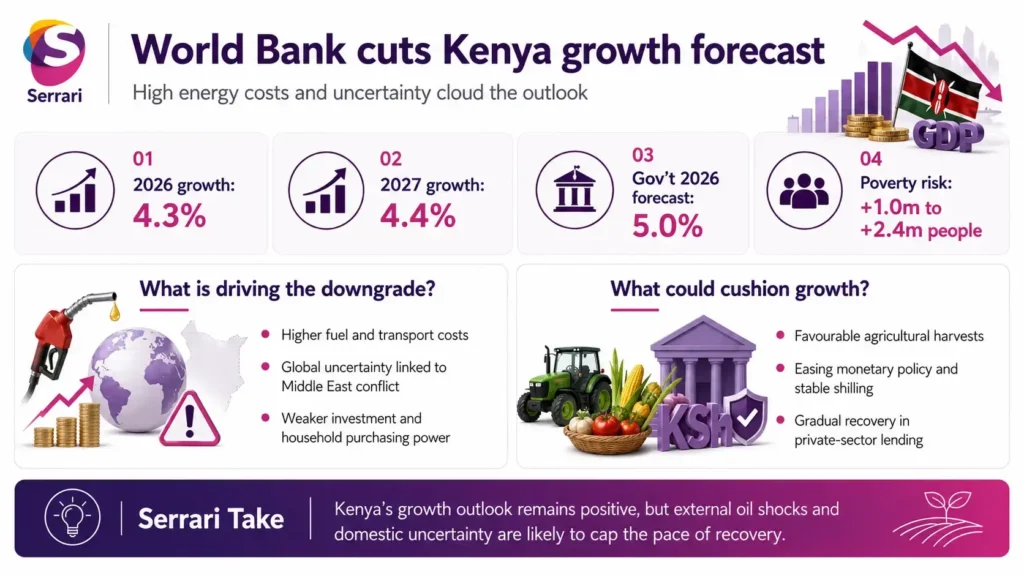
The World Bank has cut Kenya’s 2026 economic growth forecast to 4.3%, warning that higher energy costs and global uncertainty are weakening investment, household spending and the country’s wider economic outlook.
Growth is expected to improve only marginally to 4.4% in 2027, leaving the lender considerably less optimistic than the Kenyan government, which expects the economy to expand by 5.0% in 2026 and 5.2% in 2027.
The downgrade reflects the economic impact of the Middle East conflict, which has pushed up fuel and transport costs. The World Bank estimates the shock could also push between one million and 2.4 million additional Kenyans below the international poverty line.
Key Overview
- The World Bank forecasts Kenya’s economy will grow 4.3% in 2026 and 4.4% in 2027.
- The 2026 projection is 0.6 percentage points below the lender’s pre-conflict forecast.
- The government expects stronger growth of 5.0% in 2026 and 5.2% in 2027.
- Higher fuel and commodity costs could lift the poverty rate by 2 to 4.5 percentage points.
- Between one million and 2.4 million additional people could fall below the $3-a-day poverty line.
- Agriculture, lower interest rates, exchange-rate stability and recovering private-sector credit provide some support.
Middle East Conflict Forces a Sharp Growth Downgrade
Kenya’s economy entered 2026 with stronger momentum, but the external environment has changed rapidly.
The World Bank now expects real GDP growth of 4.3% this year, 0.6 percentage points below its pre-conflict projection.
The economy is then forecast to grow by 4.4% in 2027 before moving gradually towards growth of around 5% over the longer term.
The downgrade mainly reflects higher energy and shipping costs caused by the Middle East conflict. Kenya is a net importer of petroleum, making businesses and households particularly vulnerable when global oil prices rise.
Higher fuel costs increase expenses across transport, manufacturing, agriculture and other sectors. Businesses can absorb some of those costs, but sustained increases are often passed to consumers through higher prices.
The World Bank also expects uncertainty to weaken private investment as companies become more cautious about expanding or committing capital.
Fuel Shock Threatens to Push Millions Into Poverty
The impact goes beyond headline GDP growth.
World Bank analysis found that diesel prices rose 17.9% between March and April 2026, while petrol increased by 10.8%. Transport prices were 10% higher year on year in April and food prices had risen by 8.8%.
The lender’s poverty impact estimates suggest the share of Kenyans living below the $3-per-day international poverty line could increase by between 2 and 4.5 percentage points in 2026.
That would translate into an additional one million to 2.4 million people falling below the threshold.
Low-income households are particularly exposed because food and transport account for a large share of their spending. Families have less flexibility to absorb higher prices without cutting consumption elsewhere.
The conflict could also affect remittances. The World Bank has warned that weaker inflows, particularly from the Gulf region, could reduce an important source of household income.
Domestic Strengths Provide Some Protection
Despite the downgrade, Kenya has several factors working in its favour.
Favourable agricultural conditions could support production and incomes, while a more accommodative monetary policy has reduced borrowing costs.
Private-sector credit growth has also recovered. The World Bank reported that lending to businesses and households increased by 8.1% in March 2026 after near-zero or negative growth in early 2025.
Commercial lending rates had fallen from 17.2% in November 2024 to 14.7% by March 2026.
The exchange rate has also remained broadly stable, helping Kenya avoid the additional inflationary pressure that would come from a sharply weaker shilling.
These conditions provide some protection against external shocks, but they may not be enough to fully offset the effects of expensive energy and weaker global confidence.
Context is everything. Stay ahead of shifting trends with today’s market updates, and uncover emerging opportunities using the Serrari Group Market Index and Marketplace. Then, take control of your own financial future by exploring our Money & Life Reset Transformation Blueprint ™ to build stronger habits, create better systems, and design a path toward lasting wealth.
Government Remains More Optimistic on Growth
The World Bank’s forecast is notably weaker than the government’s outlook.
Kenya’s National Treasury expects the economy to grow by 5.0% in 2026, before accelerating to 5.2% in 2027.
The Treasury had previously expected growth of 5.3% this year but revised the forecast lower because of the adverse external environment.
The difference between the government and World Bank forecasts reflects uncertainty over how long elevated energy prices will last and how strongly domestic demand will withstand the shock.
Kenya’s economy grew by 4.6% in 2025 after a late-year drought weakened agricultural performance.
Election Risks Could Slow Investment in 2027
The global environment is not the only risk.
Kenya is scheduled to hold its next general election in August 2027, and the World Bank has warned that approaching elections could delay investment and structural reforms.
Businesses often postpone major commitments during periods of political and policy uncertainty. Pre-election spending pressures could also complicate efforts to reduce the fiscal deficit and stabilise public debt.
The latest economic assessment identifies climate shocks, political uncertainty and slower reform implementation among the key risks to the outlook.
Droughts and floods remain especially important because agriculture is a major source of employment and household income.
New Financing Supports Kenya’s Reform Programme
The World Bank is continuing to support Kenya as the government pursues fiscal and structural reforms.
A $750 million development policy operation is designed to strengthen public finances, improve competition, support climate action and build more resilient economic institutions.
The broader financing programme also includes plans for a roughly $500 million sustainability-linked facility aimed at improving Kenya’s access to financing and reducing dependence on expensive domestic borrowing.
The reform financing framework comes as high interest costs and heavy domestic borrowing continue to constrain government spending.
Kenya’s near-term challenge is now to preserve growth while managing external shocks, high living costs and election-related uncertainty.
The World Bank still expects the economy to expand, but its forecast makes clear that strong agriculture and easing financial conditions will have to work harder to offset a much more difficult global environment.
Sources: World Bank / Reuters / National Treasury of Kenya
Your financial future isn’t something you wait for—it’s something you build.
The real question is: when do you begin?
Move beyond simply staying informed.
Navigate the markets with clarity—track trends through the Serrari Group Market Index, uncover opportunities in the Serrari Marketplace, and build practical knowledge with our Curated Wealth Builder Platform.
Stay connected to what truly matters.
Get daily insights on macro trends and financial movements across Kenya, Africa, and global markets—delivered through the Serrari Newsletter.
Growth opens doors.
Advance your career through professional programs including ACCA, HESI A2, ATI TEAS 7 , HESI EXIT , NCLEX – RN and NCLEX – PN, Financial Literacy!🌟—designed to move you forward with confidence.
See where money is flowing—clearly and in real time.
Track Money Market Funds, Treasury Bills, Treasury Bonds, Green Bonds, and Fixed Deposits, alongside global and African indexes, key economic indicators, and the evolving Crypto and stablecoin landscape—all within Serrari’s Market Index.