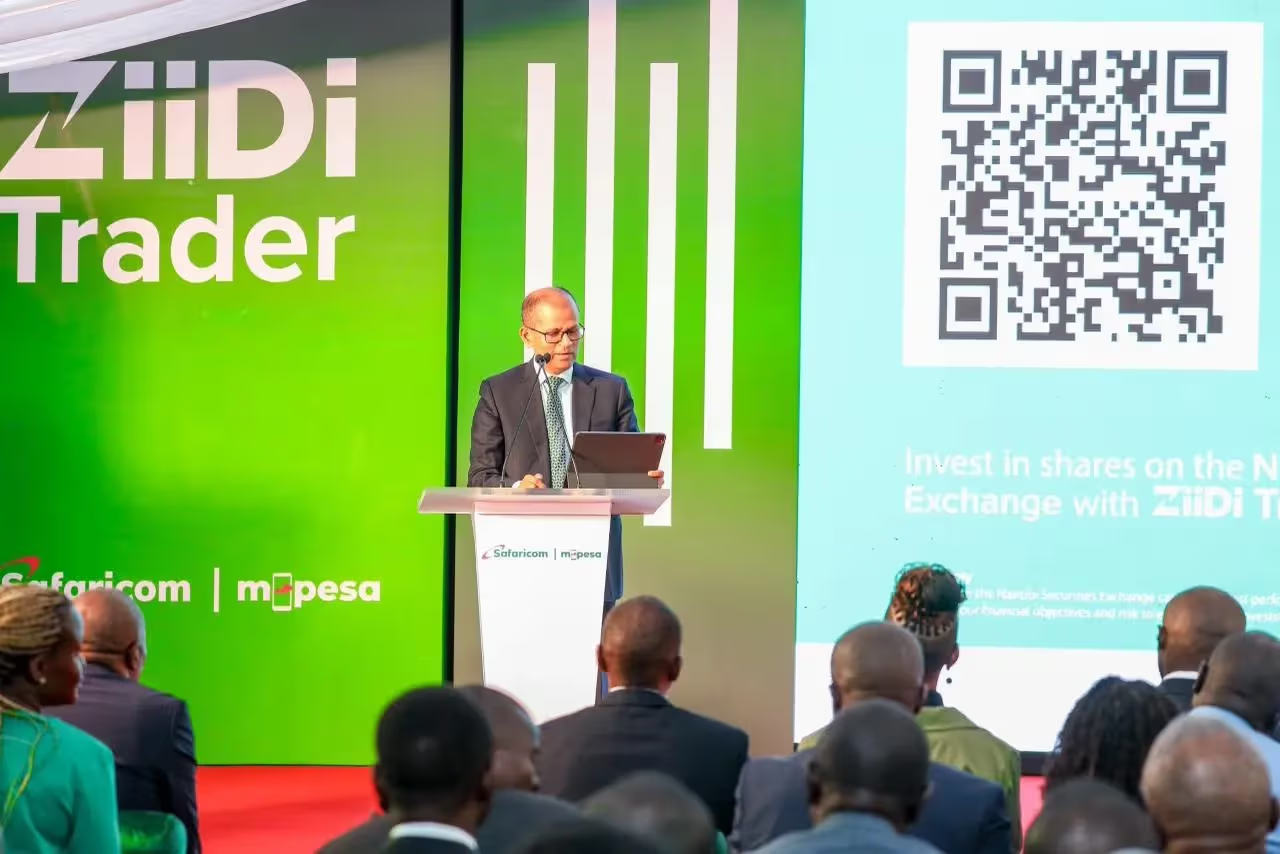
Safaricom’s Ziidi Trader platform has triggered a sharp increase in trading activity on the Nairobi Securities Exchange by making stock trading accessible through M-Pesa. By removing traditional barriers such as paperwork, high minimum investments, and complex onboarding processes, the platform has opened the market to millions of new retail investors. This surge reflects a broader shift toward financial inclusion, where mobile technology is bridging the gap between everyday users and capital markets. While the growth presents opportunities for deeper market participation and wealth creation, it also raises concerns around investor education, market volatility, and regulatory readiness. Overall, Ziidi marks a pivotal moment in Kenya’s journey toward a more inclusive and digitally driven financial ecosystem.
LIVEKenya MMF rates: Average 9.13% across 27 funds · top fund 11.01% · 22 OctCompare funds →Key Overview
Kenya’s capital markets are entering a transformative phase following the launch of Safaricom’s Ziidi Trader platform. By embedding stock trading into the M-Pesa ecosystem, the platform has significantly increased retail participation on the Nairobi Securities Exchange (NSE). Trading activity has surged, signaling a shift toward a more inclusive, accessible, and digitally driven investment environment that could reshape how millions of Kenyans engage with wealth creation.
Introduction: A New Chapter for Kenya’s Capital Markets
The Nairobi Securities Exchange has long stood as a central pillar of Kenya’s financial system, yet for many years it remained somewhat distant from the everyday Kenyan. While millions actively used mobile money platforms for payments, savings, and borrowing, participation in the stock market was limited to a relatively small segment of the population. This disconnect reflected a deeper structural issue: accessibility. Investing in equities was often perceived as complex, bureaucratic, and reserved for those with substantial capital or specialized knowledge.
That perception is now being challenged in a profound way. The introduction of Safaricom’s Ziidi Trader platform has triggered a dramatic rise in trading activity, fundamentally altering how Kenyans interact with the stock market. Within days of its launch in early February, the volume of daily trades on the NSE surged to levels two or even three times higher than what had previously been considered normal. This shift is not merely a statistical anomaly. It represents the early stages of a broader transformation in Kenya’s financial landscape, one that could redefine participation, liquidity, and long-term capital formation.
Markets move fast; don’t get left behind. We’ve paired the Serrari Group Market Index with a curated Marketplace and a comprehensive Wealth Builder Course to ensure you have the data—and the skills—to act on it.
The Immediate Impact: A Surge in Market Activity
The effect of Ziidi Trader on the NSE was almost instantaneous. When pilot trading began on 5 February, the number of daily equity transactions quickly began to climb. What had previously been a market averaging between 4,000 and 7,800 trades per day suddenly experienced a sharp escalation. By 5 February, trades had already reached 8,713, and just a few days later, on 9 February, they rose to over 14,000. The peak came on 11 February, when the exchange recorded more than 25,000 trades in a single day, the highest level ever observed in the market’s history.
This surge was not limited to the number of transactions alone. The value of equities traded also reflected heightened activity, with billions of Kenyan shillings changing hands over consecutive trading sessions. Major companies such as Safaricom, Kenya Power, KenGen, and leading banks including Equity, KCB, and Co-operative Bank dominated trading volumes, suggesting that new participants were gravitating toward well-known, established firms. This pattern is typical in markets experiencing an influx of first-time investors, who often prefer recognizable and relatively stable stocks.
What makes this surge particularly significant is its timing. It occurred against a backdrop of improving market performance, indicating that accessibility—not just returns—was the missing ingredient needed to unlock broader participation.
Historical Context: From Decline to Renewal
To fully appreciate the significance of this development, it is necessary to revisit the NSE’s recent history. Over the past decade, the exchange has gone through cycles of growth and decline. Between the mid-2010s and early 2020s, the market faced persistent challenges, including reduced foreign investor inflows, limited new listings, and declining liquidity. Investor confidence weakened, and the market struggled to maintain momentum.
This downward trend was evident in the performance of the NSE All Share Index, which fell to notably low levels by late 2023. The index dropping below 86 reflected broader concerns about economic conditions, corporate earnings, and the attractiveness of the Kenyan market relative to global alternatives.
However, the period from 2025 into early 2026 marked a turning point. The market began to recover, supported by improved macroeconomic conditions, stronger corporate performance, and renewed investor interest. By mid-February 2026, the index had climbed significantly, surpassing 213. This rebound signaled that the underlying fundamentals of the market were improving.
Yet, despite this recovery, a critical issue remained unresolved. Retail participation was still remarkably low. Out of a population exceeding 50 million, only about 200,000 individuals were actively trading on the NSE. Even though over 1.4 million Kenyans owned shares, most were inactive. This gap highlighted a structural barrier: the market was not easily accessible to the average citizen.
The Role of M-Pesa: Bridging the Accessibility Gap
Kenya’s global leadership in mobile money provides an important backdrop to this transformation. M-Pesa revolutionized financial transactions by making it possible for millions of people to send, receive, and store money using their mobile phones. It effectively brought financial services to populations that had previously been excluded from formal banking systems.
Safaricom’s strategy with Ziidi builds directly on this success. By integrating stock trading into a platform that millions already use daily, it removes the friction traditionally associated with investing. There is no longer a need for lengthy account-opening procedures, extensive paperwork, or high minimum investment thresholds. Instead, users can access the stock market through a familiar interface, using funds stored in their mobile wallets.
This shift represents a powerful convergence of financial inclusion and capital markets. It transforms passive users of financial services into active participants in wealth creation. In doing so, it addresses one of the most significant barriers that has historically limited the growth of Kenya’s equity market.
From Savings to Investing: The Evolution of Ziidi
The introduction of Ziidi Trader did not occur in isolation. It builds on Safaricom’s earlier efforts to expand its financial services ecosystem. In January 2025, the company launched the Ziidi Money Market Fund in partnership with Standard Investment Bank and ALA Capital. This product allowed users to invest small amounts, starting from as little as KSh 100, and earn returns that compounded daily.
The success of the money market fund demonstrated a strong appetite for accessible investment products. Within months, it attracted over a million active users and accumulated millions of dollars in assets under management. More importantly, it served as an entry point for individuals who had never invested before, introducing them to the concept of earning returns on their money.
Ziidi Trader represents the next stage in this journey. While the money market fund offers relatively low-risk, stable returns, equity trading introduces higher potential rewards alongside greater risk. This progression mirrors the natural evolution of an investor, moving from savings to more sophisticated forms of investment.
By creating this pathway, Safaricom is not just offering isolated financial products. It is building an integrated ecosystem that guides users along a continuum of financial engagement, from basic transactions to long-term wealth creation.
Why This Matters: A Structural Transformation
The surge in trading activity on the NSE is more than a short-term phenomenon. It signals a deeper structural shift in Kenya’s financial system. For decades, access to capital markets was limited, both by design and by circumstance. Now, that barrier is being dismantled.
One of the most significant implications of this shift is the democratization of investment opportunities. Ordinary Kenyans, many of whom were previously excluded from the stock market, can now participate in economic growth through equity ownership. This has the potential to reshape wealth distribution and create new avenues for financial empowerment.
LIVENSE market summarySee NSE data →Increased participation also enhances market liquidity. A more active market is generally more efficient, with better price discovery and reduced volatility over the long term. This can attract additional investment, both domestic and foreign, further strengthening the market.
There is also a cultural dimension to this transformation. Traditionally, savings in Kenya have been concentrated in bank deposits, SACCOs, and real estate. The rise of mobile-based investing could shift this dynamic, encouraging greater diversification and a more balanced approach to financial planning.
Context is everything. While you follow today’s updates, use the Serrari Group Market Index and Marketplace to spot emerging shifts. Need to sharpen your edge? Our Wealth Builder Course turns these insights into a professional-grade strategy.
Risks and Challenges: Navigating the Transition
Despite its promise, this transformation is not without risks. One of the most pressing concerns is the level of financial literacy among new investors. Many individuals entering the market through Ziidi may have limited understanding of how equities work, including the risks involved. This could lead to poor investment decisions, particularly during periods of market volatility.
The influx of retail investors can also introduce short-term instability. Markets dominated by inexperienced participants may experience sharp price swings, driven by sentiment rather than fundamentals. This phenomenon has been observed in other markets where retail trading surged rapidly.
Regulatory challenges also come into play. As trading volumes increase and new digital platforms emerge, regulators must ensure that appropriate safeguards are in place. This includes protecting investors from fraud, ensuring transparency, and maintaining the integrity of the market.
There is also the question of infrastructure. The NSE must be able to handle increased activity without compromising system stability. Any disruptions could undermine confidence and slow the momentum generated by Ziidi.
Alignment with National Economic Goals
The rise of retail participation in the NSE aligns closely with Kenya’s broader economic objectives. Under the government’s Bottom-Up Economic Transformation Agenda, there is a strong emphasis on inclusivity and wealth creation. Capital markets are seen as a critical tool for mobilizing the resources needed to fund large-scale development projects.
By expanding the investor base, platforms like Ziidi can contribute to this goal. A larger pool of domestic investors reduces reliance on foreign capital and creates a more stable funding environment. The NSE’s ambition to reach millions of active retail investors within the next few years reflects this vision.
In this context, the success of Ziidi is not just a private-sector achievement. It is part of a broader national effort to build a more inclusive and resilient economy.
Looking Ahead: The Future of Retail Investing in Kenya
The early success of Ziidi Trader suggests that Kenya is on the cusp of a new era in capital markets. In the short term, trading volumes are likely to remain elevated as more users adopt the platform. Over time, the focus will shift toward sustainability, ensuring that participation translates into meaningful financial outcomes for investors.
The next phase of development may involve greater product diversification, including the introduction of new asset classes and investment vehicles. There is also potential for deeper integration with other financial services, creating a seamless experience that spans payments, savings, and investments.
Education will play a crucial role in this evolution. As more Kenyans enter the market, there will be a growing need for accessible, practical guidance on investing. This will help ensure that the benefits of increased participation are widely shared.
Ultimately, the long-term impact of Ziidi will depend on how effectively these challenges are addressed. If managed well, it could serve as a model for other emerging markets, demonstrating how technology can be used to democratize access to capital markets.
Conclusion: A Defining Moment for the NSE
Safaricom’s Ziidi platform has introduced a new dynamic to Kenya’s financial landscape. By leveraging the widespread adoption of M-Pesa, it has opened the doors of the stock market to millions of people who were previously excluded. The resulting surge in trading activity is a clear indication of the latent demand for accessible investment opportunities.
This moment represents both an opportunity and a responsibility. The opportunity lies in building a more inclusive, vibrant, and resilient capital market. The responsibility lies in ensuring that this growth is sustainable, equitable, and supported by strong regulatory and educational frameworks.
As Kenya continues to navigate this transition, the success of Ziidi will likely be measured not just by trading volumes, but by its ability to create lasting value for investors and contribute to the country’s broader economic development.
Your financial future isn’t something you wait for, it’s something you build.
The real question is: when do you begin?
Move beyond simply staying informed.
Navigate the markets with clarity—track trends through the Serrari Group Market Index, uncover opportunities in the Serrari Marketplace, and build practical knowledge with our Curated Wealth Builder Course.
Stay connected to what truly matters.
Get daily insights on macro trends and financial movements across Kenya, Africa, and global markets—delivered through the Serrari Newsletter.
Growth opens doors.
Advance your career through professional programs including ACCA, HESI A2, ATI TEAS 7 , HESI EXIT , NCLEX – RN and NCLEX – PN, Financial Literacy!🌟—designed to move you forward with confidence.
See where money is flowing—clearly and in real time.
Track Money Market Funds, Treasury Bills, Treasury Bonds, Green Bonds, and Fixed Deposits, alongside global and African indexes, key economic indicators, and the evolving Crypto and stablecoin landscape—all within Serrari’s Market Index.