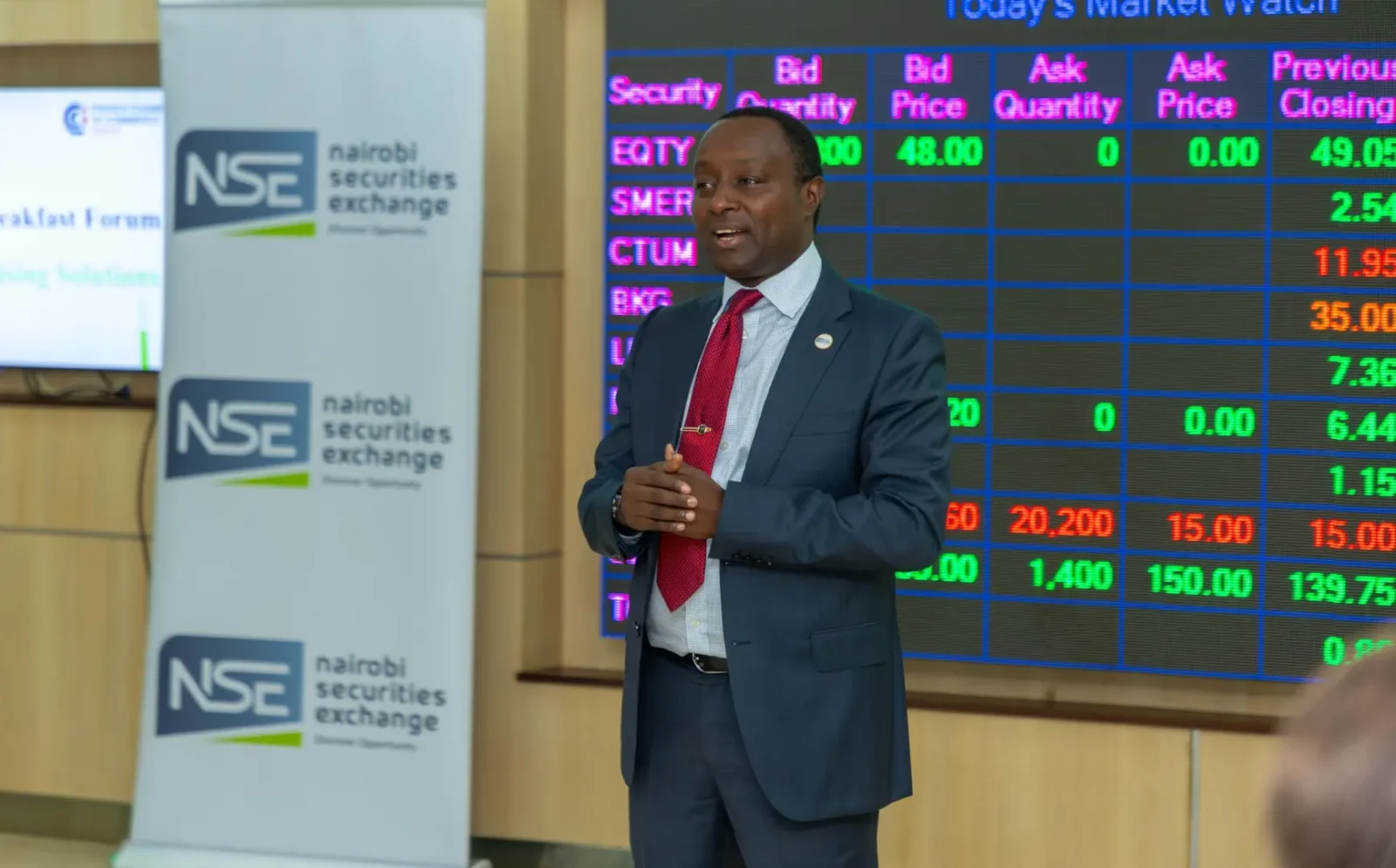
The Nairobi Securities Exchange delivered its most impressive weekly performance since February 2026, adding KSh 128.42 billion in market capitalisation to close the week ended April 10 at KSh 3,432.92 billion — a 3.89% gain that lifted the bourse back above the pre-KPC listing level of KSh 3,289 billion for the first time since the selloff began. The rally, driven by aggressive institutional buying in the banking sector and a meaningful surge in foreign portfolio inflows, clawed back more than half of the KSh 231.17 billion lost during the Week 13 rout. All major indices advanced: the NSE 10 led with a 4.76% gain, the Banking Index added 4.49% to 238.86, the NSE 25 rose 3.98%, and the NSE 20 advanced 3.18%. Foreign portfolio inflows accounted for approximately 28% of weekly activity — nearly three times the 10% average seen in March — signalling a meaningful return of international investor appetite. The macro backdrop was broadly supportive: the Central Bank of Kenya held its benchmark rate unchanged at 8.75%, the shilling held steady at KSh 129.53 per dollar, and Kenya’s Eurobond yields fell sharply across all tenors, with the 13-year bond tightening by 73 basis points to 8.65%. The one note of caution is the continued drawdown in foreign exchange reserves, which fell for a fifth consecutive week to USD 13,316 million — down USD 1.28 billion since early March, though still comfortably above the statutory minimum of four months of import cover.
LIVENSE market summarySee NSE data →Key Overview
- Market Cap Gain: KSh 128.42 billion added in the week ended April 10, 2026 — the strongest weekly gain since Week 7 in February
- Closing Market Cap: KSh 3,432.92 billion, up 3.89% from KSh 3,304.50 billion — back above the pre-KPC listing level of KSh 3,289 billion
- Rally Recovery: More than half of the KSh 231.17 billion lost during the Week 13 rout has been clawed back
- Index Performance: NSE 10 led at +4.76%; Banking Index +4.49% to 238.86; NSE 25 +3.98%; All Share Index +3.89% to 207.01; NSE 20 +3.18%
- Sector Leaders: Banking (45% of total traded value); Telecoms (steady 3.2% price growth); Manufacturing showing cautious recovery
- Foreign Inflows: Foreign portfolio inflows rose to ~28% of weekly activity, up sharply from the 10% average in March
- CBK Policy Rate: Held unchanged at 8.75% on April 8
- Currency: Shilling steady at KSh 129.53 per dollar
- FX Reserves: Fell for a fifth consecutive week to USD 13,316 million (5.7 months of import cover) — down USD 1.28 billion since March 5
- Eurobond Yields: Fell sharply — 13-year bond tightened 73bps to 8.65%; 30-year fell 46bps to 9.15%; 10-year down 29bps to 7.53%
A Bourse Breaking Its Silence
There are weeks on the Nairobi Securities Exchange that pass with barely a ripple — thin volumes, listless price movements, and the quiet frustration of a market that seems unable to find a catalyst for direction. The week ended April 10, 2026 was emphatically not one of those weeks. In what market participants described as uncharacteristic activity on the NSE floor, investors moved with purpose and conviction, piling into blue-chip stocks across the banking, telecommunications, and manufacturing sectors in a manner that has become increasingly rare in Kenya’s equity market.
The result was a KSh 128.42 billion addition to market capitalisation — the most significant weekly gain since the record-setting Week 7 in February 2026. Market cap rose 3.89% to KSh 3,432.92 billion from KSh 3,304.50 billion, pushing the bourse back above the psychologically and technically significant pre-KPC listing level of KSh 3,289 billion for the first time since the selloff that had been weighing on the market. More than half of the KSh 231.17 billion lost during the brutal Week 13 rout has now been recovered.
For a market that has spent much of the past year navigating headwinds — from global risk-off sentiment and dollar strength to domestic fiscal pressures and equity outflows — this is a meaningful moment. Whether it represents a genuine inflection point or a powerful but ultimately temporary bounce is the question that every serious investor in Kenya’s equity market is now asking.
Markets move fast; don’t get left behind. We’ve paired the Serrari Group Market Index with a curated Marketplace and a comprehensive Wealth Builder Platform to ensure you have the data—and the skills—to act on it.
Historical Context: The NSE’s Journey Through Boom and Bust
The Nairobi Securities Exchange has a history that stretches back to 1954, when it was established as an informal market to facilitate the trading of stocks among European residents of colonial Kenya. Formalised after independence and gradually opened to broader participation, the NSE grew through the 1970s and 1980s as an institution primarily serving large domestic corporations and the Kenyan government’s privatisation programme.
The liberalisation of Kenya’s capital markets in the 1990s and early 2000s marked a turning point. Foreign investor access was progressively opened, new listing requirements were introduced to improve corporate governance standards, and the development of the Central Depository and Settlement Corporation created the electronic infrastructure for modern securities trading. The NSE All Share Index became a benchmark that international fund managers began to include in their emerging and frontier market assessments — a milestone that brought both capital and scrutiny to Kenya’s corporate sector.
The 2000s were a period of significant growth for the NSE, driven by strong economic expansion, a wave of privatisation listings, and the emergence of a domestic retail investor class that the Safaricom IPO of 2008 dramatically expanded. The Safaricom listing — one of the largest in African history at the time — introduced hundreds of thousands of ordinary Kenyans to equity investing for the first time, permanently altering the demographic profile of the NSE’s investor base.
The decade that followed was more turbulent. Global financial crises, domestic political uncertainty around the 2007-2008 post-election violence and subsequent elections, currency volatility, and the structural challenge of a relatively small and illiquid market with limited sectoral diversification all contributed to periods of sharp decline and slow recovery. The NSE has consistently demonstrated resilience — recovering from each setback and attracting renewed interest as Kenya’s economic fundamentals have improved — but it has also demonstrated the vulnerability of a frontier market to both external shocks and domestic confidence crises.
The current recovery, emerging from the Week 13 rout that erased KSh 231.17 billion in market value, fits this historical pattern of sharp declines followed by recoveries driven by a combination of improved fundamentals, attractive valuations, and a return of investor confidence. The speed and breadth of the current bounce — with all major indices advancing and foreign inflows surging — suggests that the recovery has more substance than a simple technical rebound.
Dissecting the Rally: What Drove the KSh 128 Billion Gain
Understanding why the NSE surged this week requires looking at the specific dynamics across sectors, investor types, and the broader macroeconomic context that shaped market behaviour.
Banking Sector: The Engine of the Rally
The banking sector was unambiguously the dominant force in this week’s rally, accounting for 45% of total traded value and driving the Banking Index to a 4.49% gain — closing at 238.86. The aggressive institutional buying that characterised the sector’s performance reflects a confluence of factors that have made Kenyan bank stocks increasingly attractive to sophisticated investors.
Kenya’s major banks — including Equity Group, KCB Group, Co-operative Bank, and NCBA — have demonstrated resilience in their financial performance despite the challenging macro environment of the past two years. Net interest margins have benefited from the elevated interest rate environment, loan books have continued to grow, and digital banking penetration has expanded the customer base and reduced the cost of service delivery. With Q2 2026 corporate earnings expected to show continued strength, the institutional buying observed this week appears to reflect a calculated repositioning ahead of results season — investors securing positions before anticipated positive earnings announcements push prices higher.
The Banking Index’s performance also reflects the broader signal from Kenya’s Eurobond market, where yields fell sharply across all tenors this week. A 73 basis point tightening in the 13-year Eurobond to 8.65%, a 46 basis point decline in the 30-year to 9.15%, and a 29 basis point fall in the 10-year to 7.53% collectively signal improving investor confidence in Kenya’s sovereign creditworthiness — a development that has direct positive implications for the banking sector, which holds substantial quantities of government securities on its balance sheet and whose funding costs are closely linked to the sovereign credit premium.
Telecommunications: Steady and Anchored
The telecommunications sector contributed a steady 3.2% price growth during the week, anchoring the NSE 20 Share Index and providing the broad-based market participation that distinguishes a genuine rally from a sector-specific spike. Safaricom — the dominant listed telecommunications company and one of the NSE’s largest constituents by market capitalisation — is a stock that institutional investors treat as a proxy for the health of Kenya’s consumer economy. Its steady performance this week is consistent with the broader portfolio rebalancing thesis: investors returning to quality, liquid names with predictable cash flows and strong dividend track records.
Manufacturing and Allied: Cautious Optimism
The manufacturing and allied sector showed more tentative recovery, with cautious growth reflecting the complexity of its current situation. Supply chain pressures — which have been a persistent feature of Kenya’s manufacturing environment since the post-pandemic period — are beginning to ease, according to sector participants, as global logistics costs normalise and the shilling’s stability reduces input cost volatility for import-dependent manufacturers. But the recovery in this sector is appropriately cautious: consumer spending power has been under pressure from elevated food prices and utility costs, and the demand environment for manufactured goods remains challenging.
The Foreign Investor Signal: From 10% to 28%
Perhaps the single most significant data point in this week’s market activity is the surge in foreign portfolio inflows, which accounted for approximately 28% of weekly trading activity — compared to just 10% in March. This nearly threefold increase in foreign participation is not a random fluctuation. It is a directional signal from international investors who have reassessed Kenya’s risk-reward profile and concluded that the post-Week 13 selloff created entry points that are too attractive to ignore.
Foreign portfolio flows into frontier and emerging market equities are driven by a complex interaction of global and local factors. On the global side, the current environment — with US equity markets near all-time highs but facing geopolitical and inflation headwinds — is creating incentives for diversification into markets with different risk profiles and return drivers. Kenya, with its relatively low correlation to US equity markets and its exposure to the structural growth story of East Africa’s consumer economy, represents exactly the kind of diversification that global allocators are seeking.
On the local side, the combination of attractive valuations following the Week 13 selloff, the CBK’s rate stability at 8.75%, the shilling’s steadiness at KSh 129.53, and the sharp decline in Eurobond yields has created a risk-adjusted return profile that is genuinely compelling for investors with the risk appetite and investment horizon to access frontier market equities. The recovery above the pre-KPC listing level of KSh 3,289 billion also removes a technical overhang that had been discouraging some momentum-oriented investors from re-entering the market.
The sustainability of these foreign inflows is, of course, the critical question. March’s 10% average reflected a period of risk aversion and capital outflows — the kind of environment in which frontier markets like Kenya are typically penalised as investors retreat to the perceived safety of developed market assets. The return to 28% this week is encouraging, but it will need to be sustained and ideally deepened over coming weeks before it can be characterised as a structural shift rather than an opportunistic bounce.
The Macro Picture: Rates, Reserves, and the Currency Question
The equity market rally unfolded against a macroeconomic backdrop that is broadly supportive but contains important nuances that investors must navigate carefully.
LIVENSE market summarySee NSE data →The Central Bank of Kenya’s decision to hold its benchmark rate unchanged at 8.75% on April 8 was widely anticipated but nonetheless significant. The hold reflects a monetary policy committee that sees the current rate as appropriate given the balance of risks: inflation has ticked up marginally to 4.40% in March from 4.30% in February, but remains well within a manageable range and comfortably below the CBK’s ceiling. GDP growth of 4.9% in Q3 2025, while a slight moderation from the 5.0% in Q2, remains respectable by both regional and global standards. The interbank rate (KESONIA) holding steady at 8.75% confirms that the rate hold is credible and that the banking system has adequate liquidity.
The shilling’s stability at KSh 129.53 per dollar — a 0.35% appreciation from the previous week’s 129.99 — is a positive development for an economy with significant import dependencies and a corporate sector with dollar-denominated debt obligations. However, the mechanism by which this stability is being maintained warrants careful attention. CBK foreign exchange reserves have now fallen for five consecutive weeks, declining by USD 340 million in the most recent week alone to USD 13,316 million — equivalent to 5.7 months of import cover. Since March 5, reserves have been drawn down by USD 1.28 billion, from USD 14,597 million (6.2 months of cover).
This sustained reserve drawdown — the longest consecutive decline since September-October 2023 — suggests that the CBK has been intervening in the foreign exchange market to support the shilling, selling dollars to prevent depreciation pressure from translating into a weaker currency. While reserves remain comfortably above the statutory minimum of four months of import cover, the pace and duration of the drawdown is a trend that requires monitoring. If the drawdown continues at the current rate, the buffer above the statutory minimum will erode, potentially constraining the CBK’s ability to intervene and putting the shilling’s stability at risk.
The Eurobond market’s strong performance this week — with yields falling across all three tenors — is perhaps the most encouraging macro signal. Eurobond yields are a direct measure of what international investors require to lend money to the Kenyan government in hard currency, and sharp yield compression across the 10-year, 13-year, and 30-year bonds signals improving confidence in Kenya’s debt sustainability and fiscal trajectory. The 73 basis point tightening in the 13-year bond is particularly striking — a move of that magnitude in a single week reflects a meaningful reassessment of Kenya’s sovereign risk by international bond investors.
Key Rates at a Glance: Week Ended April 10, 2026
The following snapshot captures the key economic and financial indicators shaping Kenya’s investment environment this week:
GDP growth moderated slightly to 4.9% in Q3 2025 from 5.0% in Q2, reflecting a broadly stable but gradually softening growth trajectory. Inflation edged up to 4.40% in March from 4.30% in February — a marginal increase that keeps price pressures within a manageable range. The CBR and KESONIA interbank rate both held at 8.75%, confirming monetary policy stability. Treasury bill rates were broadly stable, with the 91-day holding at 7.40%, the 182-day at 7.83%, and the 364-day easing slightly to 8.27% from 8.28%. The shilling strengthened modestly to KSh 129.53 from 129.99, while Eurobond yields compressed sharply — the 10-year falling 29 basis points to 7.53%, the 13-year declining 73 basis points to 8.65%, and the 30-year down 46 basis points to 9.15%.
Context is everything. While you follow today’s updates, use the Serrari Group Market Index and Marketplace to spot emerging shifts. Need to sharpen your edge? Our Wealth Builder Platform turns these insights into a professional-grade strategy.
Risks to Consider
The week’s strong performance is genuinely encouraging, but investors should weigh it against a set of risks that remain present in Kenya’s market environment.
FX reserve depletion is the most immediate domestic risk. Five consecutive weeks of reserve drawdown — stripping USD 1.28 billion from the CBK’s buffer since early March — raises questions about the sustainability of the shilling’s current stability. If dollar inflows from tourism, remittances, and export earnings do not recover sufficiently to replenish reserves, the CBK may face a choice between allowing the shilling to depreciate or continuing to draw down reserves towards levels that could trigger credit rating concerns.
Earnings delivery risk is a near-term consideration. The rally appears to be pricing in improved Q2 2026 corporate earnings — particularly in the banking sector. If actual results disappoint relative to these expectations, the market could give back a meaningful portion of this week’s gains. The gap between anticipated and delivered earnings is always a source of potential volatility around reporting season.
Foreign flow reversibility is a structural characteristic of frontier market investing that investors must always respect. The foreign portfolio inflows that drove 28% of this week’s activity can reverse as quickly as they arrived — in response to global risk sentiment shifts, dollar strength, or adverse domestic developments. A market that rises sharply on foreign inflows is potentially vulnerable to equally sharp declines if those flows reverse.
The global risk environment remains a headwind. The geopolitical tensions and inflation concerns weighing on US markets have direct implications for global risk appetite and, by extension, for the flow of capital to frontier markets like Kenya. A deterioration in the global macro environment could rapidly reduce the foreign investor interest that has been a key driver of this week’s rally.
Challenges Ahead
Several structural challenges will determine whether this week’s rally marks the beginning of a sustained NSE recovery or proves to be a powerful but temporary bounce.
Market depth and liquidity remain persistent constraints. The NSE’s daily trading volumes — even in a strong week — are modest by the standards of comparable emerging market exchanges. This thin liquidity means that large institutional transactions can move prices significantly in both directions, amplifying volatility and creating challenges for investors seeking to build or reduce positions without moving the market against themselves.
Corporate governance and disclosure standards, while improved, continue to vary significantly across listed companies. Investors — particularly international participants who are returning to the market — require consistent, timely, and transparent financial reporting to make informed investment decisions. Companies that fall short of these standards risk being excluded from the investment universe of the institutional investors whose participation is most critical for market development.
The pipeline of new listings is essential for the NSE’s long-term development. A market that cannot attract new high-quality listings risks becoming a shrinking pool of increasingly concentrated risk. The KPC listing — which preceded the Week 13 selloff — highlights the sensitivity of the market to major new issuances, and the NSE’s ability to manage future listings in ways that do not destabilise the broader market will be an important test of the exchange’s maturity.
Looking Ahead: Can the Rally Be Sustained?
The NSE’s KSh 128.42 billion gain this week is a genuine and meaningful market event. It is not a statistical quirk or a thin-volume spike — it is a broad-based rally across sectors and investor types that has moved the market to a technically important level and generated the kind of momentum that, if sustained, could attract further capital and compress the discount at which Kenyan equities have traded relative to their fundamental value.
The catalysts for continuation are present. The CBK’s rate stability provides a predictable monetary policy backdrop. Eurobond yield compression signals improving sovereign credit confidence. Foreign investor interest is returning. Corporate earnings season is approaching. And the market remains attractively valued relative to regional peers, despite this week’s strong performance.
The risks to continuation are equally real. Reserve drawdown, global risk sentiment, earnings delivery, and the inherent reversibility of foreign portfolio flows all represent potential headwinds that could interrupt the recovery narrative at any point.
What is clear is that this week has changed the conversation around Kenya’s equity market. The question is no longer whether the NSE can recover from the Week 13 selloff — it demonstrably can, and it has begun to do so with conviction. The question is whether the recovery has the structural support — in earnings, in policy, in foreign flows, and in domestic confidence — to become the sustained bull run that Kenya’s long-suffering equity investors have been waiting for.
Your financial future isn’t something you wait for, it’s something you build.
The real question is: when do you begin?
Move beyond simply staying informed.
Navigate the markets with clarity—track trends through theSerrari Group Market Index, uncover opportunities in theSerrari Marketplace, and build practical knowledge with our CuratedWealth Builder Platform.
Stay connected to what truly matters.
Get daily insights on macro trends and financial movements across Kenya, Africa, and global markets—delivered through the Serrari Newsletter.
Growth opens doors.
Advance your career through professional programs including ACCA, HESI A2, ATI TEAS 7 , HESI EXIT , NCLEX – RN and NCLEX – PN, Financial Literacy!🌟—designed to move you forward with confidence.
See where money is flowing—clearly and in real time.
Track Money Market Funds, Treasury Bills, Treasury Bonds, Green Bonds, and Fixed Deposits, alongside global and African indexes, key economic indicators, and the evolving Crypto and stablecoin landscape—all within Serrari’s Market Index.