
Succession planning is not just for large corporations. It is for every business owner, every family with assets, and every individual who wants their wealth and responsibilities passed on smoothly when life changes. Done well, it protects the people you lead, the business you built, and the legacy you leave behind. Done poorly — or ignored altogether — it hands a decade of hard work over to disputes, taxes, and confusion.
This guide simplifies succession planning and estate management for Kenyan, African, and global investors, families, and business owners. It covers what each one is, why they matter, and how to implement them with a practical six-step process. Along the way, it connects to the wider Serrari framework on wealth management, allocation and distribution and the financial triangle of savings, investments, and insurance.
Markets move fast; don’t get left behind. Pair the Serrari Group Market Index with a curated Serrari Marketplace and the comprehensive Wealth Builder Course to make sure you have the data — and the skills — to act on what you see.
What Is Succession Management?
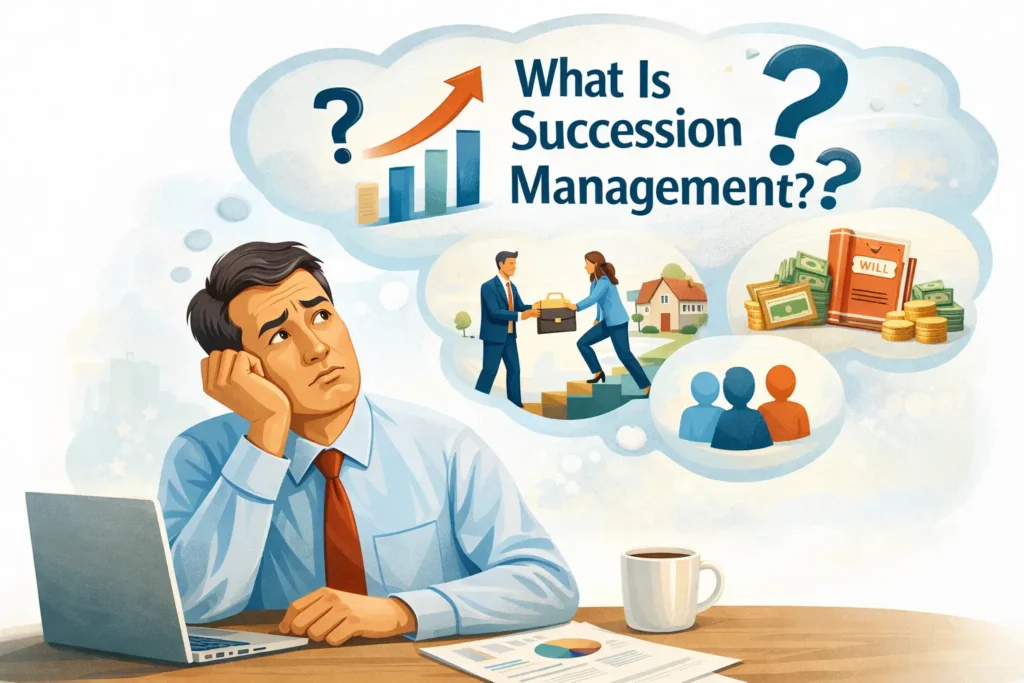
Succession management is the deliberate process of planning who takes over important roles or assets when someone steps down, retires, becomes incapacitated, or passes away. It answers the questions most people would rather avoid:
- Who runs the business if the CEO or founder leaves?
- Who manages the family’s assets if the head of the household retires?
- Who inherits wealth — and who has authority to manage it?
- How do we avoid disputes, delays, and loss of value?
In plain terms: it is a backup plan for leadership and wealth transfer — and it is an ongoing process, not a one-time task.
Why Succession Planning Matters
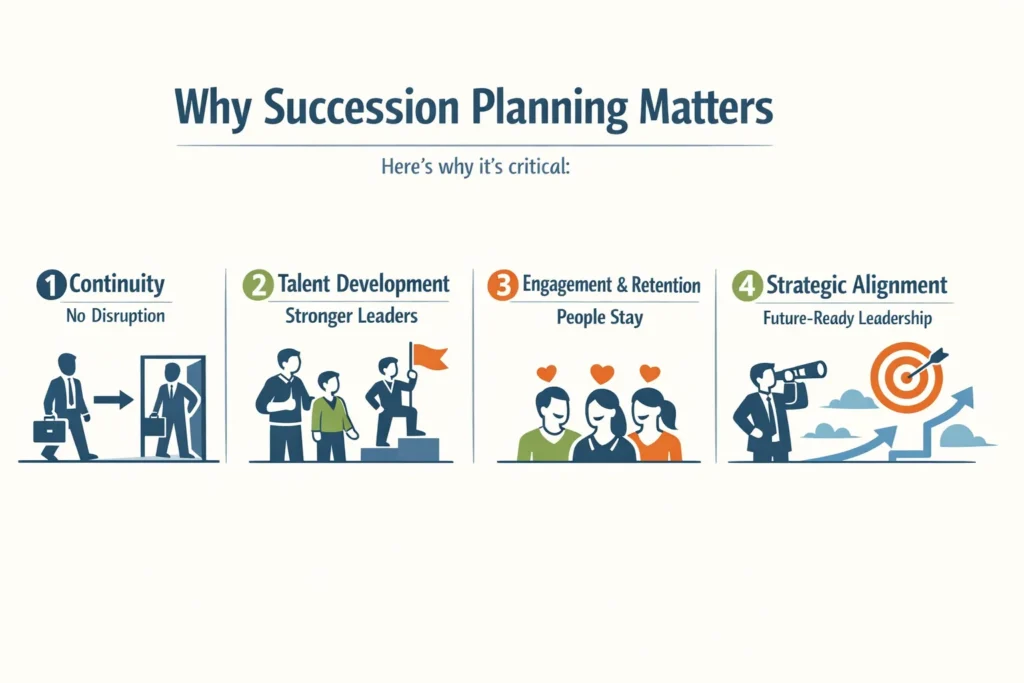
1. Continuity — no disruption
When a key person leaves, operations do not grind to a halt. Someone credible is already prepared to step in, customers keep buying, lenders stay calm, and investors do not head for the exit.
2. Talent development — stronger leaders
High-potential employees or family members are identified and developed early. They grow into leadership roles through exposure and mentorship, instead of being thrown into them unprepared.
3. Engagement and retention — people stay
Ambitious team members stay loyal when they can see a future inside the organisation. Visible succession paths are one of the most powerful retention tools a business has.
4. Strategic alignment — future-ready leadership
You prepare leaders who already understand your long-term vision, values, and capital-allocation philosophy. That matters especially in family businesses where strategic continuity is tied to relational and cultural continuity — see Serrari’s primer on business financial planning and investment and capital allocation.
How Succession Planning Connects to Estate Management

Estate management focuses on preserving and transferring wealth efficiently. Succession planning focuses on people and leadership; estate management focuses on assets and ownership. Together they cover the two dimensions of every real transition — who runs it, and who owns it.
Succession vs Estate Management at a Glance
| Dimension | Succession Planning | Estate Management |
| Primary Focus | People — who will lead and make decisions | Assets — who owns what, and when |
| Typical Tools | Talent reviews, mentorship, leadership pipelines, shareholder agreements | Wills, trusts, insurance, powers of attorney, tax planning |
| Applies To | Businesses, family-run enterprises, boards, family offices | Individuals, families, business owners, shareholders |
| Timing | Ongoing — reviewed annually or after major events | Ongoing — triggered by marriage, birth, business changes, death |
| Main Risk If Ignored | Leadership vacuum, business decline, investor exit | Family disputes, tax shock, wealth erosion, probate delays |
The Estate Management Toolkit
| Tool | What It Does |
| Will | Legal document that sets out how your assets will be distributed after death and names guardians for minor children |
| Trust | Legal arrangement where a trustee holds and manages assets for the benefit of named beneficiaries — useful for privacy, control, and generational transfer |
| Power of Attorney | Designates someone to make financial or healthcare decisions on your behalf if you become incapacitated |
| Life Insurance | Creates instant liquidity for heirs — pays off debts, estate costs, and provides income replacement |
| Shareholder / Partnership Agreement | Defines what happens to business shares on death, incapacity, exit, or dispute — prevents forced sales and family conflict |
| Tax Plan | Structures ownership and gifting to minimise estate taxes, duties, and probate costs |
| Asset Register | A single, up-to-date list of every asset, account, policy, and password your family will need to find |
Life insurance deserves special mention: it can create instant liquidity for heirs, cover estate taxes, and buy out business partners without forcing a distressed asset sale. For a foundation on where insurance fits inside the wider plan, see Serrari’s guides on insurance and risk protection, risk management tools, and financial risk management for business owners.
Context is everything. While you follow today’s updates, use the Serrari Group Market Index and the Serrari Marketplace to spot emerging shifts. Need to sharpen your edge? The Wealth Builder Course turns these insights into a professional-grade strategy.
How to Implement Succession Planning: A Simple 6-Step Guide
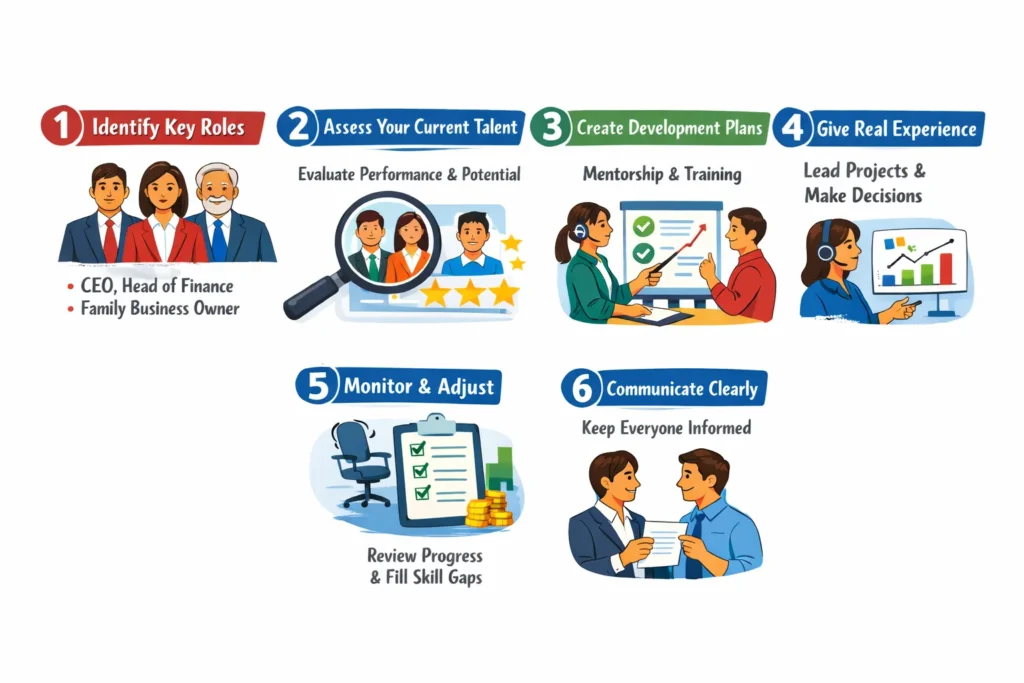
Step 1: Identify Key Roles
Start with the positions and responsibilities without which the organisation cannot function:
- CEO or Managing Director
- Head of Finance / CFO
- Owner or principal shareholder of a family business
- Trustee or administrator of family assets
- Key technical or client-owning leaders
For small-business owners, pair this with Serrari’s For Small Business hub and business financing options — succession without financing continuity is half a plan.
Step 2: Assess Your Current Talent
For each key role, answer four questions: who performs consistently, who shows leadership potential, who aligns with your values, and who has the relationships to hold the business together? Evaluate on performance, skills, experience, and growth potential — not tenure or proximity.
Step 3: Create Development Plans
Once potential successors are identified, prepare them intentionally. Development plans typically include:
- Assigning experienced mentors
- Rotating responsibilities across functions
- Formal leadership and technical training
- Stretch assignments that expand scope before a title change
Career-relevant programs on Serrari Ed — including ACCA prep courses and the Financial Literacy special offer — can accelerate the finance, control, and governance skills future leaders need.
Step 4: Give Real Experience
Leadership is learned through decisions, not lectures. Let successors lead live projects, join strategy meetings, own P&Ls, and handle difficult situations with customers, regulators, and staff. Exposure builds judgement.
Step 5: Monitor and Adjust
Succession planning is dynamic. Review progress at least annually: are successors growing, are there skill gaps, are new roles emerging, has anyone’s situation changed? Track key indicators alongside your wider finances on a personal finance dashboard or its business equivalent.
Step 6: Communicate Clearly
Most succession disputes are communication failures in disguise. Make sure:
- Potential successors understand expectations and timelines
- Stakeholders — boards, co-founders, investors — know the plan
- Family members understand the estate arrangements, including trusts, shareholdings, and any conditional provisions
Clarity today prevents courtrooms tomorrow.
What Happens Without Succession Planning?
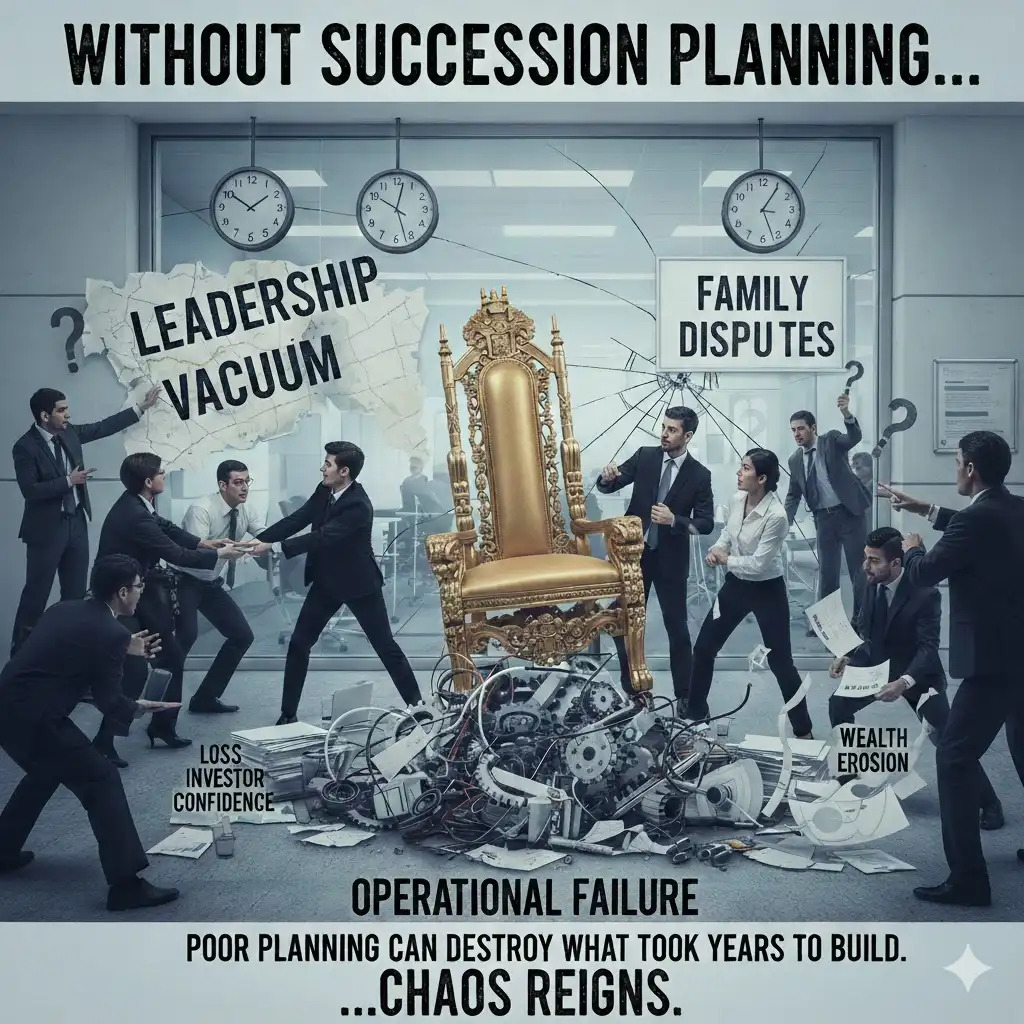
The costs of neglect are predictable and severe:
- Leadership vacuum — decisions stall, key staff leave, competitors move in
- Family disputes — relationships rupture over ambiguous wishes
- Business decline — customers and lenders lose confidence
- Loss of investor confidence — valuations fall, buyouts become fire-sales
- Wealth erosion — taxes, legal fees, and forced asset sales eat into the estate
Poor planning can unwind what took decades to build. The wider framework in Serrari’s timeless wealth lessons and surprising golden rule of wealth keeps returning to one theme: consistent behaviour compounded over decades is what creates lasting wealth — and a well-executed succession is how you protect that compounding across generations.
Succession and Estate Planning by Audience
For Individuals and Families
Start with a simple will, a designated power of attorney, adequate life insurance, and a clear, up-to-date asset register. Graduate to a trust when complexity, privacy, or generational transfer goals justify it. Anchor the plan in a solid personal finance plan and a robust financial safety net.
For Business Owners
Combine succession planning (who runs it) with an estate plan (who owns it). At minimum: shareholder / partnership agreements with buy-sell provisions, key-person life insurance, a trained number two, and a documented operating playbook. Serrari’s resources on business financial planning and financial risk management go deeper.
For Diaspora and Multi-Jurisdiction Families
Cross-border assets add probate, tax, and forex complexity. Draft wills that work in each jurisdiction, align trust structures with local law, and consolidate visibility into a single asset register. Serrari’s For Individuals hub and Serrari Advisory are designed for these layered situations.
The Big Picture: Stability, Growth, Preservation, Legacy
Succession management and estate management are not admin tasks — they are how you:
- Protect stability during the inevitable transitions every business and family faces
- Support continued growth by ensuring capable leadership takes the baton
- Preserve wealth from unnecessary taxes, legal costs, and forced sales
- Protect the legacy you spent years building, for the people and causes that matter to you
FAQ: Succession Planning and Estate Management
What is the difference between succession planning and estate planning?
Succession planning is about people — who takes over leadership and decision-making roles. Estate planning is about assets — how ownership transfers and how taxes, debts, and wishes are handled. Most serious plans address both together.
When should I start succession and estate planning?
Now. If you have dependents, a business, property, or investments, the correct time is already yesterday. A basic will, a power of attorney, and a named successor are enough to start; you can add trusts and more sophisticated structures as your situation grows.
Do I need a lawyer to write a will or create a trust?
For simple estates, templated wills can be a starting point — but for anything involving a business, minor children, multiple properties, or cross-border assets, professional legal and tax advice is essential. Serrari Advisory can coordinate with qualified legal counsel on your behalf.
How does life insurance fit into estate planning?
Life insurance creates immediate, tax-efficient liquidity when your estate may need it most — paying off debts, covering estate taxes, supporting dependents, and funding buyouts between business partners. See Serrari’s insurance and risk protection guide for a fuller treatment.
What is a shareholder agreement and why do business owners need one?
A shareholder or partnership agreement defines exactly what happens to shares on death, incapacity, exit, or dispute. Without it, surviving partners and heirs can end up tied into forced sales, deadlocked ownership, or lengthy court battles. It is one of the highest-return documents any business owner can put in place.
How often should I review my succession and estate plan?
Annually, and after any major life or business event — marriage, divorce, birth, major acquisition or sale, relocation, or the loss of a key person. Outdated plans are often worse than no plan at all.
What is the role of a trust in estate management?
A trust separates legal ownership (the trustee) from benefit (the beneficiary), which can give you control over when and how heirs receive assets, privacy beyond probate, protection from creditors, and efficient generational transfer. Serrari’s guide on wealth management, allocation and distribution explains where trusts fit in a complete plan.
Stay Connected, Keep Growing
Your financial future is not something you wait for — it is something you build. The real question is: when do you begin?
Move beyond simply staying informed. Navigate the markets with clarity — track trends through the Serrari Group Market Index, uncover opportunities in the Serrari Marketplace, and build practical knowledge with the curated Wealth Builder Guide.
Stay connected to what truly matters. Get daily insights on macro trends and financial movements across Kenya, Africa, and global markets — delivered through the Serrari Newsletter on the Serrari Group homepage.
Growth opens doors. Advance your career through professional programs on Serrari Ed, including ACCA prep courses and the Financial Literacy special offer — designed to move you forward with confidence.
See where money is flowing — clearly and in real time. Track Money Market Funds, Treasury Bills, Treasury Bonds, Green Bonds, and Fixed Deposits, alongside global and African indexes, key economic indicators, and the evolving crypto and stablecoin landscape — all within Serrari’s Market Index.