
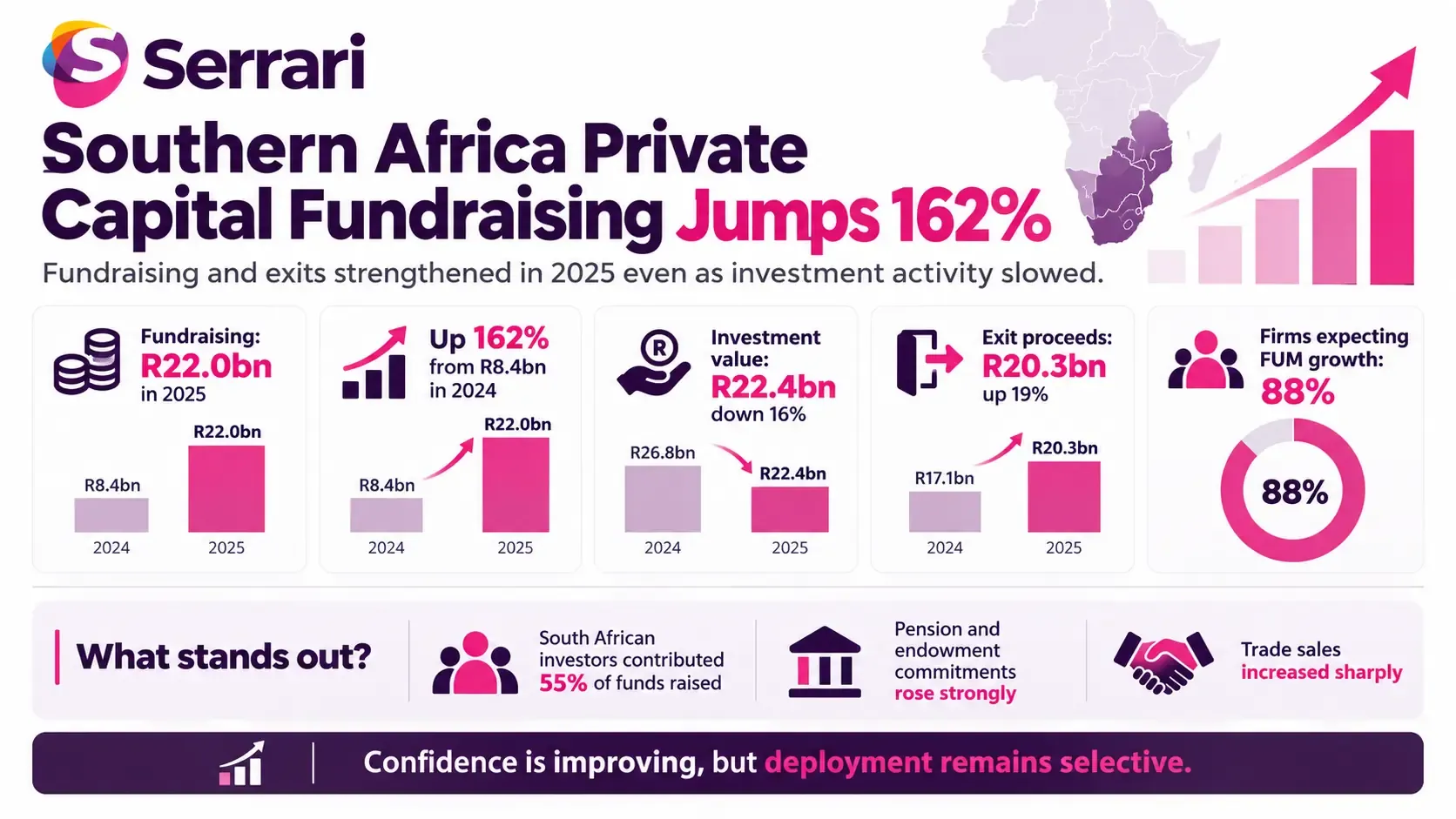
Southern Africa’s private capital industry experienced a sharp fundraising recovery in 2025, with commitments rising 162% to R22 billion, compared with R8.4 billion in 2024. Exit proceeds also increased, although investment activity slowed as fund managers became more selective. The findings, released in the 2026 SAVCA Private Capital Industry Survey, suggest stronger institutional investor confidence but show that fundraising gains have yet to translate into faster dealmaking.
Key Overview
- Fundraising: Increased from R8.4 billion in 2024 to R22 billion in 2025, a rise of approximately 162%.
- Domestic investors: South African investors contributed 55% of capital raised.
- Institutional commitments: Pension and endowment fund contributions grew from R1.6 billion to R4.4 billion among disclosed investor categories.
- Investment activity: Declined 16% to R22.4 billion, while the number of investments fell from 228 to 186, excluding Business Partners.
- Exits: Proceeds increased 19% to R20.3 billion, with 52 recorded exits.
- Funds under management: Fell about 3% to R226.4 billion by the end of 2025.
Institutional Investors Drive Fundraising Recovery
The 2026 private capital survey findings show fundraising recovered from the steep decline recorded in 2024, reaching its second-highest level in a decade. The number of firms raising capital increased from 13 to 18.
South African pension and endowment funds were the largest disclosed investor category, raising commitments by 175% to R4.4 billion. Meanwhile, recycled proceeds from previous investment disposals contributed R4.3 billion, demonstrating how successful exits can finance new investment rounds.
Infrastructure, energy and related strategies captured 62% of fundraising, down from 71% in 2024. Generalist funds increased their share from 22% to 33%. Large managers with more than R10 billion under management attracted 51% of capital raised, indicating substantial concentration among established firms.
Deal Activity Slows Despite Stronger Capital Raising
Total investment value declined from R26.6 billion to R22.4 billion, a 16% reduction, although it remained above the survey’s ten-year average of R21.7 billion. New investment value dropped 22% to R15.3 billion, while follow-on funding to existing portfolio businesses rose modestly to R7.1 billion.
The shift indicates managers were devoting a larger proportion of capital to companies already in their portfolios. Follow-on investments represented 32% of investment value, up from 26% in 2024.
Energy, real estate and infrastructure together accounted for around 40% of deployments. Energy’s share climbed from 13% to approximately 20%, and real estate rose from 6% to 11%, while infrastructure fell from 27% to 9%. Education’s share reached approximately 16%, largely because of activity by one manager rather than a sector-wide trend.
Context is everything. Stay ahead of shifting trends with today’s market updates, and uncover emerging opportunities using the Serrari Group Market Index and Marketplace. Then, take control of your own financial future by exploring our Money & Life Reset Transformation Blueprint ™ to build stronger habits, create better systems, and design a path toward lasting wealth.
Exit Proceeds Rise as Trade Buyers Return
Exit proceeds increased from R17.1 billion to R20.3 billion, a 19% gain, while the number of exits stayed at 52. Trade sales rose from 15 to 27, generating R5.8 billion. By contrast, sales to private capital firms or financial institutions declined from 19 to five.
Where acquisition costs and sale proceeds were disclosed, the proceeds-to-cost ratio improved from 1.5 to 1.6 times. However, write-offs increased from eight to nine, underscoring continued pressure on some investments.
The previous annual industry survey had documented weaker fundraising conditions in 2024, making the latest rebound especially notable.
Portfolio Performance and Technology Priorities
Performance across portfolio companies was uneven. Among 261 companies assessed for employment over 2023–2025, 70% expanded their workforce, while 30% reduced headcount. Among 196 businesses assessed for revenue, 56% recorded annualised growth above 5%, while 26% saw revenue decline.
Technology transformation became a priority for 40% of responding firms, up from 11% in the previous survey. At the same time, managers continued to flag unreliable environmental, social and governance data as an obstacle to consistent portfolio monitoring.
Outlook: More Capital Available, but Execution Matters
Confidence about future funds under management improved: 88% of firms expected moderate or accelerated growth over the next three years, compared with 79% previously. However, actual funds under management fell from R233.3 billion to R226.4 billion in 2025, while undrawn commitments decreased to R45.4 billion.
The results point to a market with renewed fundraising momentum and improving exit liquidity, but one where stronger capital commitments have not yet produced more investment deals. Sustaining the recovery will depend on deploying available capital effectively and generating returns that keep institutional investors engaged.
Sources: Africa Private Equity News / SAVCA / EY
Your financial future isn’t something you wait for—it’s something you build.
The real question is: when do you begin?
Move beyond simply staying informed.
Navigate the markets with clarity—track trends through the Serrari Group Market Index, uncover opportunities in the Serrari Marketplace, and build practical knowledge with our Curated Wealth Builder Platform.
Stay connected to what truly matters.
Get daily insights on macro trends and financial movements across Kenya, Africa, and global markets—delivered through the Serrari Newsletter.
Growth opens doors.
Advance your career through professional programs including ACCA, HESI A2, ATI TEAS 7 , HESI EXIT , NCLEX – RN and NCLEX – PN, Financial Literacy!🌟—designed to move you forward with confidence.
See where money is flowing—clearly and in real time.
Track Money Market Funds, Treasury Bills, Treasury Bonds, Green Bonds, and Fixed Deposits, alongside global and African indexes, key economic indicators, and the evolving Crypto and stablecoin landscape—all within Serrari’s Market Index.