The South Africa 10-year bond yield eased to around 8.67% after reaching a more than two-week high of 8.71% on August 18. The decline followed July inflation data showing headline consumer inflation slowing to 4.3%, below market expectations of 4.5%. However, core inflation increased to 4.2%, complicating the outlook for interest rates. Investors now expect the South African Reserve Bank to remain cautious while monitoring domestic inflation and global geopolitical risks.
Key Overview
South African government bonds strengthened modestly as the benchmark 10-year yield retreated from its recent high. Headline inflation slowed from 5% in June to 4.3% in July, ending four consecutive months of acceleration. Core inflation, however, increased from 4.1% to 4.2%. The mixed data supports expectations that the SARB could leave its policy rate unchanged at 7% at its September 23 meeting.
South Africa 10-Year Bond Yield Slips to 8.67%
The South Africa 10-year bond yield edged lower to approximately 8.67% as investors assessed encouraging headline inflation figures against persistent underlying price pressures.
The benchmark yield had climbed to approximately 8.71% on August 18, its highest level in more than two weeks, before easing.
Because bond prices and yields move inversely, the decline suggests modest improvement in demand for longer-dated South African government bonds.
Investors are balancing several factors, including domestic inflation, expectations for the South African Reserve Bank’s next policy decision and developments in international markets.
Attention is also focused on signals from the U.S. Federal Reserve because changes in American interest-rate expectations can influence capital flows and borrowing costs across emerging markets.
South Africa Inflation Slows to 4.3%
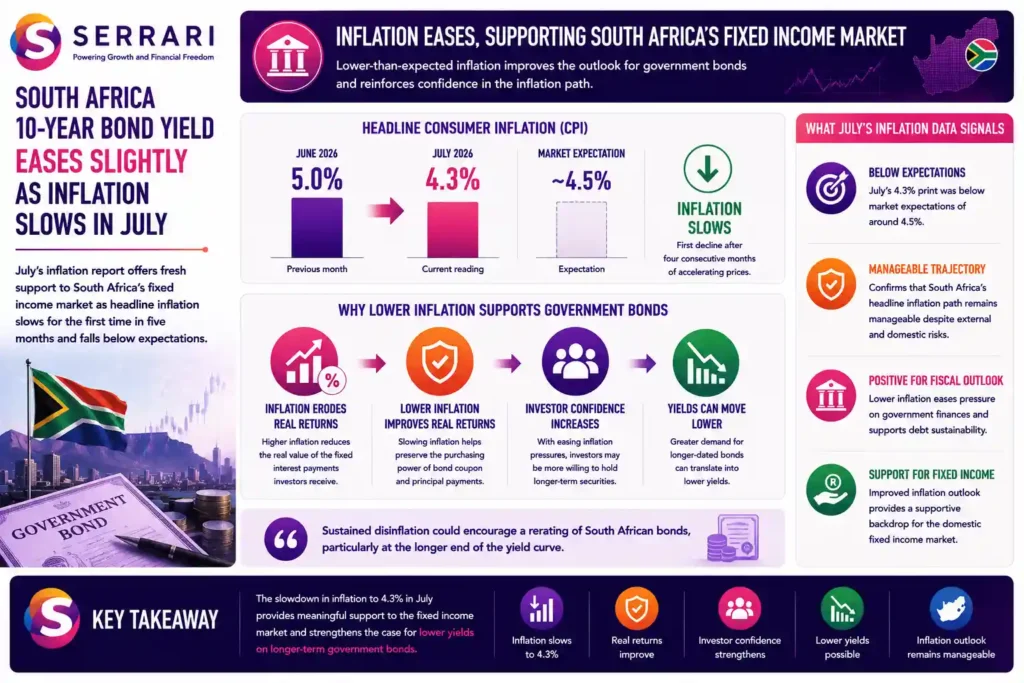
July’s inflation report provided some support to the domestic fixed income market.
Headline consumer inflation slowed to 4.3% from 5% in June, bringing an end to four consecutive months of accelerating price growth.
The reading was also below expectations of approximately 4.5%.
Lower-than-anticipated headline inflation is generally supportive for government debt because inflation reduces the real value of the fixed payments investors receive from bonds.
If inflation pressures continue easing, investors may become more willing to hold longer-term securities at lower yields.
The July figures also strengthen the argument that South Africa’s headline inflation trajectory remains manageable despite external risks.
Context is everything. Stay ahead of shifting trends with today’s market updates, and uncover emerging opportunities using the Serrari Group Market Index and Marketplace. Then, take control of your own financial future by exploring our Money & Life Reset Transformation Blueprint ™ to build stronger habits, create better systems, and design a path toward lasting wealth.
Core Inflation Creates a More Complicated Picture
The headline figure does not tell the entire story.
Core inflation, which strips out some volatile components and can provide a clearer indication of underlying price pressures, increased slightly to 4.2% from 4.1%.
That was its highest level since July 2024.
The divergence between headline and core inflation creates a more complicated environment for the South African Reserve Bank.
A central bank looking only at headline inflation could potentially see greater room for monetary easing. Rising core inflation, however, suggests underlying price pressures have not disappeared.
This reduces the likelihood that policymakers will respond aggressively to a single softer headline reading.
SARB Expected to Remain Cautious
The SARB kept its policy rate unchanged at 7% at its previous meeting.
Policymakers pointed to a more favourable inflation outlook and expectations that inflation could eventually move toward the central bank’s 3% target.
The latest figures broadly support that direction, but the increase in core inflation gives policymakers reason to remain cautious.
Market expectations currently favour another hold when the central bank meets on September 23.
For bond investors, the direction of monetary policy is particularly important. Expectations of lower future interest rates can support bond prices and push yields down, while renewed inflation concerns can produce the opposite effect.
The SARB must therefore determine whether July’s decline in headline inflation represents a durable trend or temporary relief.
Global Risks Still Matter for South African Bonds
Domestic inflation is only one influence on South African bond yields.
As an emerging market, South Africa is sensitive to changes in global risk appetite, U.S. Treasury yields and expectations surrounding Federal Reserve policy.
Investors were awaiting the latest Federal Open Market Committee minutes for additional guidance on the U.S. monetary policy outlook.
Higher U.S. yields can make American government securities more attractive relative to emerging market bonds, potentially requiring countries such as South Africa to offer higher yields to maintain investor demand.
Geopolitical developments surrounding the Iran conflict are another risk.
Any renewed increase in energy prices could raise inflation expectations, particularly for economies exposed to imported fuel costs. That could complicate the SARB’s inflation outlook and limit its ability to reduce interest rates.
What Could Move the 10-Year Yield Next?
The next direction for the South Africa 10-year bond yield will likely depend on whether inflation continues moving toward the SARB’s target.
Further declines in headline inflation accompanied by stabilising core prices could strengthen expectations for eventual monetary easing and provide support for sovereign bonds.
However, persistent core inflation, higher oil prices or rising global yields could keep South African borrowing costs elevated.
The September 23 SARB meeting will therefore be an important event for the bond market.
For now, the decline from 8.71% to approximately 8.67% represents only a modest move. It suggests investors welcomed the softer headline inflation figure but remain unwilling to make a stronger bet on falling interest rates while underlying inflation and global risks remain uncertain.
FAQs
What is the South Africa 10-year bond yield?
The South Africa 10-year bond yield is the return investors demand for holding benchmark South African government debt with approximately 10 years until maturity. It was trading around 8.67% after reaching 8.71% on August 18.
Why did South Africa’s 10-year bond yield fall?
The yield eased after headline consumer inflation slowed to 4.3% in July from 5% in June. The reading was below the expected 4.5%, reducing some concerns about near-term inflation pressures and supporting government bonds.
What is South Africa’s current interest rate?
The South African Reserve Bank kept its policy rate unchanged at 7% at its latest meeting. Expectations currently favour another hold at the September 23 meeting as policymakers assess headline and core inflation alongside global risks.
Could South African bond yields fall further?
Yes, particularly if inflation continues declining and expectations for future SARB rate cuts strengthen. However, higher core inflation, rising oil prices, U.S. monetary policy and geopolitical uncertainty could keep yields elevated or push them higher again.
Your financial future isn’t something you wait for—it’s something you build.
The real question is: when do you begin?
Move beyond simply staying informed.
Navigate the markets with clarity—track trends through the Serrari Group Market Index, uncover opportunities in the Serrari Marketplace, and build practical knowledge with our Curated Wealth Builder Platform.
Stay connected to what truly matters.
Get daily insights on macro trends and financial movements across Kenya, Africa, and global markets—delivered through the Serrari Newsletter.
Growth opens doors.
Advance your career through professional programs including ACCA, HESI A2, ATI TEAS 7 , HESI EXIT , NCLEX – RN and NCLEX – PN, Financial Literacy!🌟—designed to move you forward with confidence.
See where money is flowing—clearly and in real time.
Track Money Market Funds, Treasury Bills, Treasury Bonds, Green Bonds, and Fixed Deposits, alongside global and African indexes, key economic indicators, and the evolving Crypto and stablecoin landscape—all within Serrari’s Market Index.