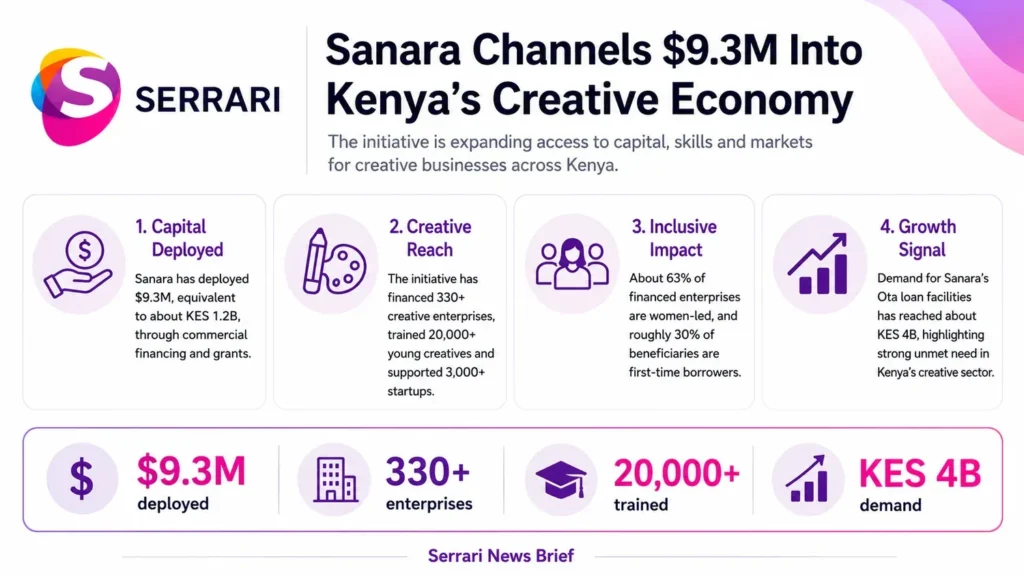
Sanara has deployed more than $9.3 million, equivalent to about KES 1.2 billion, through commercial financing and grants to strengthen Kenya’s creative economy. The programme has expanded access to capital for more than 330 creative enterprises, supported over 3,000 creative startups and equipped more than 20,000 young creatives with business and technical skills.
The initiative operates across Nairobi, Mombasa, Nakuru, Kisumu, Kakamega and Turkana, targeting creative entrepreneurs who have historically struggled to access formal finance. Supported by the Mastercard Foundation and implemented by HEVA Fund, SNDBX Ubuntu, Baraza Media Lab and GoDown Arts Centre, Sanara is positioning creative enterprise as an investable sector rather than a purely cultural activity.
Key Overview
The programme’s financing portfolio shows strong demand for capital in Kenya’s creative industries. Demand for Sanara’s Ota loan facilities has reached about KES 4 billion, far above the amount already deployed, highlighting the financing gap faced by artists, designers, media businesses, performers, content creators and creative startups.
Sanara’s inclusive approach is also notable. Nearly 63% of financed enterprises are women-led, while about 30% of beneficiaries are first-time borrowers, according to programme details shared at the Nairobi forum. This gives historically underserved entrepreneurs a pathway into formal finance.
Sanara Expands Creative Finance Across Six Counties
Sanara’s latest results were presented during the Sanara Creative Economy Learning Forum in Nairobi, where investors, policymakers, development partners and creative industry leaders assessed lessons from the programme.
The initiative combines loans, grants, market access and enterprise support. According to Sanara’s implementation framework, the programme is designed to provide fair and suitable financing for creative and cultural businesses, equip young people with market-relevant skills and promote safer working environments in the sector.
That blended model is important because creative businesses often struggle to meet traditional banking requirements. Many operate with irregular cash flows, intangible assets, informal records and limited collateral. By pairing financing with business development support, Sanara is trying to reduce risk for lenders while helping creative enterprises become more commercially resilient.
Women, Refugees and First-Time Borrowers Gain Access
Sanara’s financing model is deliberately inclusive. The programme targets young women and men aged 18 to 35, including young women, refugees and persons with disabilities working in fashion, film, television, content creation, gaming, audio-visual production, live music, theatre and performing arts.
The Ota Pepea Access to Market Initiative has also helped refugee creatives from Turkana showcase products in Nairobi, connect with new buyers and access international markets. This shows how creative finance can move beyond grants by linking entrepreneurs to real commercial opportunities.
The inclusive focus matters because Kenya’s creative sector is youth-driven and highly informal. Many talented creators lack access to structured capital, contracts, mentorship and distribution channels. Sanara’s results suggest that targeted finance, skills training and market linkages can help convert creative talent into sustainable businesses.
Context is everything. Stay ahead of shifting trends with today’s market updates, and uncover emerging opportunities using the Serrari Group Market Index and Marketplace. Then, take control of your own financial future by exploring our Money & Life Reset Transformation Blueprint ™ to build stronger habits, create better systems, and design a path toward lasting wealth.
Creative Economy Gains Investor Attention
Kenya’s creative economy is increasingly being discussed as a serious investment sector. The Kenya Investment Authority describes the sector as rapidly growing and says it contributes over 5% to national GDP, driven by a young, talented and digitally savvy population.
Other sector discussions have pointed to the same opportunity. Kenya’s creative industries are gaining momentum across music, film, fashion, digital content, gaming, design and performing arts, but remain constrained by weak access to finance, limited infrastructure and fragmented market channels.
Government and industry actors have also acknowledged the sector’s economic potential. The Kenya News Agency has previously reported that arts, recreation and entertainment account for about 5% of GDP, underlining why more structured financing models are needed.
Skills and Market Access Are as Important as Capital
The Sanara forum highlighted that money alone is not enough. Creative enterprises often need financial literacy, pricing support, business modelling, digital skills, intellectual property awareness, market access and stronger production infrastructure.
That is why Sanara’s model combines financing with training and ecosystem development. Business support helps creatives commercialise talent, while grants and technical assistance reduce the early-stage burden for startups that are not yet ready for commercial debt.
The programme is also working with county governments to strengthen creative economy policy frameworks and map creative infrastructure. This is critical because counties need better data on studios, performance spaces, production hubs, galleries, training centres and market access points if they are to support long-term growth.
Outlook: Kenya’s Creative Sector Needs Scalable Capital
Sanara’s deployment of KES 1.2 billion is a major signal for Kenya’s creative economy, but the reported KES 4 billion demand for Ota loans shows that unmet need remains large. The next phase will require more participation from banks, investors, development finance institutions, county governments and private-sector buyers.
If the sector can combine finance, policy support, infrastructure and market access, Kenya’s creative industries could become a stronger source of jobs, exports, innovation and youth enterprise.
Sanara’s early results show that creative businesses are not just cultural assets. With the right capital and support systems, they can become investable enterprises capable of contributing meaningfully to Kenya’s economic growth.
Sources used: Africa Business Communities / HEVA Fund / Kenya Investment Authority / Kenya News Agency / TechTrendsKE / The Star
Your financial future isn’t something you wait for—it’s something you build.
The real question is: when do you begin?
Move beyond simply staying informed.
Navigate the markets with clarity—track trends through the Serrari Group Market Index, uncover opportunities in the Serrari Marketplace, and build practical knowledge with our Curated Wealth Builder Platform.
Stay connected to what truly matters.
Get daily insights on macro trends and financial movements across Kenya, Africa, and global markets—delivered through the Serrari Newsletter.
Growth opens doors.
Advance your career through professional programs including ACCA, HESI A2, ATI TEAS 7 , HESI EXIT , NCLEX – RN and NCLEX – PN, Financial Literacy!🌟—designed to move you forward with confidence.
See where money is flowing—clearly and in real time.
Track Money Market Funds, Treasury Bills, Treasury Bonds, Green Bonds, and Fixed Deposits, alongside global and African indexes, key economic indicators, and the evolving Crypto and stablecoin landscape—all within Serrari’s Market Index.