The 2026 FIFA World Cup is no longer just a football tournament. It has become a global commercial engine built on broadcasting, ticketing, sponsorship, tourism, player valuations, data technology and betting.
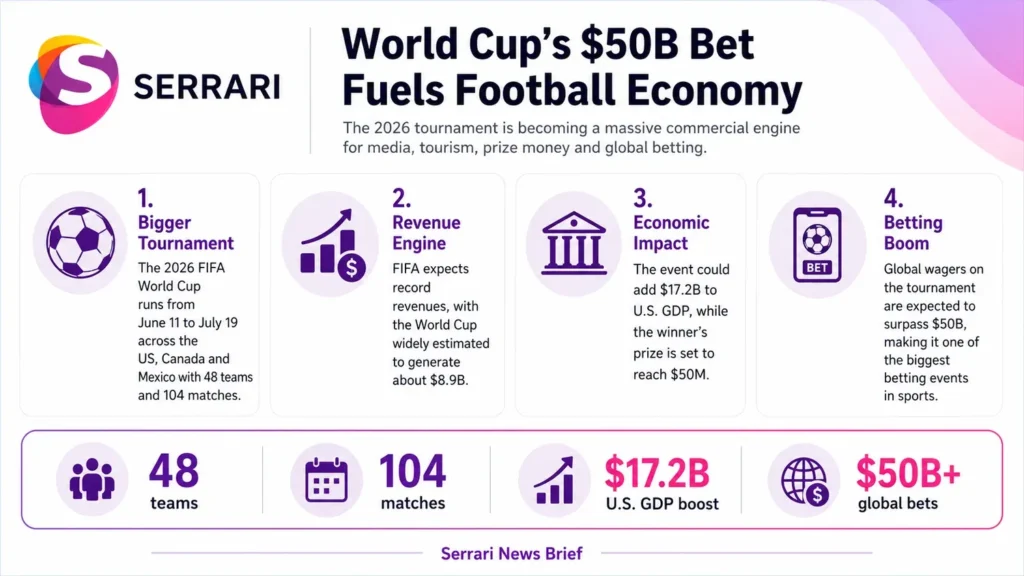
Hosted across the United States, Canada and Mexico from June 11 to July 19, the tournament has expanded to 48 teams and 104 matches, making it the largest edition in World Cup history. The bigger format gives FIFA more matches to sell, broadcasters more content to package, sponsors more exposure and host cities a larger tourism event to manage.
Key Overview
FIFA expects the 2026 cycle to deliver record revenues, with its revised budget showing the tournament cycle reaching about $13 billion in total revenue and the 2026 World Cup itself widely estimated at about $8.9 billion. Much of that comes from broadcast rights, hospitality, ticketing and commercial partnerships.
The economics also extend beyond FIFA. A FIFA-WTO study estimated the tournament could support $30.5 billion in U.S. gross output and add $17.2 billion to U.S. GDP, while analysts expect global betting on the event to exceed $50 billion.
FIFA’s Biggest Commercial Tournament Yet
The 2026 World Cup’s expanded format is central to its commercial power. FIFA confirms that 48 teams will compete in 104 fixtures, up from 32 teams and 64 matches in Qatar 2022. That means more matchdays, more inventory for broadcasters and sponsors, and more opportunities for hospitality and ticket revenue.
According to FIFA’s official tournament schedule, matches are being staged across 16 host cities in the United States, Mexico and Canada. The U.S. carries the largest share of games, making the tournament especially exposed to North America’s media, tourism and consumer markets.
FIFA’s financial expectations reflect that scale. Its revised 2023-2026 budget shows a major revenue cycle built around the men’s World Cup, while reported analysis of the 2026 balance sheet estimates about $3.9 billion from television broadcasting and income, plus around $3 billion from hospitality and ticket sales.
U.S. Economy Gets a Multibillion-Dollar Boost
The tournament’s economic impact is also significant for host markets. A FIFA-WTO study estimated that the 2026 tournament could create 185,000 full-time equivalent jobs in the United States, generate $30.5 billion in gross output and add $17.2 billion to GDP.
That impact is spread across accommodation, food services, transport, retail, real estate, professional services, finance and public administration. According to the FIFA-WTO economic study, the U.S. alone is expected to receive one of the largest country-level boosts from the event.
However, the benefits are not evenly distributed. Host cities face costs for safety, transport, security and public operations, while FIFA captures much of the central commercial revenue from rights, sponsorships and ticketing. That makes the World Cup both an economic opportunity and a public-spending debate.
Context is everything. Stay ahead of shifting trends with today’s market updates, and uncover emerging opportunities using the Serrari Group Market Index and Marketplace. Then, take control of your own financial future by exploring our Money & Life Reset Transformation Blueprint ™ to build stronger habits, create better systems, and design a path toward lasting wealth.
Player Values Turn Squads Into Assets
The financial story also sits on the pitch. National teams now carry enormous market value because squads are effectively collections of elite sporting assets.
CIES Football Observatory ranks England as the most valuable 2026 World Cup squad at about €1.454 billion, followed by France at €1.436 billion and Spain at €1.407 billion, according to its team valuation analysis. Germany and Portugal also rank among the highest-value squads.
Individual player valuations show the same trend. CIES places Lamine Yamal at €358 million, far ahead of Erling Haaland at €227 million, with Kylian Mbappé also among the world’s most valuable footballers in its player valuation model. These figures reflect age, contract length, performance, position and projected future value.
Prize Money and Smart Ball Technology Rise
FIFA has also lifted the financial rewards. The winner of the 2026 World Cup will receive $50 million, while the runner-up will get $33 million. FIFA says $655 million will be distributed as performance-based prize money to the 48 participating teams, with each team also receiving preparation funding.
That marks a significant rise from Qatar 2022, when Argentina earned $42 million for winning the tournament. FIFA confirmed the new prize structure in its financial contribution announcement, describing it as a record package for participating nations.
Technology is also becoming part of the business model. The 2026 Adidas Trionda ball includes connected-ball technology, with a motion sensor designed to support officiating decisions by transmitting real-time movement and contact data. According to technical reporting on the ball, the sensor records data hundreds of times per second, helping VAR teams review touches, speed, spin and trajectory.
Betting Boom Raises Commercial and Social Risks
The World Cup’s betting economy may be its fastest-growing commercial layer. Macquarie analyst Chad Beynon has estimated that global wagers on the 2026 tournament could exceed $50 billion, up from more than $35 billion in 2022, according to betting industry reporting.
The surge is being driven by more matches, wider U.S. legal betting access, in-play products, same-game parlays and player-prop markets. Prediction markets have also grown around football outcomes, giving users more ways to speculate on match results and tournament scenarios.
But the risks are serious. Football betting can produce life-changing losses, especially for younger fans and casual bettors drawn in by promotions. Regulated operators argue that deposit limits, age checks and self-exclusion tools offer safeguards, but campaigners warn that high-volume sports betting still exposes vulnerable users to debt and addiction.
The 2026 World Cup shows how football now concentrates media rights, tourism, investment, labour markets, technology and gambling into one global event. The spectacle remains on the pitch, but the economy now surrounds every pass, goal and whistle.
Sources used: FIFA / FIFA Inside / World Trade Organization / CIES Football Observatory / The Guardian / Reuters / AS USA / Yogonet / The Business Standard
Your financial future isn’t something you wait for—it’s something you build.
The real question is: when do you begin?
Move beyond simply staying informed.
Navigate the markets with clarity—track trends through the Serrari Group Market Index, uncover opportunities in the Serrari Marketplace, and build practical knowledge with our Curated Wealth Builder Platform.
Stay connected to what truly matters.
Get daily insights on macro trends and financial movements across Kenya, Africa, and global markets—delivered through the Serrari Newsletter.
Growth opens doors.
Advance your career through professional programs including ACCA, HESI A2, ATI TEAS 7 , HESI EXIT , NCLEX – RN and NCLEX – PN, Financial Literacy!🌟—designed to move you forward with confidence.
See where money is flowing—clearly and in real time.
Track Money Market Funds, Treasury Bills, Treasury Bonds, Green Bonds, and Fixed Deposits, alongside global and African indexes, key economic indicators, and the evolving Crypto and stablecoin landscape—all within Serrari’s Market Index.