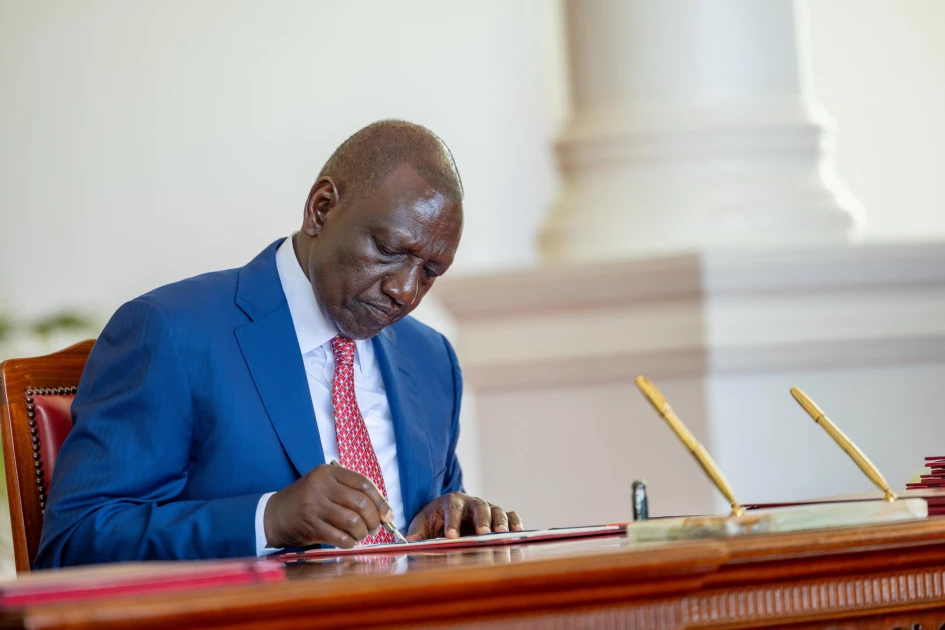
President William Ruto on Monday, 11 May 2026, assented to three pieces of legislation aimed at reforming Kenya’s tax regime, strengthening investor confidence, and accelerating the country’s shift toward a technology-driven economy. The laws signed at State House Nairobi are the Income Tax (Amendment) Bill, the Special Economic Zones (Amendment) Bill, and the Technopolis Bill. Together, they restructure Capital Gains Tax administration, widen the sectors eligible to operate within Special Economic Zones to include oil and gas, introduce a guaranteed 10-year tax incentive period for SEZ licensees, and establish a legal framework for technopolises — specialised innovation hubs designed to attract technology companies and research institutions. The signing, the seventh presidential assent ceremony of 2026, came during the Africa Forward Summit in Nairobi and is part of the government’s broader push to attract foreign capital and expand industrialisation.
Markets move fast; don’t get left behind. We’ve paired the Serrari Group Market Index with a curated Marketplace and a comprehensive Wealth Builder Platform to ensure you have the data—and the skills—to act on it.
Key Overview
- Bills signed: Income Tax (Amendment) Bill, Special Economic Zones (Amendment) Bill, Technopolis Bill
- Date signed: 11 May 2026, at State House Nairobi
- Income Tax changes: Rationalisation of Capital Gains Tax; exemption for internal company reorganisations with no external economic gain
- SEZ expansion: New sectors eligible include oil and gas, agro-processing, mining, manufacturing, and advanced technology
- SEZ incentive period: Guaranteed minimum 10-year licence tenure for developers, operators, and enterprises
- SEZ tax changes: VAT zero-rating on certain supplies; removal of 10-year cap on withholding tax exemptions for royalties and management fees
- Technopolis Act: Establishes legal framework for creation and governance of technopolises; creates the Technopolis Development Authority as successor to Konza Technopolis Development Authority
- Kenya’s FDI (2024): Approximately $1.5 billion, with a strategic target of $10 billion by 2027
- Gazetted SEZs: 28 public and private zones as of 2025
- Senior officials present: Deputy President Kithure Kindiki, ICT Cabinet Secretary William Kabogo, Attorney General Dorcas Oduor, National Assembly Speaker Moses Wetang’ula
Three Laws, One Economic Signal
The signing ceremony at State House brought together Deputy President Kithure Kindiki, ICT Cabinet Secretary William Kabogo, Attorney General Dorcas Oduor, National Assembly Speaker Moses Wetang’ula, Majority Leader Kimani Ichung’wah and Minority Leader Junet Mohamed — a cross-party presence that underscored the political consensus behind the reforms. The timing was equally deliberate: the bills were signed during the Africa Forward Summit 2026 at the Kenyatta International Convention Centre, where President Ruto was co-hosting more than 30 African heads of state and French President Emmanuel Macron to discuss trade and investment partnerships.
President Ruto said the new laws are streamlining Kenya’s regulatory framework to create a more efficient, predictable, and competitive business environment. The legislation is the latest in a series of investment-focused reforms by the administration, which has positioned Kenya as an open, investor-friendly destination amid intense continental competition for foreign capital. Over the past two-and-a-half years, the Ruto government has enacted 10 legal interventions to make its SEZ programme more competitive, with additional measures embedded in the forthcoming Business Laws Amendment Bill 2026.
Income Tax Reforms: Aligning with Global Standards
The Income Tax (Amendment) Act restructures the administration of Capital Gains Tax (CGT) to align Kenya’s framework with international taxation best practices. While the raw original article described the change in broad terms, the actual mechanics are more detailed. The law exempts Capital Gains Tax on transfers of property undertaken as part of internal company reorganisations where there is no actual economic gain or third-party transaction. This provision is designed to support efficient business restructuring, promote tax neutrality, and preserve the tax base by ensuring that tax is only imposed when a genuine external realisation of value occurs.
The amendment matters because Kenya’s CGT regime has historically been a pain point for investors, particularly multinationals managing cross-border group restructurings that trigger technical disposals without any real change in economic ownership. By carving out such transactions, the government is attempting to reduce a friction point that has complicated deal structures and, in some cases, discouraged certain types of foreign investment. The government has been engaged in a broader effort to align Kenya’s tax regime with recognised principles of taxation while reinforcing improvements in the ease of doing business.
These changes come against a challenging fiscal backdrop. The Kenya Revenue Authority reported a KSh 152 billion revenue shortfall against FY 2025/2026 targets, a figure that has intensified public and parliamentary scrutiny over expanding tax incentives at a time of rising revenue pressure. Proponents of the reform counter that Kenya risks losing ground to African peer jurisdictions that already offer more generous fiscal protections for large-scale investors.
Context is everything. While you follow today’s updates, use the Serrari Group Market Index and Marketplace to spot emerging shifts. Need to sharpen your edge? Our Wealth Builder Platform turns these insights into a professional-grade strategy.
Special Economic Zones: Expanding the Playing Field
The Special Economic Zones (Amendment) Act significantly broadens the scope of Kenya’s SEZ programme, which was originally established under the Special Economic Zones Act of 2015. The most consequential change is the integration of upstream and midstream petroleum operations into SEZs, expanding the zones beyond their traditional focus on manufacturing and export-oriented industries to now encompass oil and gas, agro-processing, mining, and advanced technology production.
For investors, the law introduces several financially significant provisions. It establishes a guaranteed 10-year tax incentive regime for developers, operators, and enterprises licensed under the SEZ programme. This replaces a previous graduated framework where some benefits could last up to 25 years but were subject to periodic review, creating uncertainty for long-cycle capital investments. The new fixed-period model is intended to give multinational investors more predictable fiscal planning horizons. The law also introduces VAT zero-rating on certain supplies within SEZs and removes the previous 10-year cap on withholding tax exemptions for royalties and management fees under the Income Tax Act.
These amendments come as Kenya intensifies its effort to scale its SEZ programme into a genuine driver of industrialisation. As of 2025, the country had 28 gazetted SEZs, both public and private, including major zones such as Tatu City and the Vipingo SEZ in Kilifi County. With backing from the International Finance Corporation (IFC), the government is targeting at least KSh 1.5 trillion in foreign investment through these zones. In a two-and-a-half-year period through 2025, SEZs and Export Processing Zones collectively created 30,000 direct jobs through 90 operational businesses.
The broader continental context adds urgency. Africa now has more than 230 special economic zones across 43 countries, and the competition for foreign capital among them is intensifying. Research from the OECD and the French Development Agency has shown that African SEZs are evolving — countries with SEZs tend to produce more technologically sophisticated goods and access new international markets — but their track record remains mixed compared with Asian counterparts. Kenya’s expanded framework is a bet that broader sectoral eligibility and more predictable fiscal terms can help close that gap.
The Technopolis Act: From Konza to a National Framework
The Technopolis Bill, originally introduced in 2024, creates a comprehensive legal framework for the creation, development, and governance of technopolises in Kenya. It establishes the Technopolis Development Authority as the successor to the Konza Technopolis Development Authority (KoTDA), which had been governing the 5,000-acre Konza project 60 kilometres southeast of Nairobi under a 2012 legal notice rather than a full act of parliament.
Under the new law, a technopolis is defined as a gazetted geographical area with a high concentration of technology companies, research institutions, and innovation hubs operating under a single regulatory framework. Konza remains the flagship project under this definition, but the Act is written broadly enough to allow the Cabinet Secretary for ICT to gazette additional technopolises elsewhere in Kenya through a government notice. Each technopolis must feature modern integrated infrastructure, adopt emerging technologies, and integrate green building and sustainability practices.
The Authority has wide-ranging powers: it can allocate land to investors, issue development permits, license businesses, run one-stop shops for government services, and establish science parks, ICT parks, and innovation centres. It is also required to establish a Science Museum in every gazetted technopolis, with a dedicated Chief Curator running programmes including science fairs, education initiatives, and exhibits documenting Kenya’s contribution to science and technology.
The law matters because Konza has long operated in a governance grey zone. While the project has made significant physical progress — Phase 1 horizontal infrastructure spanning over 400 acres is complete, featuring 40 kilometres of smart roads, a 120MW substation, and a Tier III National Data Centre — it has been governed by an administrative order that limited the authority’s institutional weight and legal standing. The new statute gives the authority more teeth, a clearer governance structure, and a formal dispute resolution system. It also provides for a competitively appointed CEO serving a four-year term renewable once, and a board with explicit requirements for gender balance, youth representation, and inclusion of persons with disabilities.
Konza itself is in the midst of a transformation. Its private power grid went live in early 2026, delivering 99.99% uptime through Konza Smart Energy. The Kenya Advanced Institute of Science and Technology, modelled on South Korea’s KAIST, is preparing for its academic launch in late 2026. A Digital Media City backed by a $284 million financing agreement with South Korea is also under development. And the Konza Export Processing Zone is projected to create up to 10,000 jobs focused on manufacturing, including solar panels and textiles. As of 2025, at least 75% of the parcels at Konza had been committed by investors, though the government has had to issue ultimatums urging some to begin developing their plots.
The FDI Challenge Kenya Is Trying to Solve
These legislative reforms are not happening in a vacuum. Kenya is trying to solve a stubborn problem: despite being one of the largest recipients of FDI in Africa, its inflows have flatlined. According to the UNCTAD World Investment Report 2025, FDI flows to Kenya declined marginally to an estimated $1.503 billion in 2024 from $1.504 billion the previous year. Kenya’s FDI-to-GDP ratio stood at just 0.2% in 2024, well below the sub-Saharan African average of 2.3%.
The government’s own Strategic Plan 2023–2027, launched in May 2024, sets an ambitious target of increasing FDI from $500 million in 2022 to $10 billion by 2027 — a goal that will require a radical improvement in Kenya’s investment competitiveness. The continent as a whole saw record FDI inflows of $97 billion in 2024, a 75% year-on-year increase spread across 45 countries, meaning Kenya must move aggressively to capture its share of a growing but intensely competitive pool.
Obstacles remain significant. Investors continue to cite Kenya’s high tax burden — including the doubling of VAT on fuel products to 16% under the Finance Act 2023 — corruption, infrastructure quality, political unrest (the Finance Bill 2024 protests eroded confidence significantly), and regulatory complexity across counties as deterrents. Kenya ranks 121st out of 180 economies on Transparency International’s 2024 Corruption Perception Index and 96th out of 133 on the Global Innovation Index 2024.
What the Reforms Signal
Taken together, the three laws signed on Monday represent the Ruto administration’s most concentrated legislative push to reposition Kenya’s investment architecture. The Income Tax amendments tackle a specific but meaningful technical friction point. The SEZ reforms broaden the playing field and lock in fiscal predictability for large-scale, long-cycle investments. And the Technopolis Act gives institutional backbone to Kenya’s technology and innovation ambitions, moving Konza from an administrative project to a statutory city with the legal infrastructure to scale.
Whether these reforms translate into material increases in foreign capital will depend on execution. As one legal analysis noted, the Technopolis Act does not guarantee that the infrastructure, incentives, or governance will function as intended — those are execution questions a law cannot answer. But the legislative framework is now in place, and the timing — in the middle of a summit designed to showcase Kenya to the world — suggests the government intends to move quickly.
With the Africa Forward Summit drawing over 4,000 delegates and €23 billion in Franco-African investment commitments to Nairobi this week, and with 11 bilateral deals signed between Kenya and France covering everything from commuter rail to nuclear energy, the legislation gives Kenya a concrete regulatory product to offer investors at a moment when the world’s attention is on the country. The government is betting that legal certainty, sectoral breadth, and institutional modernisation will be enough to shift Kenya’s FDI trajectory from stagnation to growth.
Your financial future isn’t something you wait for—it’s something you build.
The real question is: when do you begin?
Move beyond simply staying informed.
Navigate the markets with clarity—track trends through the Serrari Group Market Index, uncover opportunities in the Serrari Marketplace, and build practical knowledge with our Curated Wealth Builder Platform.
Stay connected to what truly matters.
Get daily insights on macro trends and financial movements across Kenya, Africa, and global markets—delivered through the Serrari Newsletter.
Growth opens doors.
Advance your career through professional programs including ACCA, HESI A2, ATI TEAS 7 , HESI EXIT , NCLEX – RN and NCLEX – PN, Financial Literacy!🌟—designed to move you forward with confidence.
See where money is flowing—clearly and in real time.
Track Money Market Funds, Treasury Bills, Treasury Bonds, Green Bonds, and Fixed Deposits, alongside global and African indexes, key economic indicators, and the evolving Crypto and stablecoin landscape—all within Serrari’s Market Index.