Global financial markets remain under pressure as elevated crude oil prices and sharply higher government bond yields increase concerns about inflation, financing costs and corporate profitability. The benchmark 10-year US Treasury yield approached 5.3%, while oil prices remained elevated amid continuing uncertainty surrounding the US-Iran conflict and shipping through the Strait of Hormuz.
Asian markets have been particularly sensitive because several major economies rely heavily on imported energy. India has faced pressure across equities and its currency, while China has delivered a more encouraging signal after manufacturing activity returned to expansion in September.
Key Overview
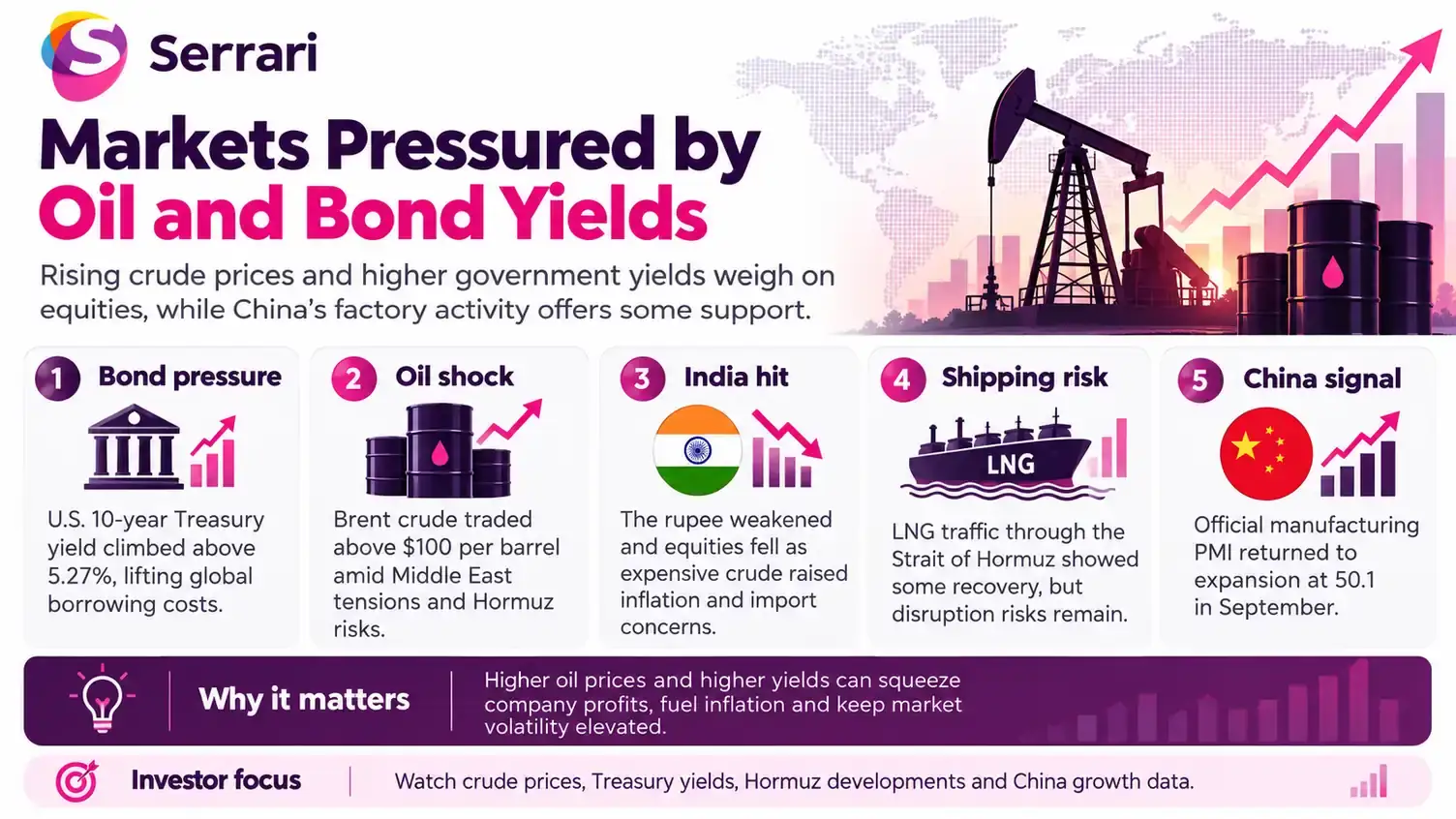
- The US 10-year Treasury yield approached 5.3%, keeping global borrowing costs elevated.
- Brent crude remained above $100 per barrel during parts of September 29 as Middle East risks remained in focus.
- Indian equities extended recent losses amid high oil prices and persistent foreign-investor selling.
- The Indian rupee remained under pressure as expensive crude increased concerns over import costs.
- India imports close to 90% of its crude requirements, making it especially exposed to global oil shocks.
- Qatar-linked LNG vessels have shown signs of returning through the Strait of Hormuz despite continued disruptions.
- China’s official manufacturing PMI rose to 50.1 in September from 49.8 in August.
- The private RatingDog manufacturing PMI strengthened to 52.1, its highest level in five months.
Oil and Bond Yields Tighten Financial Conditions
The simultaneous rise in energy prices and bond yields has created an increasingly difficult environment for global investors.
US government bond markets remained under heavy pressure on September 29, with the 10-year Treasury yield nearing 5.3% as investors adjusted to higher inflation risks, elevated government borrowing and expectations that interest rates could remain restrictive.
Higher Treasury yields influence markets far beyond government debt. They increase benchmark financing costs for households and businesses while also raising the return investors can earn from relatively low-risk assets, potentially placing downward pressure on equity valuations.
Oil has reinforced these concerns. Brent crude remained elevated as markets assessed geopolitical developments involving the United States and Iran and the possibility of further disruption to energy flows through the Strait of Hormuz.
A prolonged period of expensive oil could revive inflationary pressures through transportation, manufacturing and logistics costs, complicating the policy outlook for major central banks.
India Feels Pressure From Expensive Crude
India is particularly vulnerable to elevated energy prices because it imports the vast majority of the crude oil it consumes.
Indian equities extended their decline on September 29 as higher oil prices and global bond yields weighed on sentiment. Persistent foreign-investor selling has added to the pressure after major stock benchmarks moved toward six-month lows.
The rupee has faced similar challenges. More expensive crude raises India’s import bill and increases demand for dollars from energy companies, creating pressure on the local currency.
By September 30, however, conditions had improved slightly as lower oil prices reduced some pressure on the rupee.
Higher energy costs can also affect India’s inflation outlook, trade deficit and company profit margins if businesses cannot fully pass additional expenses to consumers.
Context is everything. Stay ahead of shifting trends with today’s market updates, and uncover emerging opportunities using the Serrari Group Market Index and Marketplace. Then, take control of your own financial future by exploring our Money & Life Reset Transformation Blueprint ™ to build stronger habits, create better systems, and design a path toward lasting wealth.
Hormuz Remains Central to the Energy Outlook
The Strait of Hormuz remains one of the most important variables for global energy markets.
The strategic passage handles substantial volumes of global oil and LNG exports, meaning even partial disruption can influence freight rates, insurance costs, supply availability and energy prices.
Recent shipping data has shown tentative improvement, with Qatar-linked LNG traffic beginning to recover despite continued regional tensions.
However, activity remains below normal levels, and QatarEnergy has warned that the broader Hormuz crisis could affect some expansion projects and LNG supply commitments.
For markets, a sustained normalisation of shipping through the strait could ease one of the major risk premiums currently embedded in oil and gas prices.
China Manufacturing Returns to Expansion
China provided one of the more positive economic developments entering the final quarter of 2026.
Official data released on September 30 showed that the country’s manufacturing PMI increased to 50.1 from 49.8 in August, ending two consecutive months of contraction.
A reading above 50 indicates expansion, while a figure below that threshold signals contraction.
The privately compiled RatingDog manufacturing PMI improved even further, rising to 52.1 from 51.5, its strongest reading in five months.
The recovery was supported by improved production conditions after severe weather disrupted activity in August, while export demand and manufacturing linked to the global artificial-intelligence boom also provided support.
China’s wider economy nevertheless remains uneven. Weakness in property markets and subdued household demand continue to weigh on domestic momentum, leaving policymakers under pressure to provide further support.
What Markets Are Watching Next
Global investors are now balancing several closely connected risks: oil prices, government bond yields, inflation, currency volatility and geopolitical developments.
The immediate focus remains on whether energy prices begin a sustained decline or remain elevated enough to reinforce inflation pressures. Progress toward restoring normal shipping through the Strait of Hormuz would significantly influence that outlook.
China’s return to manufacturing expansion provides a potential source of support for global trade and Asian economic activity, but stronger factory output alone may not offset the effects of expensive energy and restrictive financial conditions.
For investors and businesses, the final quarter of 2026 is therefore beginning with bonds, currencies, commodities and equities increasingly responding to the same combination of geopolitical uncertainty and changing interest-rate expectations.
Sources: Reuters / Arab News
Your financial future isn’t something you wait for—it’s something you build.
The real question is: when do you begin?
Move beyond simply staying informed.
Navigate the markets with clarity—track trends through the Serrari Group Market Index, uncover opportunities in the Serrari Marketplace, and build practical knowledge with our Curated Wealth Builder Platform.
Stay connected to what truly matters.
Get daily insights on macro trends and financial movements across Kenya, Africa, and global markets—delivered through the Serrari Newsletter.
Growth opens doors.
Advance your career through professional programs including ACCA, HESI A2, ATI TEAS 7 , HESI EXIT , NCLEX – RN and NCLEX – PN, Financial Literacy!🌟—designed to move you forward with confidence.
See where money is flowing—clearly and in real time.
Track Money Market Funds, Treasury Bills, Treasury Bonds, Green Bonds, and Fixed Deposits, alongside global and African indexes, key economic indicators, and the evolving Crypto and stablecoin landscape—all within Serrari’s Market Index.