Nigeria has raised approximately N19 trillion through Treasury bills and bonds during the first six months of 2026, financing more than 65% of its domestic borrowing programme. The increased issuance reflects the government’s efforts to fund its budget deficit while rising inflation and higher borrowing costs continue to reshape the country’s fixed income market.
Key Overview
- Nigeria raised about N19 trillion through Treasury bills and bonds in H1 2026.
- The amount represents more than 65% of the government’s domestic borrowing target.
- The June bond auction reached N1.2 trillion, the largest of the year.
- Bond yields climbed sharply as inflation accelerated.
- Analysts expect elevated yields to persist during the second half of 2026.
- Treasury bills and bonds remain central to Nigeria’s fiscal financing strategy.
Nigeria Treasury Bills and Bonds Raise N19 Trillion in Six Months
Nigeria has raised approximately N19 trillion through Treasury bills and bonds during the first half of 2026, highlighting the government’s increasing reliance on domestic debt markets to finance its growing fiscal deficit.
According to Coronation Research, the research subsidiary of Coronation Merchant Bank Limited, the amount raised through Nigeria Treasury bills and bonds represents more than 65% of the country’s domestic borrowing programme for 2026.
The strong issuance comes as the Federal Government seeks to finance its N31.46 trillion budget deficit, while balancing rising inflation, higher borrowing costs and increasing investor demand for fixed income securities.
Domestic Borrowing Accelerates
The Federal Government has budgeted approximately N29.20 trillion for domestic borrowing during 2026.
By the end of the first six months, authorities had already raised roughly N19.03 trillion, placing the government well ahead of schedule in executing its domestic financing programme.
The funding has been secured primarily through Nigeria government bonds and Treasury bill auctions managed by the Debt Management Office (DMO), allowing the government to reduce reliance on external borrowing while tapping strong domestic investor demand.
Domestic debt continues to play a vital role in financing infrastructure, public services and other government expenditure under Nigeria’s fiscal programme.
Context is everything. Stay ahead of shifting trends with today’s market updates, and uncover emerging opportunities using the Serrari Group Market Index and Marketplace. Then, take control of your own financial future by exploring our Money & Life Reset Transformation Blueprint ™ to build stronger habits, create better systems, and design a path toward lasting wealth.
June Bond Auction Marks Major Shift
A significant turning point came during the June bond auction.
The Debt Management Office allotted approximately N1.2 trillion in government bonds, making it the largest single bond auction conducted in 2026.
The sizable issuance represented a sharp increase from previous months.
FGN bond offers had gradually declined earlier in the year:
- January: N900 billion
- February: N800 billion
- April: N700 billion
- May: N600 billion
The June increase effectively doubled the previous month’s offer size, signalling that government financing needs had intensified as the year progressed.
The larger issuance also reflected continued investor appetite for higher-yielding government securities despite changing market conditions.
Rising Bond Yields Reflect Inflation Pressures
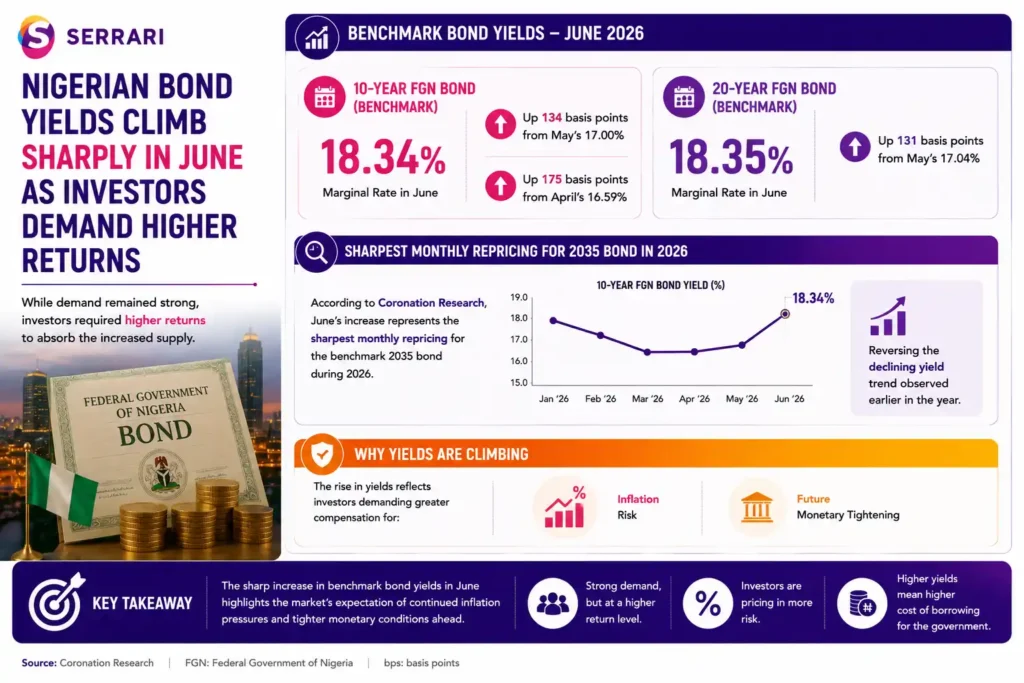
While demand remained strong, investors required higher returns to absorb the increased supply.
The benchmark 10-year Nigeria government bonds recorded a marginal rate of 18.34% in June.
This represented:
- An increase of 134 basis points from May’s 17.00%
- A rise of 175 basis points from April’s 16.59%
Similarly, the 20-year FGN bond increased to 18.35%, compared with 17.04% in May.
According to Coronation Research, this represented the sharpest monthly repricing for the benchmark 2035 bond during 2026, reversing the declining yield trend observed earlier in the year.
The higher yields demonstrate that investors are demanding greater compensation for inflation risk and future monetary tightening.
Inflation Driving Fixed Income Markets
One of the primary drivers behind higher yields has been the return of rising inflation.
Nigeria’s headline inflation increased for three consecutive months:
- March: 15.38%
- April: 15.69%
- May: 15.93%
This marked a reversal after nearly eleven months of disinflation throughout much of 2025.
As inflation expectations rise, investors generally seek higher interest rates to preserve the real value of their investments.
Government securities therefore adjust accordingly, resulting in higher borrowing costs for the Federal Government.
The inflation outlook remains one of the most closely watched indicators in Nigeria’s fixed income market.
Treasury Bills Continue Supporting Government Financing
Alongside bonds, Nigeria T-bills remain an important source of government funding.
Treasury bills provide short-term financing while helping the government manage liquidity and refinance maturing obligations.
Because they mature within one year, Treasury bills attract a wide range of institutional investors, commercial banks, pension funds and money market funds seeking relatively lower-risk investment opportunities.
Combined with longer-dated government bonds, Treasury bills allow the government to maintain a diversified debt maturity profile while managing refinancing risks.
The consistent demand for these instruments has enabled Nigeria to execute a substantial portion of its borrowing programme within the first half of the year.
Analysts Expect Higher Yields to Continue
Market analysts believe upward pressure on bond yields may continue throughout the second half of 2026.
Several factors are contributing to this outlook.
Persistent inflation continues to influence investor expectations, while anticipated pre-election government spending could increase liquidity within the financial system.
An expanding money supply may also place additional pressure on inflation, encouraging investors to seek even higher returns on government securities.
If these trends continue, future Treasury bill auctions and bond issuances could price at higher yields than those recorded during the first half of the year.
Implications for Investors
Higher government bond yields create both opportunities and challenges.
For investors, rising yields increase the attractiveness of newly issued government securities by offering improved income potential.
Institutional investors such as pension funds, insurance companies and asset managers may allocate additional capital toward government bonds as returns become more competitive.
However, higher yields also increase borrowing costs for the government and may raise financing expenses across the broader economy as corporate borrowers compete with government debt for investor capital.
Balancing fiscal financing needs with sustainable borrowing costs will therefore remain a key policy challenge.
Conclusion
Nigeria’s Treasury bills and bonds have generated approximately N19 trillion during the first half of 2026, allowing the government to complete more than 65% of its planned domestic borrowing programme.
The sharp increase in June bond issuance demonstrates the growing importance of domestic debt markets in financing Nigeria’s fiscal deficit. At the same time, rising inflation has pushed bond yields higher, signalling that investors are demanding greater compensation for future economic risks.
As inflationary pressures and government borrowing continue to shape market conditions, Nigeria’s fixed income market is likely to remain an important focus for both policymakers and investors during the remainder of 2026.
FAQs
1. Why has Nigeria raised so much through Treasury bills and bonds in 2026?
Nigeria has relied heavily on Treasury bills and government bonds to finance its 2026 budget deficit and support public expenditure without depending entirely on external borrowing. Domestic debt allows the government to raise funds from local investors, including banks, pension funds and asset managers, while maintaining access to relatively stable sources of financing. Raising over N19 trillion during the first half of the year demonstrates the government’s commitment to executing its domestic borrowing programme efficiently.
2. Why are Nigeria’s government bond yields increasing?
Government bond yields have risen largely because inflation has started accelerating again after nearly a year of declining price pressures. Investors typically require higher returns when inflation increases to preserve the purchasing power of their investments. At the same time, larger government borrowing requirements and expectations of increased public spending have contributed to higher yields across both medium- and long-term government securities.
3. What is the difference between Treasury bills and government bonds?
Treasury bills are short-term government securities that mature within one year and are commonly used for short-term financing and liquidity management. Government bonds, on the other hand, have much longer maturities that can range from several years to decades and are used to finance long-term government expenditure. Both instruments are considered relatively low-risk investments because they are backed by the Federal Government, although their maturity periods and interest rate characteristics differ.
4. What does higher government borrowing mean for investors and the economy?
Higher government borrowing creates opportunities for investors by providing access to attractive fixed income returns, particularly when bond yields are rising. However, increased borrowing also raises the government’s debt servicing costs and can influence interest rates across the wider economy. If government securities offer significantly higher yields, businesses may face higher borrowing costs as investors allocate more capital toward government debt instead of private-sector investments.
Your financial future isn’t something you wait for—it’s something you build.
The real question is: when do you begin?
Move beyond simply staying informed.
Navigate the markets with clarity—track trends through the Serrari Group Market Index, uncover opportunities in the Serrari Marketplace, and build practical knowledge with our Curated Wealth Builder Platform.
Stay connected to what truly matters.
Get daily insights on macro trends and financial movements across Kenya, Africa, and global markets—delivered through the Serrari Newsletter.
Growth opens doors.
Advance your career through professional programs including ACCA, HESI A2, ATI TEAS 7 , HESI EXIT , NCLEX – RN and NCLEX – PN, Financial Literacy!🌟—designed to move you forward with confidence.
See where money is flowing—clearly and in real time.
Track Money Market Funds, Treasury Bills, Treasury Bonds, Green Bonds, and Fixed Deposits, alongside global and African indexes, key economic indicators, and the evolving Crypto and stablecoin landscape—all within Serrari’s Market Index.